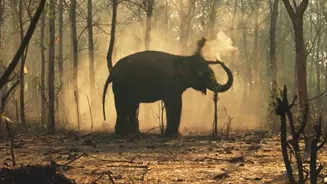









Odisha is witnessing a worrying rise in elephant deaths, revealing deep cracks in wildlife protection, infrastructure planning and conflict management. Recent data placed before the state Assembly show that a range of preventable and natural factors are together pushing one of India’s most iconic species into greater peril.
Elephant mortality in focus
Between April 2024 and September 2025, Odisha recorded the deaths of 136 wild elephants across different districts. The figures presented in the Assembly underline that this is not an isolated or one time spike, but part of a sustained pattern of stress on elephant populations. The information, shared in response to a question from Congress MLA Taraprasad Bahinipati, points to multiple causes that range from power infrastructure and railway movement to disease and ageing.
Electrocution as a major killer
Electrocution has emerged as the single biggest identified cause of death in this period, claiming the lives of 42 elephants. Many of these incidents are linked to low hanging live wires, illegal hooking for power in villages, and uninsulated lines passing through or close to elephant corridors. In some cases, elephants have come into contact with sagging conductors while moving in search of food and water. These deaths highlight serious gaps in coordination between the forest department and electricity utilities, and underline the urgent need for regular joint inspections and corrective action in sensitive areas.
Disease and natural causes
Disease claimed 31 elephant lives over the eighteen month period. In several cases, post mortem examinations pointed to infections, organ failure and other health complications that often go undetected until it is too late. Limited field level veterinary capacity and the difficulty of monitoring free ranging herds complicate early diagnosis. Alongside disease, another 31 elephants were recorded as having died due to natural causes, including old age and conditions that did not show signs of human interference. While natural mortality is expected in any wild population, the combination of disease and natural deaths becomes more alarming when layered over high levels of avoidable mortality.
Accidents and human conflict
Rail traffic added another threat, with four elephants killed in train accidents during the period under review. These incidents generally occur on stretches where railway lines cut across traditional elephant paths, particularly during night time movement or in poor visibility. Speed control, better lighting, early warning systems and coordination between railway and forest authorities remain key demands of conservation groups. The state also recorded four human deaths linked to encounters with elephants, and four cases of elephant deaths attributed directly to poaching. These numbers expose the dual face of human elephant interaction in Odisha: on the one hand, villagers face crop loss, fear and occasional fatalities; on the other, elephants encounter retaliation, traps and firearms in contested spaces.
Unexplained deaths and investigations
For 20 of the 136 elephants, the cause of death is yet to be conclusively established. In such cases, carcasses may be found in advanced stages of decomposition, or evidence may be inconclusive even after preliminary investigation. The pending status of these cases indicates that inquiries and forensic analysis are still in progress, or that authorities have not been able to gather enough information to fix responsibility or determine a clear medical reason. This uncertainty raises questions about monitoring, reporting and the speed of field response when an elephant death is first detected.
Enforcement and official response
Forest, Environment and Climate Change Minister Ganesh Ram Singkhuntia informed the Assembly that 92 individuals allegedly involved in incidents leading to elephant deaths have been arrested and produced before courts. These arrests relate to cases of deliberate electrocution, poaching and other illegal activities that resulted in fatalities. The minister stated that such cases are being regularly monitored, signalling an attempt by the government to demonstrate that enforcement mechanisms are active. However, the continued loss of elephants from a range of causes suggests that punishment alone cannot address the underlying structural issues. Stronger power line management, better land use planning, scientific mitigation of human elephant conflict and long term habitat protection will be essential if Odisha is to reverse this troubling trend and secure a safer future for its wild elephants.