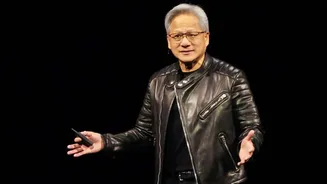

In a recent appearance on the No Priors AI podcast, Huang said that every Nvidia engineer now relies on an AI-powered coding assistant, called Cursor, to handle the grunt work. His ultimate vision? A world where his engineers never have to write a line of code again.
“Nothing would give me more joy than if none of our engineers were coding at all,” Huang said. “And they were just purely solving undiscovered problems.”
At first glance, it sounds counterintuitive, the man leading one of the world’s most advanced tech companies encouraging his own engineers to stop coding.
But for Huang, this isn’t about abandoning engineering; it’s about redefining it. He views coding as a routine task, while the real magic, he argues, lies in pursuing the purpose, discovering and solving problems no one else has cracked yet.
Purpose vs Task: Huang’s radical engineering philosophy
Over the past year, Huang has been evangelising what he calls the ‘Purpose vs Task’ framework, an idea that’s fast becoming part of Nvidia’s internal culture. He’s explained it in multiple interviews, including a viral chat with Joe Rogan.
The premise is straightforward, coding, like typing or formatting, is just a means to an end. The real job of an engineer, according to Huang, is not to tinker with syntax but to tackle problems the world hasn’t solved yet.
“Every engineer at Nvidia now uses AI tools like Cursor,” he said. “I want them to focus entirely on discovering and solving new problems, not just writing code.”
Is this what giving up to AI looks like?
Huang’s approach might seem like surrendering human creativity to artificial intelligence, but he argues the opposite. He believes AI doesn’t replace engineers, it liberates them.
To make his point, he points to a different field altogether: radiology.
Years ago, AI pioneer Geoffrey Hinton predicted radiologists would vanish within five years because machines could read scans faster and more accurately. Yet the opposite happened. “Instead, radiologist numbers have grown,” Huang said.
His reasoning, reading scans was never the purpose of a radiologist’s job, it was just the task. The true purpose lies in diagnosing diseases and improving patient outcomes. AI automated the repetitive part, freeing radiologists to focus on higher-value thinking.
Huang believes the same is about to happen to software engineers. Coding, once seen as the heart of tech work, may soon be as routine as typing in Word. AI can do the syntax, humans, Huang insists, should do the thinking.
That doesn’t mean jobs will vanish. Instead, they’ll evolve. Engineers may no longer spend hours debugging, but they’ll be expected to define problems, design systems, and interpret complex results. In short, they’ll become problem architects, not code writers.