



What is the story about?
Nasa’s Artemis II mission is approaching its final and most technically demanding phase, as the four-member crew prepares to re-enter Earth’s atmosphere after a historic journey around the Moon.
The mission has already broken records, advanced scientific understanding, and demonstrated key technologies required for future lunar exploration.
Yet, as mission officials and astronauts alike emphasise, the most critical test still lies ahead: the return to Earth.
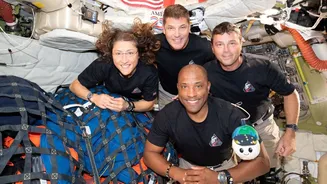
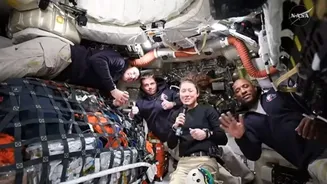
The astronauts — Reid Wiseman, Victor Glover, Christina Koch, and Jeremy Hansen — are expected to conclude their nearly 10-day mission with a splashdown in the Pacific Ocean off the coast of San Diego on Friday.
Their return will mark the culmination of the first crewed mission to travel around the Moon since Apollo 17 and represents a foundational step in Nasa’s long-term ambitions under the Artemis programme.
Artemis II has already secured a place in the history of human spaceflight. During the mission, the crew travelled to a distance of roughly 252,000 miles from Earth, surpassing the long-standing record held by the Apollo 13 mission by several thousand miles.
At one point, the spacecraft reached approximately 252,760 miles (406,778 kilometres) from Earth, setting a new benchmark for how far humans have ventured into space.
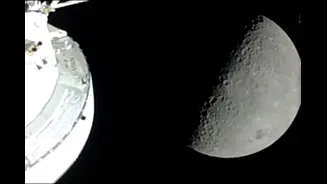
The astronauts completed a lunar flyby that took them across the far side of the Moon, a region permanently hidden from Earth-based observation. During this phase, they observed the lunar surface from about 4,000 miles above, providing a unique vantage point.
Unlike previous missions that relied heavily on satellites or remote sensing, Artemis II enabled real-time human observations of the Moon. Scientists on Earth, stationed near Nasa’s Mission Control Centre in Houston, closely monitored the crew’s communications.

Teams of lunar researchers analysed both live and recorded transmissions, documenting insights and engaging in discussions with the astronauts across a distance of more than 250,000 miles.
According to the crew, the Moon acts as a “witness plate” of the solar system’s early formation, preserving evidence of processes that shaped planetary bodies billions of years ago.
The mission’s six-hour flyby created opportunities for dynamic exchanges between scientists on Earth and those aboard the spacecraft, bridging the gap between theoretical research and direct human experience.
One of the defining features of Artemis II’s return journey is its reliance on a carefully calculated orbital path known as a free-return trajectory.
This approach allows the spacecraft — named Integrity by the crew — to travel around the Moon and return to Earth using gravitational forces rather than continuous propulsion.
The trajectory resembles a figure-eight pattern, with Earth and the Moon forming the two focal points of the spacecraft’s path. As the Orion capsule approached the Moon, it entered a region where lunar gravity began to dominate.
The Moon effectively “caught up” with the spacecraft and redirected its path, pulling it around before sending it back toward Earth.
This process is rooted in the principles of orbital mechanics, particularly the so-called “three-body problem,” which involves calculating the gravitational interactions between Earth, the Moon, and the spacecraft.
While Earth’s gravity governs the initial phase of the mission, the Moon’s gravitational influence takes over as the spacecraft enters its sphere of influence. Even the Sun’s gravitational pull plays a minor role, requiring precise adjustments to ensure the spacecraft remains on course.
Experts explain that the spacecraft’s path involves a transfer of angular momentum between the spacecraft and the Moon. As Orion passed in front of the Moon, it effectively lost some momentum, allowing lunar gravity to alter its trajectory and direct it back toward Earth.
This concept is similar to gravitational slingshot techniques used in interplanetary missions, where spacecraft gain or lose momentum by passing near larger celestial bodies.
The elegance of the free-return trajectory lies in its built-in safety mechanism. Even if the spacecraft’s engines were to fail, the trajectory itself would naturally guide the crew back toward Earth.
This design has been a cornerstone of crewed lunar missions since the Apollo era and remains a critical component of Artemis II.
Reentry involves the spacecraft plunging into Earth’s atmosphere at extremely high speeds, generating intense heat and pressure.
The Orion capsule is expected to reach speeds of up to 23,839 miles per hour (38,365 kilometres per hour) as it encounters the upper layers of the atmosphere.
At such velocities, friction with atmospheric particles produces temperatures high enough to create a plasma sheath around the spacecraft, giving the appearance of a blazing fireball.
"I've actually been thinking about entry since April 3, 2023 when we got assigned to this mission," said Victor Glover.
"There's so many more pictures, so many more stories, and gosh, I haven't even begun to process what we've been through. We've still got two more days, and riding a fireball through the atmosphere is profound as well."
The spacecraft’s heat shield is designed to withstand these extreme conditions, protecting the crew from the intense thermal and mechanical stresses of reentry.
This component is among the most critical systems being tested during Artemis II, as it will play a central role in future missions involving lunar landings and potential journeys to Mars.
Nasa officials have indicated that the reentry sequence will last approximately 13 minutes, beginning when the spacecraft enters the upper atmosphere and ending with its splashdown in the Pacific Ocean.
During this time, Orion will use its thrusters to stabilise and decelerate, followed by the deployment of parachutes in multiple stages.
The final descent of Artemis II involves a carefully choreographed sequence designed to ensure a safe landing. As the spacecraft slows, it will deploy drogue parachutes to stabilise its orientation, followed by pilot parachutes that help release the main parachutes.
The main chutes then significantly reduce the capsule’s speed, bringing it down to approximately 25 feet per second before it contacts the ocean surface.
Nasa’s recovery operations have been meticulously planned, with the U.S. Navy playing a central role. The USS John P Murtha has been deployed to the designated splashdown zone in the Pacific Ocean, where it will coordinate the retrieval of the crew and spacecraft.
Divers will approach the capsule shortly after landing, securing it and assisting the astronauts as they exit. The crew will be transferred onto an inflatable platform — referred to as the “front porch” — before being brought aboard the recovery vessel. This process has been rehearsed extensively to ensure efficiency and safety.
The selection of the splashdown site near San Diego reflects both practical considerations and mission requirements. While the free-return trajectory naturally directs the spacecraft toward the Pacific Ocean, the precise landing zone was refined through a series of small course corrections.
The region offers favourable weather conditions, proximity to naval support, and established recovery infrastructure.
As the spacecraft makes its way back to Earth, the crew has been preparing both technically and mentally for reentry. Nasa officials have outlined a series of activities designed to ensure that all systems are functioning correctly and that the astronauts are ready for the final phase of the mission.
The crew has been conducting tests to validate Orion’s manual control capabilities, an essential requirement for future missions that will involve docking with other spacecraft in orbit. These tests are part of a broader effort to certify Orion’s systems for upcoming Artemis missions.
Some planned activities have been adjusted to prioritise reentry preparations. For instance, a scheduled exercise involving the construction of a radiation shelter within the capsule was cancelled to allow more time for configuring the spacecraft for its descent.
On the day before reentry, the astronauts are expected to conduct simulations and checks of key systems, ensuring that all components are operating as intended. These preparations are crucial, as any anomalies during reentry could pose significant risks.
Mission officials have expressed confidence in the spacecraft’s performance so far. However, they continue to point out that Artemis II is a test flight, and each phase of the mission provides valuable data for future operations.
While Artemis II is a standalone mission, its broader significance lies in its role within Nasa’s long-term exploration strategy. The Artemis programme aims to establish a sustained human presence on the Moon and eventually enable missions to Mars.
Christina Koch described the programme as a relay effort, with each mission building upon the achievements of its predecessors. "In fact, we have batons that we bought to symbolize, physically, that. We plan to hand them to the next crew, and every single thing that we do is with them in mind."
Future missions, including Artemis III, are expected to involve complex operations such as docking between the Orion spacecraft and lunar landers in Earth orbit. Subsequent missions aim to achieve crewed landings on the Moon, marking the first such event since the Apollo era.
Nasa has indicated that these missions will involve collaboration with international partners and commercial entities.
With inputs from agencies
The mission has already broken records, advanced scientific understanding, and demonstrated key technologies required for future lunar exploration.
Yet, as mission officials and astronauts alike emphasise, the most critical test still lies ahead: the return to Earth.
The astronauts — Reid Wiseman, Victor Glover, Christina Koch, and Jeremy Hansen — are expected to conclude their nearly 10-day mission with a splashdown in the Pacific Ocean off the coast of San Diego on Friday.
Their return will mark the culmination of the first crewed mission to travel around the Moon since Apollo 17 and represents a foundational step in Nasa’s long-term ambitions under the Artemis programme.
A record-breaking journey through deep space
Artemis II has already secured a place in the history of human spaceflight. During the mission, the crew travelled to a distance of roughly 252,000 miles from Earth, surpassing the long-standing record held by the Apollo 13 mission by several thousand miles.
At one point, the spacecraft reached approximately 252,760 miles (406,778 kilometres) from Earth, setting a new benchmark for how far humans have ventured into space.
The astronauts completed a lunar flyby that took them across the far side of the Moon, a region permanently hidden from Earth-based observation. During this phase, they observed the lunar surface from about 4,000 miles above, providing a unique vantage point.
Unlike previous missions that relied heavily on satellites or remote sensing, Artemis II enabled real-time human observations of the Moon. Scientists on Earth, stationed near Nasa’s Mission Control Centre in Houston, closely monitored the crew’s communications.
Nasa astronaut and Artemis II Commander Reid Wiseman peers out of one of the Orion spacecraft's main cabin windows, looking back at Earth, as the crew travels towards the Moon. Image/Nasa
Teams of lunar researchers analysed both live and recorded transmissions, documenting insights and engaging in discussions with the astronauts across a distance of more than 250,000 miles.
According to the crew, the Moon acts as a “witness plate” of the solar system’s early formation, preserving evidence of processes that shaped planetary bodies billions of years ago.
The mission’s six-hour flyby created opportunities for dynamic exchanges between scientists on Earth and those aboard the spacecraft, bridging the gap between theoretical research and direct human experience.
The “free-return trajectory” guiding Orion home
One of the defining features of Artemis II’s return journey is its reliance on a carefully calculated orbital path known as a free-return trajectory.
This approach allows the spacecraft — named Integrity by the crew — to travel around the Moon and return to Earth using gravitational forces rather than continuous propulsion.
The trajectory resembles a figure-eight pattern, with Earth and the Moon forming the two focal points of the spacecraft’s path. As the Orion capsule approached the Moon, it entered a region where lunar gravity began to dominate.
The Moon effectively “caught up” with the spacecraft and redirected its path, pulling it around before sending it back toward Earth.
This process is rooted in the principles of orbital mechanics, particularly the so-called “three-body problem,” which involves calculating the gravitational interactions between Earth, the Moon, and the spacecraft.
While Earth’s gravity governs the initial phase of the mission, the Moon’s gravitational influence takes over as the spacecraft enters its sphere of influence. Even the Sun’s gravitational pull plays a minor role, requiring precise adjustments to ensure the spacecraft remains on course.
Experts explain that the spacecraft’s path involves a transfer of angular momentum between the spacecraft and the Moon. As Orion passed in front of the Moon, it effectively lost some momentum, allowing lunar gravity to alter its trajectory and direct it back toward Earth.
This concept is similar to gravitational slingshot techniques used in interplanetary missions, where spacecraft gain or lose momentum by passing near larger celestial bodies.
The elegance of the free-return trajectory lies in its built-in safety mechanism. Even if the spacecraft’s engines were to fail, the trajectory itself would naturally guide the crew back toward Earth.
This design has been a cornerstone of crewed lunar missions since the Apollo era and remains a critical component of Artemis II.
Preparing for the most dangerous phase: Reentry
Reentry involves the spacecraft plunging into Earth’s atmosphere at extremely high speeds, generating intense heat and pressure.
The Orion capsule is expected to reach speeds of up to 23,839 miles per hour (38,365 kilometres per hour) as it encounters the upper layers of the atmosphere.
At such velocities, friction with atmospheric particles produces temperatures high enough to create a plasma sheath around the spacecraft, giving the appearance of a blazing fireball.
"I've actually been thinking about entry since April 3, 2023 when we got assigned to this mission," said Victor Glover.
"There's so many more pictures, so many more stories, and gosh, I haven't even begun to process what we've been through. We've still got two more days, and riding a fireball through the atmosphere is profound as well."
The spacecraft’s heat shield is designed to withstand these extreme conditions, protecting the crew from the intense thermal and mechanical stresses of reentry.
This component is among the most critical systems being tested during Artemis II, as it will play a central role in future missions involving lunar landings and potential journeys to Mars.
Nasa officials have indicated that the reentry sequence will last approximately 13 minutes, beginning when the spacecraft enters the upper atmosphere and ending with its splashdown in the Pacific Ocean.
During this time, Orion will use its thrusters to stabilise and decelerate, followed by the deployment of parachutes in multiple stages.
The mechanics of splashdown and recovery
The final descent of Artemis II involves a carefully choreographed sequence designed to ensure a safe landing. As the spacecraft slows, it will deploy drogue parachutes to stabilise its orientation, followed by pilot parachutes that help release the main parachutes.
The main chutes then significantly reduce the capsule’s speed, bringing it down to approximately 25 feet per second before it contacts the ocean surface.
Nasa’s recovery operations have been meticulously planned, with the U.S. Navy playing a central role. The USS John P Murtha has been deployed to the designated splashdown zone in the Pacific Ocean, where it will coordinate the retrieval of the crew and spacecraft.
Divers will approach the capsule shortly after landing, securing it and assisting the astronauts as they exit. The crew will be transferred onto an inflatable platform — referred to as the “front porch” — before being brought aboard the recovery vessel. This process has been rehearsed extensively to ensure efficiency and safety.
The selection of the splashdown site near San Diego reflects both practical considerations and mission requirements. While the free-return trajectory naturally directs the spacecraft toward the Pacific Ocean, the precise landing zone was refined through a series of small course corrections.
The region offers favourable weather conditions, proximity to naval support, and established recovery infrastructure.
Life aboard Orion during the return phase
As the spacecraft makes its way back to Earth, the crew has been preparing both technically and mentally for reentry. Nasa officials have outlined a series of activities designed to ensure that all systems are functioning correctly and that the astronauts are ready for the final phase of the mission.
The crew has been conducting tests to validate Orion’s manual control capabilities, an essential requirement for future missions that will involve docking with other spacecraft in orbit. These tests are part of a broader effort to certify Orion’s systems for upcoming Artemis missions.
Some planned activities have been adjusted to prioritise reentry preparations. For instance, a scheduled exercise involving the construction of a radiation shelter within the capsule was cancelled to allow more time for configuring the spacecraft for its descent.
On the day before reentry, the astronauts are expected to conduct simulations and checks of key systems, ensuring that all components are operating as intended. These preparations are crucial, as any anomalies during reentry could pose significant risks.
Mission officials have expressed confidence in the spacecraft’s performance so far. However, they continue to point out that Artemis II is a test flight, and each phase of the mission provides valuable data for future operations.
Artemis II as a stepping stone for future lunar missions
While Artemis II is a standalone mission, its broader significance lies in its role within Nasa’s long-term exploration strategy. The Artemis programme aims to establish a sustained human presence on the Moon and eventually enable missions to Mars.
Christina Koch described the programme as a relay effort, with each mission building upon the achievements of its predecessors. "In fact, we have batons that we bought to symbolize, physically, that. We plan to hand them to the next crew, and every single thing that we do is with them in mind."
Future missions, including Artemis III, are expected to involve complex operations such as docking between the Orion spacecraft and lunar landers in Earth orbit. Subsequent missions aim to achieve crewed landings on the Moon, marking the first such event since the Apollo era.
Nasa has indicated that these missions will involve collaboration with international partners and commercial entities.
With inputs from agencies