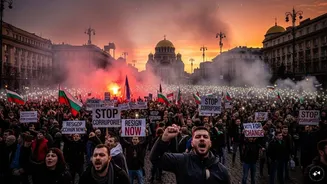







Bulgaria has entered a fresh phase of political uncertainty after its Prime Minister announced his resignation following weeks of large-scale public demonstrations against the government. The protests, sparked initially by anger over a proposed national budget, have evolved into a broader movement against corruption, mismanagement and what many Bulgarians describe as the deterioration of democratic standards in their country.
The departure of the Prime Minister marks yet another chapter in Bulgaria’s continuing political instability. He was the sixth person to occupy the post in five years, underscoring deep divisions within the nation’s fractured political landscape. With his resignation, the government coalition that has struggled to maintain unity now faces the daunting task of regaining public trust and stabilising the economy ahead of Bulgaria’s adoption of the euro at the start of the new year.
Growing anger over planned tax increases
The protests that led to the Prime Minister’s fall began after the government unveiled a controversial draft budget for the coming year. The proposal sought to raise both income taxes and social security contributions to fund an ambitious plan for increased public spending. Officials defended the move, arguing that additional revenue was needed to improve healthcare, pensions and education, sectors that remain underfunded in one of the European Union’s poorest member states.
However, ordinary citizens and opposition groups quickly condemned the budget as an unfair burden on working families. Critics accused the government of asking the population to shoulder higher costs without taking meaningful steps to curb corruption or government waste. Demonstrations began in the capital, Sofia, before rapidly spreading to cities and towns across the country. Many Bulgarians carried national flags and banners demanding transparency, economic accountability and an end to political corruption.
What started as peaceful rallies over tax policy soon transformed into an expression of long-standing frustration fuelled by years of political instability, rising living costs and declining faith in public institutions.
The shadow of corruption and political fatigue
Beyond the dispute over budget policy, the protests reveal a wider crisis of confidence in Bulgaria’s political system. Corruption scandals have repeatedly shaken public life, with allegations involving senior figures in successive governments. The perception that politicians enrich themselves while ordinary citizens struggle has led to growing disillusionment and diminished voter participation.
Many of the demonstrators see the latest unrest as part of a deeper fight for accountability and the restoration of democratic principles. Civil society organisations and independent journalists have highlighted the lack of progress in judicial reform and the persistence of patronage networks that distort public administration. These issues have made Bulgaria a focus of concern within the European Union, which continues to monitor its governance reforms closely.
The Prime Minister’s resignation, while welcomed by protest organisers, does not guarantee immediate stability. Analysts warn that without structural reforms, Bulgaria risks remaining trapped in a cycle of short-lived governments unable to address the underlying causes of public anger.
A significant shift ahead of euro adoption
Adding to the complexity of the political situation is Bulgaria’s impending transition to the euro, scheduled to take effect on the first day of the new year. The now withdrawn budget proposal was intended to be the first calculated entirely in the European currency, a symbolic step toward deeper integration within the European Union.
Economists had viewed the change as both an opportunity and a test. Adopting the euro could strengthen investor confidence and ease access to European financial markets, but it also demands clear fiscal discipline and political stability, both of which remain in question after the Prime Minister’s departure.
With the government now in turmoil, there are growing doubts about whether the transition will proceed smoothly. European officials have expressed concern that persistent domestic unrest could complicate Bulgaria’s readiness for adopting the common currency.
Citizens demand accountability and reform
The demonstrations have united a broad segment of Bulgarian society, drawing participants from varying political affiliations, professions and age groups. Public servants, students, small business owners and pensioners have all joined calls for a government that prioritises transparency over self-interest.
Protesters have repeatedly emphasised that their grievances extend far beyond taxation. Their demands encompass structural anti-corruption measures, stronger enforcement of the rule of law and more accountable management of European Union development funds. Demonstrators have also expressed dissatisfaction with the perceived erosion of independent media, which many see as another symptom of democratic decline.
Leaders of the protest movement have vowed to continue their demonstrations until significant reforms are enacted or early elections are announced. Early surveys suggest that public opinion overwhelmingly supports the demand for a new political direction and a fresh start for the country.
Uncertain future for the coalition and beyond
Following the Prime Minister’s resignation, Bulgaria’s fragile coalition government faces internal disputes about who should lead in the interim and whether new elections should be called soon. Analysts predict that any successor administration will struggle to maintain unity without addressing the corruption allegations that have plagued successive governments.
International observers view Bulgaria’s situation as a crucial test for democratic endurance within Eastern Europe. The protests have drawn attention across the continent, as the country’s challenges echo broader European concerns about maintaining public trust in institutions amid social inequality and slow economic growth.
For now, Bulgaria stands at a crossroads. As the nation prepares to join the eurozone, its citizens are demanding not only economic reform but also a transformation of the political culture that has driven repeated crises. Whether this latest wave of unrest will lead to lasting change or simply another cycle of instability remains uncertain, but what is clear is that the voice of the Bulgarian people has once again reshaped the course of their nation’s politics.