







What is the story about?
The United States Supreme Court is poised to rule on President Donald Trump’s tariffs today (Wednesday).
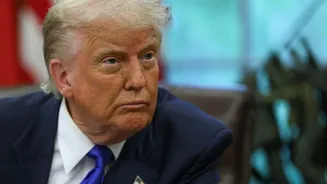
Trump, who has appointed several of the apex court justices, has repeatedly warned that the Supreme Court striking down his tariffs would be an ‘absolute disaster’ for America.
Trump on Monday yet again took to social media warning that such a development would “be a complete mess, and almost impossible for our country to pay”.
“We’re screwed,” he added. “It may not be possible,” Trump said about repaying the tariffs. But “if it were, it would be dollars that would be so large that it would take many years to figure out what number we are talking about and even, who, when, and where, to pay.”
But what are Trump’s alternatives if the Supreme Court finds that he exceeded his authority by imposing tariffs under the International Emergency Economic Powers Act (IEEPA) of 1977 and strikes them down?
First let’s take a look at what the prediction markets are saying. The money seems firmly against Trump. Prediction platforms Kalshi and Polymarket both have the odds on the apex court striking down Trump’s tariffs.
The platform Polymarket has said that there is a 73 per cent chance that the Supreme Court of the United States (SCOTUS) strikes down the tariffs.
On Kalshi, the odds of SCOTUS ruling in favour of the Trump administration on the tariff issue sit at just 30 per cent. Kalshi predicts that just three Supreme Court justices will side with Trump.
This is down 14 per cent since November, when the US Supreme Court heard oral arguments on tariffs. Traders have wagered around $3 million (Rs. 27.05 crore) on the outcome.
It is important to note that the prediction markets are summarising popular sentiment rather than conducting any judicial analysis of how the judges are likely to vote.
Now let’s take a closer look at the judges and their politics. The Supreme Court comprises Chief Justice John Roberts, Clarence Thomas, Samuel Alito, Sonia Sotomayor, Elena Kagan, Neil Gorsuch, Brett Kavanaugh, Amy Coney Barrett and Ketanji Brown Jackson.
There are six Republicans on the bench – Roberts, Thomas, Alito, Gorsuch, Kavanaugh and Barrett – compared to just three Democrats: Sotomayor, Kagan and Jackson.
Roberts, who was appointed by George W Bush, sees himself as more of a classic conservative, a consensus-builder and an institutionalist. Roberts during oral arguments on the tariff issue seemed to hint that Trump had acted outside his executive remit. “The vehicle is the imposition of taxes on Americans, and that has always been a core power of Congress,” Roberts said.
Thomas, appointed by George HW Bush, is a die-in-the-wool conservative. Thomas, the first Black man to serve on the US Supreme Court, is known for his reticence to speak or ask questions during oral arguments. He is arguably the most right-wing justice on the Supreme Court.
Samuel Alito, who was appointed to the bench by George W Bush, is a Catholic and has often spoken about how his faith shapes his worldview. Alito is generally socially conservative and focuses on liberty and law and order. During the hearings, Alito too seemed sceptical about whether the president has the authority to levy tariffs under the emergency powers act.
Gorsuch was appointed to the bench by Trump in 2017. He is considered a more moderate Republican compared to his conservative brethren on the Supreme Court, but he is by no means a liberal. He has occasionally shown an independent streak and broken with the conservative majority to side with the liberals on the court. Gorsuch too seemed not to favour the government’s arguments during the hearings. “Congress, as a practical matter, can’t get this power back once it’s handed it over to the president,” he was quoted as saying.
Kavanaugh, who was appointed by Trump, is more aligned with the politics of Roberts and Gorsuch rather than Alito and Thomas. Interestingly, Kavanaugh has often been the swing vote when it comes to 5–4 cases. Kavanaugh seemed more open to the Trump administration’s arguments that tariffs are a regulatory issue rather than a tax. “The court has repeatedly said a tariff on foreign imports is an exercise of the commerce power, not of the taxation power,” Kavanaugh said. “Why would a rational Congress say: ‘Yeah, we’re going to give the President the power to shut down trade … but can’t do a 1 per cent tariff? That doesn’t seem to have a lot of common sense behind it.’”
Barrett, another Trump appointee and the latest addition to the Supreme Court, is also a conservative. However, she is more of a textual originalist compared to some of her peers. While she closely sticks to the Republican majority, she, like Gorsuch, Kavanaugh and Roberts, has occasionally ruled alongside the liberals. “It seems to me like it could be a mess,” Barrett remarked about refunding tariffs during oral arguments on the case.
Sotomayor was appointed by then President Barack Obama. Sotomayor made history as the first Latino woman to serve on the country’s highest court. An unabashed progressive, she is the court’s most high-profile liberal and has written some of the most eloquent dissents since taking the bench. Sotomayor openly expressed scepticism of the government’s position on tariffs during the hearings. “You want to say tariffs are not taxes, but that’s exactly what they are,” she was quoted as saying.
Kagan was also appointed by Obama. Compared to Sotomayor, Kagan is more of an institutionalist and a consensus-builder who is skilled at advancing liberal arguments and trying to sway the votes of her Republican colleagues.
Jackson was appointed by then President Joe Biden. Jackson, who is also a progressive, is more closely aligned with Sotomayor, a fellow woman of colour, when it comes to politics rather than Kagan. When it comes to hearing cases, she is often focused on fairness, rights and due process.
However, one caveat applies. It must be kept in mind that the Supreme Court justices’ questions during oral arguments are not an expression of their opinion. They also may not accurately reflect their ultimate ruling.
Now, let’s examine the three possible outcomes
The Supreme Court upholding Trump’s tariffs would be a massive victory for the president and his administration less than a year after his return to office. It would further strengthen the hands of those in the administration who argue in favour of consolidating more executive power. Such people within the government, including Trump himself, view the presidency as superior to the legislative and judiciary rather than a co-equal branch of government.
This would also give a boost to Trump’s views of his own powers as the chief executive, which he noted in an interview with The New York Times are only constrained by ‘his own morality’. This could result in the US president seeking to test the limits of how far he could go when it comes to taking executive action without pushback from the Supreme Court or Congress.
It would also further diminish a Congress that has already been sidelined by the Trump administration during its second term. Such a ruling will likely lead to a modest reaction at best from the US markets, many of which have already priced in this possibility. However, this means that global trade tensions will continue.
If the court strikes the tariffs down, it would be viewed as a check on presidential authority and a blow to Trump himself. The tariff collection would be immediately suspended and the administration would be left scrambling to figure out how the revenues collected would begin being repaid to companies.
While Bessent has claimed that as much as $750 billion (Rs. 67.64 lakh crore) would have to be refunded, others peg the number closer to $150 billion (Rs. 13.53 lakh crore).
Treasury Secretary Scott Bessent previously told the court that unwinding the tariffs could cause “significant disruption”. It would be widely viewed as a boost to Congress and its powers of the purse and its right to conduct trade.
Such a ruling will likely see the US stock market rally, with clothing, toys and electronic goods companies, which have been hardest hit by the levy, doing well. However, this could also result in volatility in bond markets. US Treasuries may also come under pressure. This would also benefit exporters in India and be seen as a win for global trade.
However, don’t expect the Trump administration to go quietly. The administration has already defied orders from some judges, albeit in the lower courts. The administration is more likely to use other sections of US law, including Section 301 of the Trade Act of 1974, to levy tariffs.
Trump used this Act, which allows the US to impose tariffs on countries engaging in “unjustifiable”, “unreasonable” or “discriminatory” trade practices against it, against China in his first term. Bessent has also said that the administration could invoke Section 122 of the Trade Act of 1974, which allows a broad 15 per cent tariff for 150 days in order to fix trade imbalances. Though Section 122 has never been used in this manner, that is unlikely to stop the Trump administration from trying to do so.
The court could decide to send the case back down to the lower courts, rule on narrow technical grounds or hold that the complainants lack standing. Alternatively, the court could say that a ruling will be given at a future date.
This is arguably the worst possible outcome for all involved. This means political and legal uncertainty for the administration and Congress, as well as businesses and trading partners having no clear resolution in sight. Above all, investors hate uncertainty. This could result in stock markets around the world witnessing volatility.
With inputs from agencies
Trump, who has appointed several of the apex court justices, has repeatedly warned that the Supreme Court striking down his tariffs would be an ‘absolute disaster’ for America.
Trump on Monday yet again took to social media warning that such a development would “be a complete mess, and almost impossible for our country to pay”.
“We’re screwed,” he added. “It may not be possible,” Trump said about repaying the tariffs. But “if it were, it would be dollars that would be so large that it would take many years to figure out what number we are talking about and even, who, when, and where, to pay.”
But what are Trump’s alternatives if the Supreme Court finds that he exceeded his authority by imposing tariffs under the International Emergency Economic Powers Act (IEEPA) of 1977 and strikes them down?
What the prediction markets are saying
First let’s take a look at what the prediction markets are saying. The money seems firmly against Trump. Prediction platforms Kalshi and Polymarket both have the odds on the apex court striking down Trump’s tariffs.
The platform Polymarket has said that there is a 73 per cent chance that the Supreme Court of the United States (SCOTUS) strikes down the tariffs.
On Kalshi, the odds of SCOTUS ruling in favour of the Trump administration on the tariff issue sit at just 30 per cent. Kalshi predicts that just three Supreme Court justices will side with Trump.
This is down 14 per cent since November, when the US Supreme Court heard oral arguments on tariffs. Traders have wagered around $3 million (Rs. 27.05 crore) on the outcome.
It is important to note that the prediction markets are summarising popular sentiment rather than conducting any judicial analysis of how the judges are likely to vote.
The judges and their politics
Now let’s take a closer look at the judges and their politics. The Supreme Court comprises Chief Justice John Roberts, Clarence Thomas, Samuel Alito, Sonia Sotomayor, Elena Kagan, Neil Gorsuch, Brett Kavanaugh, Amy Coney Barrett and Ketanji Brown Jackson.
There are six Republicans on the bench – Roberts, Thomas, Alito, Gorsuch, Kavanaugh and Barrett – compared to just three Democrats: Sotomayor, Kagan and Jackson.
Roberts, who was appointed by George W Bush, sees himself as more of a classic conservative, a consensus-builder and an institutionalist. Roberts during oral arguments on the tariff issue seemed to hint that Trump had acted outside his executive remit. “The vehicle is the imposition of taxes on Americans, and that has always been a core power of Congress,” Roberts said.
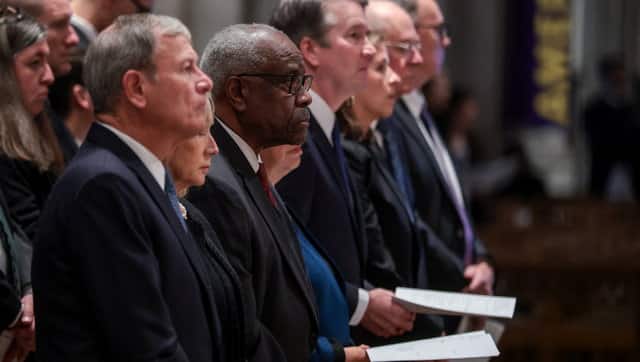
US Supreme Court justices John G Roberts Jr, Clarence Thomas and Brett M Kavanaugh. Reuters
Thomas, appointed by George HW Bush, is a die-in-the-wool conservative. Thomas, the first Black man to serve on the US Supreme Court, is known for his reticence to speak or ask questions during oral arguments. He is arguably the most right-wing justice on the Supreme Court.
Samuel Alito, who was appointed to the bench by George W Bush, is a Catholic and has often spoken about how his faith shapes his worldview. Alito is generally socially conservative and focuses on liberty and law and order. During the hearings, Alito too seemed sceptical about whether the president has the authority to levy tariffs under the emergency powers act.
Gorsuch was appointed to the bench by Trump in 2017. He is considered a more moderate Republican compared to his conservative brethren on the Supreme Court, but he is by no means a liberal. He has occasionally shown an independent streak and broken with the conservative majority to side with the liberals on the court. Gorsuch too seemed not to favour the government’s arguments during the hearings. “Congress, as a practical matter, can’t get this power back once it’s handed it over to the president,” he was quoted as saying.
Kavanaugh, who was appointed by Trump, is more aligned with the politics of Roberts and Gorsuch rather than Alito and Thomas. Interestingly, Kavanaugh has often been the swing vote when it comes to 5–4 cases. Kavanaugh seemed more open to the Trump administration’s arguments that tariffs are a regulatory issue rather than a tax. “The court has repeatedly said a tariff on foreign imports is an exercise of the commerce power, not of the taxation power,” Kavanaugh said. “Why would a rational Congress say: ‘Yeah, we’re going to give the President the power to shut down trade … but can’t do a 1 per cent tariff? That doesn’t seem to have a lot of common sense behind it.’”
Barrett, another Trump appointee and the latest addition to the Supreme Court, is also a conservative. However, she is more of a textual originalist compared to some of her peers. While she closely sticks to the Republican majority, she, like Gorsuch, Kavanaugh and Roberts, has occasionally ruled alongside the liberals. “It seems to me like it could be a mess,” Barrett remarked about refunding tariffs during oral arguments on the case.
Sotomayor was appointed by then President Barack Obama. Sotomayor made history as the first Latino woman to serve on the country’s highest court. An unabashed progressive, she is the court’s most high-profile liberal and has written some of the most eloquent dissents since taking the bench. Sotomayor openly expressed scepticism of the government’s position on tariffs during the hearings. “You want to say tariffs are not taxes, but that’s exactly what they are,” she was quoted as saying.
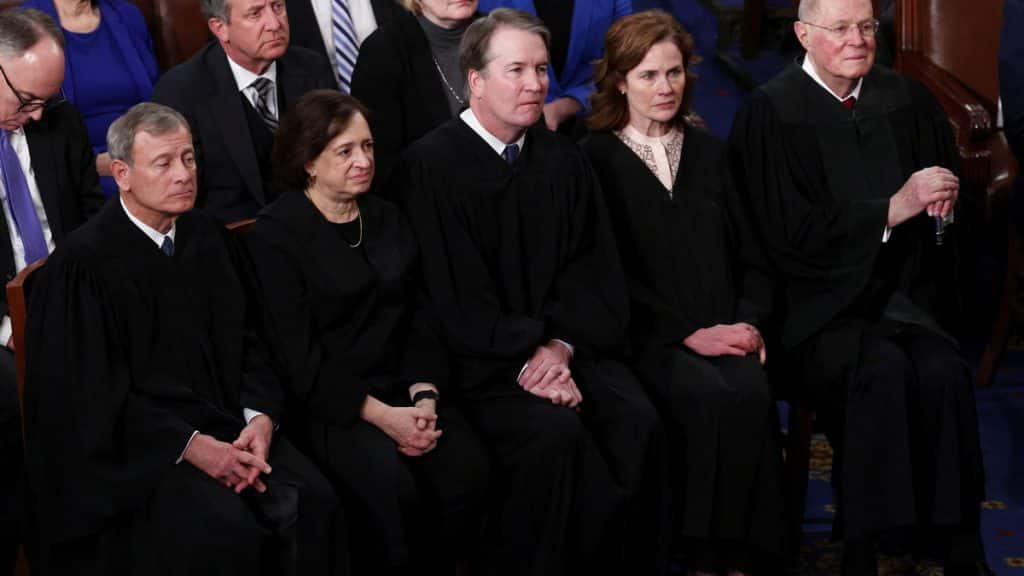
Chief Justice of the Supreme Court John Roberts, Justice Elena Kagan, Justice Brett Kavanaugh, Justice Amy Coney Barrett, and retired Justice Anthony Kennedy attend US President Donald Trump's speech to a joint session of Congress. Reuters
Kagan was also appointed by Obama. Compared to Sotomayor, Kagan is more of an institutionalist and a consensus-builder who is skilled at advancing liberal arguments and trying to sway the votes of her Republican colleagues.
Jackson was appointed by then President Joe Biden. Jackson, who is also a progressive, is more closely aligned with Sotomayor, a fellow woman of colour, when it comes to politics rather than Kagan. When it comes to hearing cases, she is often focused on fairness, rights and due process.
However, one caveat applies. It must be kept in mind that the Supreme Court justices’ questions during oral arguments are not an expression of their opinion. They also may not accurately reflect their ultimate ruling.
Now, let’s examine the three possible outcomes
What if they’re ruled legal?
The Supreme Court upholding Trump’s tariffs would be a massive victory for the president and his administration less than a year after his return to office. It would further strengthen the hands of those in the administration who argue in favour of consolidating more executive power. Such people within the government, including Trump himself, view the presidency as superior to the legislative and judiciary rather than a co-equal branch of government.
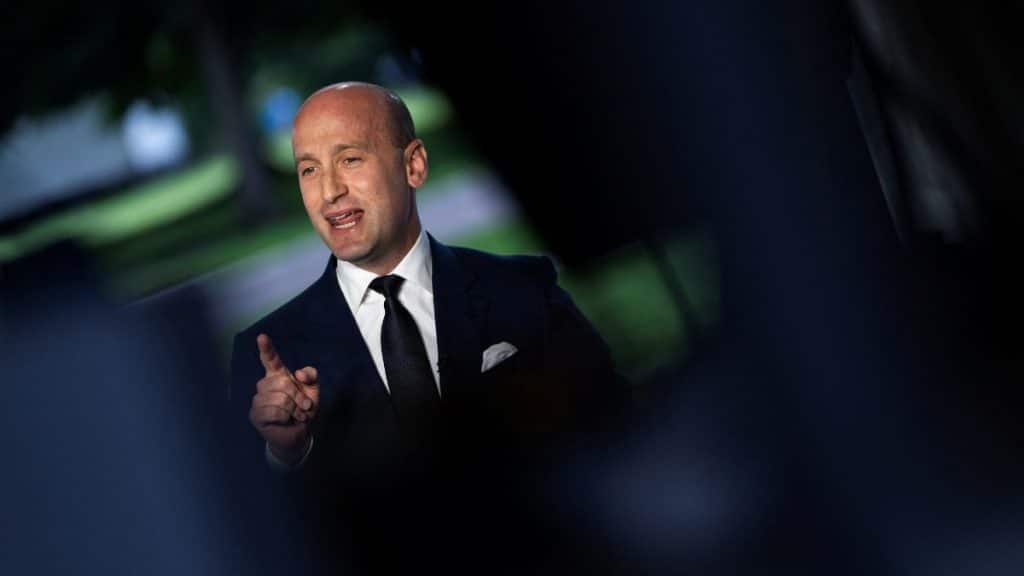
White House Deputy Chief of Staff Stephen Miller is among those who view the executive as superior to other branches. Reuters
This would also give a boost to Trump’s views of his own powers as the chief executive, which he noted in an interview with The New York Times are only constrained by ‘his own morality’. This could result in the US president seeking to test the limits of how far he could go when it comes to taking executive action without pushback from the Supreme Court or Congress.
It would also further diminish a Congress that has already been sidelined by the Trump administration during its second term. Such a ruling will likely lead to a modest reaction at best from the US markets, many of which have already priced in this possibility. However, this means that global trade tensions will continue.
What if the court strikes them down?
If the court strikes the tariffs down, it would be viewed as a check on presidential authority and a blow to Trump himself. The tariff collection would be immediately suspended and the administration would be left scrambling to figure out how the revenues collected would begin being repaid to companies.
While Bessent has claimed that as much as $750 billion (Rs. 67.64 lakh crore) would have to be refunded, others peg the number closer to $150 billion (Rs. 13.53 lakh crore).
Treasury Secretary Scott Bessent previously told the court that unwinding the tariffs could cause “significant disruption”. It would be widely viewed as a boost to Congress and its powers of the purse and its right to conduct trade.
Such a ruling will likely see the US stock market rally, with clothing, toys and electronic goods companies, which have been hardest hit by the levy, doing well. However, this could also result in volatility in bond markets. US Treasuries may also come under pressure. This would also benefit exporters in India and be seen as a win for global trade.
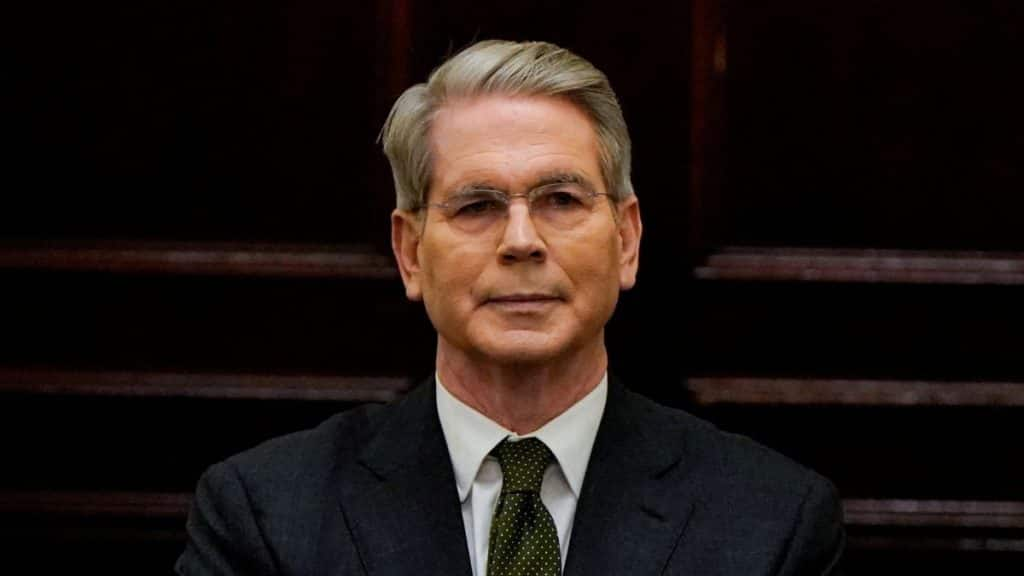
Treasury Secretary Scott Bessent told the court such a decision could cause 'significant disruption'. Reuters
However, don’t expect the Trump administration to go quietly. The administration has already defied orders from some judges, albeit in the lower courts. The administration is more likely to use other sections of US law, including Section 301 of the Trade Act of 1974, to levy tariffs.
Trump used this Act, which allows the US to impose tariffs on countries engaging in “unjustifiable”, “unreasonable” or “discriminatory” trade practices against it, against China in his first term. Bessent has also said that the administration could invoke Section 122 of the Trade Act of 1974, which allows a broad 15 per cent tariff for 150 days in order to fix trade imbalances. Though Section 122 has never been used in this manner, that is unlikely to stop the Trump administration from trying to do so.
What if no decision is made?
The court could decide to send the case back down to the lower courts, rule on narrow technical grounds or hold that the complainants lack standing. Alternatively, the court could say that a ruling will be given at a future date.
This is arguably the worst possible outcome for all involved. This means political and legal uncertainty for the administration and Congress, as well as businesses and trading partners having no clear resolution in sight. Above all, investors hate uncertainty. This could result in stock markets around the world witnessing volatility.
With inputs from agencies