







What is the story about?
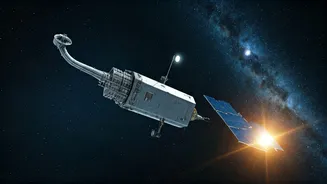
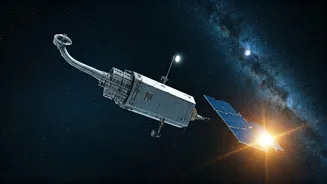
For more than two decades, Nasa's Neil Gehrels Swift Observatory has served as one of the world's most important space telescopes for studying some of the universe's most violent and short-lived events.
Now, after 22 years in orbit, the spacecraft faces a very different challenge — not from deep space, but from Earth itself. The observatory's orbit has been shrinking at an accelerating pace, leaving Nasa with only a limited window to prevent it from plunging back into the atmosphere.
While allowing ageing satellites to naturally re-enter Earth's atmosphere is standard practice once their missions end, the United States space agency has instead chosen a far more ambitious route.
Rather than retiring the spacecraft, Nasa is attempting an unprecedented robotic rescue mission that could not only preserve one of its most productive scientific observatories.
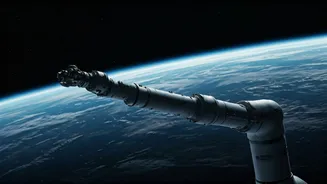
At the centre of the effort is LINK, a robotic servicing spacecraft built by Arizona-based Katalyst Space Technologies.
Once in orbit, LINK will attempt something never before accomplished by an American spacecraft — capture an uncrewed government satellite that was never designed to be serviced and gradually lift it into a safer orbit.
If successful, the mission would extend Swift's operational life by several years while providing Nasa with valuable experience in commercial satellite servicing at a fraction of the cost of building a replacement observatory.
The Neil Gehrels Swift Observatory was launched in November 2004 as a dedicated mission to investigate gamma-ray bursts, the most energetic explosions known in the universe.
These bursts can release enormous amounts of energy within seconds and offer astronomers rare opportunities to study phenomena linked to collapsing stars, neutron stars and black holes.
Over time, the observatory became one of Nasa's most versatile astrophysics platforms, capable of rapidly responding whenever astronomers detected unusual activity in space.
Equipped to observe the universe across visible, ultraviolet, X-ray and gamma-ray wavelengths, Swift has routinely investigated a wide variety of transient cosmic events whose locations or behaviour can change within minutes or even seconds.
Once Swift identifies or pinpoints a newly emerging source in space, observations are often continued using other Nasa observatories as well as ground-based telescopes operated by international partners and research institutions.
Even after more than 20 years in service, Nasa says the observatory continues to generate valuable scientific data, making it worthwhile to preserve rather than replace.
As NASA explains, "While NASA could have allowed Swift to re-enter the atmosphere, the situation presented an opportunity to demonstrate a key capability for the future of space exploration. This daring approach also extends Swift’s scientific lifetime and is more affordable than replacing the observatory’s unique capabilities."
The challenge confronting Swift is not the result of a mechanical failure or collision in space. Instead, it stems from a natural process experienced by every satellite operating in low Earth orbit.
Although commonly described as existing in the vacuum of space, spacecraft in low Earth orbit continue to encounter extremely thin traces of Earth's atmosphere. This residual atmosphere creates drag that slowly reduces a satellite's altitude over time.
Ordinarily, spacecraft compensate for this gradual loss by firing onboard propulsion systems that periodically raise their orbits.
Swift, however, was never equipped with thrusters capable of performing such manoeuvres. The observatory was not designed with future servicing in mind, leaving it unable to recover altitude on its own.
For many years, this gradual orbital decay remained manageable. Recently, however, conditions around Earth changed significantly.
Nasa, which studies how solar activity influences the near-Earth space environment, has linked Swift's accelerating descent to heightened activity from the Sun. A series of powerful solar storms increased the amount of energy entering Earth's upper atmosphere, causing it to heat and expand outward.
As the atmosphere expanded, satellites travelling hundreds of kilometres above Earth encountered denser atmospheric particles than usual, substantially increasing drag.
Originally operating at approximately 600 kilometres (373 miles) above Earth, Swift has steadily descended until reaching roughly 360 kilometres (224 miles). According to Nasa, this orbital decay is now progressing quickly enough to create a race against time.
Agency estimates indicate that Swift could approach a critical threshold of around 300 kilometres (185 miles) by the fall of 2026. Once the spacecraft reaches that altitude, atmospheric drag becomes even more significant, making recovery increasingly difficult.
Because developing, building and launching an entirely new spacecraft requires months of preparation, mission teams first needed to ensure Swift remained high enough in orbit for the rescue attempt to succeed.
To accomplish this, engineers at Nasa's Goddard Space Flight Center in Greenbelt, Maryland, together with specialists at Pennsylvania State University's Eberly College of Science, introduced operational procedures never previously used during the observatory's lifetime.
One of the most significant decisions involved temporarily suspending the telescope's scientific work.
In February earlier this year, Nasa shut down Swift's scientific instruments, bringing observations to a halt despite the observatory continuing to function normally. The pause was intended to support a completely different priority — maximising the spacecraft's survival until LINK could arrive.
Controllers also changed how Swift oriented itself while circling Earth. By maintaining an attitude that reduced the amount of atmospheric resistance acting on the spacecraft, engineers were able to slow the rate at which its orbit continued to decline.
These adjustments were designed to keep Swift's average altitude above approximately 300 kilometres (185 miles), which NASA considers the minimum altitude needed to give the servicing mission its strongest chance of success.
If LINK successfully captures the observatory and gradually raises its orbit, NASA expects Swift could return to scientific operations as early as September 2026.
The agency hopes to restore the telescope to an altitude close to the one at which it originally operated — around 600 kilometres (373 miles).
Unlike most satellite launches that begin from a ground-based launch pad, Nasa's Swift Boost mission starts in the air.
The mission relies on Northrop Grumman's Pegasus XL, an air-launched rocket that has occupied a unique place in the history of commercial spaceflight for more than three decades.
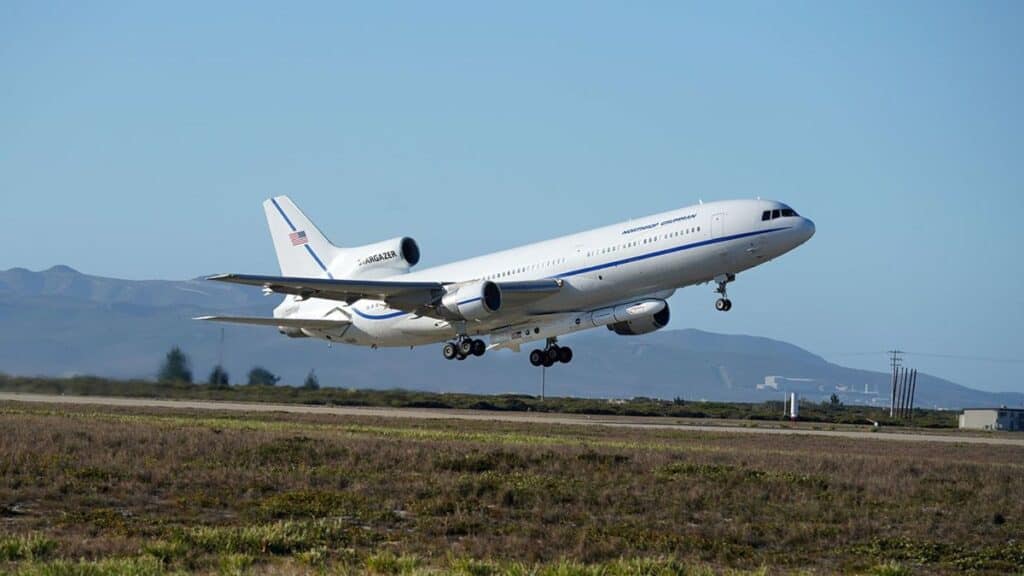
Northrop Grumman’s Stargazer, a modified L-1011 aircraft takes off from Vandenberg Air Force Base in California. The company’s Pegasus XL rocket, carried beneath the aircraft as shown here, will launch Katalyst’s LINK spacecraft.
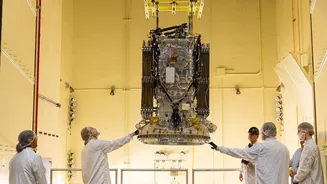
Before launch, the rocket is integrated with Katalyst Space's LINK robotic servicing spacecraft at Nasa's Wallops Flight Facility in Virginia. It is then attached beneath Northrop Grumman's modified L-1011 carrier aircraft, known as Stargazer, for the journey to the Reagan Test Site at Kwajalein Atoll in the Marshall Islands.
The choice of launch location is not incidental. By taking off from Kwajalein Atoll, Pegasus XL can place LINK directly into the same orbital plane occupied by the Neil Gehrels Swift Observatory, significantly simplifying the rendezvous phase.
The launch sequence itself differs markedly from conventional rocket launches.
Once Stargazer departs Bucholz Army Airfield, it climbs to an altitude of roughly 39,000 to 40,000 feet while travelling at approximately Mach 0.82. Only after reaching the planned release point does the aircraft release the Pegasus XL rocket.
Around five seconds later, Pegasus ignites its first-stage motor and begins its independent journey into orbit.
The launch vehicle measures about 55 feet (16.9 metres) in length and is powered by three solid-fuel rocket stages that ignite one after another during ascent. The complete climb to orbit takes only about 10 minutes, after which LINK separates from the rocket and begins its own mission.
Pegasus XL has occupied a distinctive niche in the global launch industry since making its debut in 1990. Over its operational lifetime, it has completed 45 missions and demonstrated the flexibility of air-launch systems, which can operate from different airfields rather than being tied to fixed launch complexes.
This flexibility enables the rocket to reach orbital inclinations that are difficult or inefficient to access from many conventional spaceports.
That capability proved particularly important for the Swift Boost mission because Swift occupies a relatively low orbital inclination of about 20.6 degrees relative to Earth's equator.
The mission is scheduled for liftoff no earlier than 6:23 a.m. EDT (1023 GMT) on June 30, 2026. It also represents the final mission for Pegasus XL, bringing an end to one of the longest-serving commercial launch systems in spaceflight history.
After separating from Pegasus XL, LINK will first complete a series of health checks and verify that all of its onboard systems are functioning correctly. Only then will it begin its carefully planned approach toward Swift.
Unlike scenes often depicted in science fiction, the spacecraft will not immediately attempt to dock with the observatory.
Instead, LINK will spend approximately two to three weeks observing Swift from nearby. During this period, mission teams will carefully analyse the observatory's condition while identifying the safest and most suitable locations where LINK's robotic arms can establish a secure grip.
This cautious approach reflects one of the mission's greatest engineering challenges. Swift was never built with servicing in mind. It lacks dedicated docking ports, grapple fixtures or attachment mechanisms commonly incorporated into newer spacecraft intended for future maintenance.
As a result, LINK must rely on detailed observations before making its final approach.
The servicing spacecraft itself stands approximately 1.5 metres (4.9 feet) tall and carries three robotic arms specifically designed for satellite servicing operations. Swift, by comparison, stretches about 3.9 metres (12.7 feet) across.
Once engineers determine the optimal capture point, LINK will carefully move into position before using its robotic arms to secure the observatory.
The mission does not involve a sudden orbital manoeuvre. Instead, after firmly attaching itself to Swift, LINK will activate its gentle ion propulsion system.
These highly efficient thrusters generate relatively small amounts of continuous thrust over extended periods, allowing the combined spacecraft to slowly climb into a higher orbit over several months.
Nasa's objective is to restore Swift to an altitude of roughly 600 kilometres (373 miles), close to the orbit where it began operations in 2004.
Provided the observatory's onboard systems continue functioning as expected, this higher orbit could extend its scientific life by several more years.
With inputs from agencies
Now, after 22 years in orbit, the spacecraft faces a very different challenge — not from deep space, but from Earth itself. The observatory's orbit has been shrinking at an accelerating pace, leaving Nasa with only a limited window to prevent it from plunging back into the atmosphere.
While allowing ageing satellites to naturally re-enter Earth's atmosphere is standard practice once their missions end, the United States space agency has instead chosen a far more ambitious route.
Rather than retiring the spacecraft, Nasa is attempting an unprecedented robotic rescue mission that could not only preserve one of its most productive scientific observatories.
At the centre of the effort is LINK, a robotic servicing spacecraft built by Arizona-based Katalyst Space Technologies.
Once in orbit, LINK will attempt something never before accomplished by an American spacecraft — capture an uncrewed government satellite that was never designed to be serviced and gradually lift it into a safer orbit.
If successful, the mission would extend Swift's operational life by several years while providing Nasa with valuable experience in commercial satellite servicing at a fraction of the cost of building a replacement observatory.
Why is Nasa trying to save the Neil Gehrels Swift Observatory?
The Neil Gehrels Swift Observatory was launched in November 2004 as a dedicated mission to investigate gamma-ray bursts, the most energetic explosions known in the universe.
These bursts can release enormous amounts of energy within seconds and offer astronomers rare opportunities to study phenomena linked to collapsing stars, neutron stars and black holes.
Over time, the observatory became one of Nasa's most versatile astrophysics platforms, capable of rapidly responding whenever astronomers detected unusual activity in space.
Equipped to observe the universe across visible, ultraviolet, X-ray and gamma-ray wavelengths, Swift has routinely investigated a wide variety of transient cosmic events whose locations or behaviour can change within minutes or even seconds.
Once Swift identifies or pinpoints a newly emerging source in space, observations are often continued using other Nasa observatories as well as ground-based telescopes operated by international partners and research institutions.
Even after more than 20 years in service, Nasa says the observatory continues to generate valuable scientific data, making it worthwhile to preserve rather than replace.
As NASA explains, "While NASA could have allowed Swift to re-enter the atmosphere, the situation presented an opportunity to demonstrate a key capability for the future of space exploration. This daring approach also extends Swift’s scientific lifetime and is more affordable than replacing the observatory’s unique capabilities."
Why is Swift's orbit shrinking so rapidly?
The challenge confronting Swift is not the result of a mechanical failure or collision in space. Instead, it stems from a natural process experienced by every satellite operating in low Earth orbit.
Although commonly described as existing in the vacuum of space, spacecraft in low Earth orbit continue to encounter extremely thin traces of Earth's atmosphere. This residual atmosphere creates drag that slowly reduces a satellite's altitude over time.
Ordinarily, spacecraft compensate for this gradual loss by firing onboard propulsion systems that periodically raise their orbits.
Swift, however, was never equipped with thrusters capable of performing such manoeuvres. The observatory was not designed with future servicing in mind, leaving it unable to recover altitude on its own.
For many years, this gradual orbital decay remained manageable. Recently, however, conditions around Earth changed significantly.
Nasa, which studies how solar activity influences the near-Earth space environment, has linked Swift's accelerating descent to heightened activity from the Sun. A series of powerful solar storms increased the amount of energy entering Earth's upper atmosphere, causing it to heat and expand outward.
As the atmosphere expanded, satellites travelling hundreds of kilometres above Earth encountered denser atmospheric particles than usual, substantially increasing drag.
Originally operating at approximately 600 kilometres (373 miles) above Earth, Swift has steadily descended until reaching roughly 360 kilometres (224 miles). According to Nasa, this orbital decay is now progressing quickly enough to create a race against time.
Agency estimates indicate that Swift could approach a critical threshold of around 300 kilometres (185 miles) by the fall of 2026. Once the spacecraft reaches that altitude, atmospheric drag becomes even more significant, making recovery increasingly difficult.
What has NASA already done to keep Swift alive?
Because developing, building and launching an entirely new spacecraft requires months of preparation, mission teams first needed to ensure Swift remained high enough in orbit for the rescue attempt to succeed.
To accomplish this, engineers at Nasa's Goddard Space Flight Center in Greenbelt, Maryland, together with specialists at Pennsylvania State University's Eberly College of Science, introduced operational procedures never previously used during the observatory's lifetime.
One of the most significant decisions involved temporarily suspending the telescope's scientific work.
In February earlier this year, Nasa shut down Swift's scientific instruments, bringing observations to a halt despite the observatory continuing to function normally. The pause was intended to support a completely different priority — maximising the spacecraft's survival until LINK could arrive.
Controllers also changed how Swift oriented itself while circling Earth. By maintaining an attitude that reduced the amount of atmospheric resistance acting on the spacecraft, engineers were able to slow the rate at which its orbit continued to decline.
These adjustments were designed to keep Swift's average altitude above approximately 300 kilometres (185 miles), which NASA considers the minimum altitude needed to give the servicing mission its strongest chance of success.
If LINK successfully captures the observatory and gradually raises its orbit, NASA expects Swift could return to scientific operations as early as September 2026.
The agency hopes to restore the telescope to an altitude close to the one at which it originally operated — around 600 kilometres (373 miles).
How will Nasa's rescue mission actually work?
Unlike most satellite launches that begin from a ground-based launch pad, Nasa's Swift Boost mission starts in the air.
The mission relies on Northrop Grumman's Pegasus XL, an air-launched rocket that has occupied a unique place in the history of commercial spaceflight for more than three decades.
Northrop Grumman’s Stargazer, a modified L-1011 aircraft takes off from Vandenberg Air Force Base in California. The company’s Pegasus XL rocket, carried beneath the aircraft as shown here, will launch Katalyst’s LINK spacecraft.
Image/Firstpost via Northrop Grumman
Before launch, the rocket is integrated with Katalyst Space's LINK robotic servicing spacecraft at Nasa's Wallops Flight Facility in Virginia. It is then attached beneath Northrop Grumman's modified L-1011 carrier aircraft, known as Stargazer, for the journey to the Reagan Test Site at Kwajalein Atoll in the Marshall Islands.
The choice of launch location is not incidental. By taking off from Kwajalein Atoll, Pegasus XL can place LINK directly into the same orbital plane occupied by the Neil Gehrels Swift Observatory, significantly simplifying the rendezvous phase.
The launch sequence itself differs markedly from conventional rocket launches.
Once Stargazer departs Bucholz Army Airfield, it climbs to an altitude of roughly 39,000 to 40,000 feet while travelling at approximately Mach 0.82. Only after reaching the planned release point does the aircraft release the Pegasus XL rocket.
Around five seconds later, Pegasus ignites its first-stage motor and begins its independent journey into orbit.
The launch vehicle measures about 55 feet (16.9 metres) in length and is powered by three solid-fuel rocket stages that ignite one after another during ascent. The complete climb to orbit takes only about 10 minutes, after which LINK separates from the rocket and begins its own mission.
Pegasus XL has occupied a distinctive niche in the global launch industry since making its debut in 1990. Over its operational lifetime, it has completed 45 missions and demonstrated the flexibility of air-launch systems, which can operate from different airfields rather than being tied to fixed launch complexes.
This flexibility enables the rocket to reach orbital inclinations that are difficult or inefficient to access from many conventional spaceports.
That capability proved particularly important for the Swift Boost mission because Swift occupies a relatively low orbital inclination of about 20.6 degrees relative to Earth's equator.
The mission is scheduled for liftoff no earlier than 6:23 a.m. EDT (1023 GMT) on June 30, 2026. It also represents the final mission for Pegasus XL, bringing an end to one of the longest-serving commercial launch systems in spaceflight history.
What will LINK do once it reaches orbit?
After separating from Pegasus XL, LINK will first complete a series of health checks and verify that all of its onboard systems are functioning correctly. Only then will it begin its carefully planned approach toward Swift.
Unlike scenes often depicted in science fiction, the spacecraft will not immediately attempt to dock with the observatory.
Instead, LINK will spend approximately two to three weeks observing Swift from nearby. During this period, mission teams will carefully analyse the observatory's condition while identifying the safest and most suitable locations where LINK's robotic arms can establish a secure grip.
This cautious approach reflects one of the mission's greatest engineering challenges. Swift was never built with servicing in mind. It lacks dedicated docking ports, grapple fixtures or attachment mechanisms commonly incorporated into newer spacecraft intended for future maintenance.
As a result, LINK must rely on detailed observations before making its final approach.
The servicing spacecraft itself stands approximately 1.5 metres (4.9 feet) tall and carries three robotic arms specifically designed for satellite servicing operations. Swift, by comparison, stretches about 3.9 metres (12.7 feet) across.
Once engineers determine the optimal capture point, LINK will carefully move into position before using its robotic arms to secure the observatory.
The mission does not involve a sudden orbital manoeuvre. Instead, after firmly attaching itself to Swift, LINK will activate its gentle ion propulsion system.
These highly efficient thrusters generate relatively small amounts of continuous thrust over extended periods, allowing the combined spacecraft to slowly climb into a higher orbit over several months.
Nasa's objective is to restore Swift to an altitude of roughly 600 kilometres (373 miles), close to the orbit where it began operations in 2004.
Provided the observatory's onboard systems continue functioning as expected, this higher orbit could extend its scientific life by several more years.
With inputs from agencies