








What is the story about?
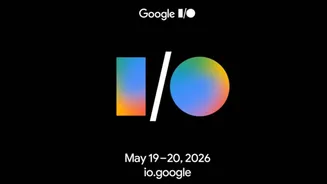
Google has set the stage for its biggest show of the year. The company announced that Google I/O 2026 will take place on May 19 and 20 at the Shoreline Amphitheatre in Mountain View, California, right next door to its global headquarters.
CEO Sundar Pichai confirmed the dates on X, adding that the event will also be live-streamed worldwide via io.google for developers and enthusiasts tuning in remotely.
As always, Google promises keynote addresses, developer sessions, and deep dives into its latest technology. But this year, one theme stands out clearly: AI is taking centre stage once again.
The two-day event kicks off on Tuesday, May 19, with the main keynote expected to begin around 10 AM Pacific Time (10:30 PM IST). The opening session traditionally packs the biggest announcements, from new software updates to major product reveals.
The venue remains the iconic Shoreline Amphitheatre, a short walk from Google’s Mountain View campus, the same place where Google has hosted several I/O conferences since 2016. For those who can’t attend in person, the company will live-stream all key sessions for free on its official website and YouTube.
If last year’s I/O is anything to go by, expect a two-hour keynote filled with demos, product previews, and a lot of references to “AI breakthroughs.”
Google has already teased that this year’s event will focus on the company’s “next generation of AI capabilities”, spanning Gemini, Android, and beyond. That likely means new models under the Gemini 3 banner, updates to AI integrations across Google Workspace apps, and further enhancements to Android’s AI-powered features.
At last year’s I/O, Google went all-in on AI, unveiling Gemini 2.5 Pro, Gemini 2.5 Flash, the Imagen 4 and Veo 3 generative models, and a series of AI-first updates across Search, Gmail, Chrome, and Meet. The company also introduced AI Mode in Search, expanded its AI Shopping tools, and rebranded its futuristic Project Starline as Google Beam, offering real-time translation.
So, expect a repeat performance, but bigger. Developers are anticipating major Gemini updates, AI-driven Android 16 features, and a possible debut of Google’s first AI smart glasses, which the company confirmed last December would arrive in 2026.
The wearable race is heating up, with Meta’s Ray-Ban smart glasses leading the charge and Apple reportedly working on its own camera-equipped AI wearables. If Google decides to lift the curtain on its version during I/O, it could mark one of the event’s most exciting hardware moments in years.
If you’re expecting a nostalgic return to the days of Android version reveals and dessert-themed updates, you might be disappointed. Google I/O has officially evolved into the company’s annual AI roadmap showcase.
Every major announcement in recent years has been powered by or connected to AI, and 2026 looks set to continue that trend. From Gemini-integrated hardware to AI-driven developer tools, the company is likely to double down on its strategy to make artificial intelligence the foundation of everything it builds.
In short, Google I/O 2026 won’t just be another tech conference. It will be a full-blown preview of Google’s AI-powered future, streamed live from the heart of Silicon Valley.
CEO Sundar Pichai confirmed the dates on X, adding that the event will also be live-streamed worldwide via io.google for developers and enthusiasts tuning in remotely.
See you all at Google I/O starting May 19th! https://t.co/KgNKbb3nMu pic.twitter.com/OD6x3IYtTi
— Sundar Pichai (@sundarpichai) February 17, 2026
As always, Google promises keynote addresses, developer sessions, and deep dives into its latest technology. But this year, one theme stands out clearly: AI is taking centre stage once again.
Google I/O 2026: When and where to watch
The two-day event kicks off on Tuesday, May 19, with the main keynote expected to begin around 10 AM Pacific Time (10:30 PM IST). The opening session traditionally packs the biggest announcements, from new software updates to major product reveals.
The venue remains the iconic Shoreline Amphitheatre, a short walk from Google’s Mountain View campus, the same place where Google has hosted several I/O conferences since 2016. For those who can’t attend in person, the company will live-stream all key sessions for free on its official website and YouTube.
If last year’s I/O is anything to go by, expect a two-hour keynote filled with demos, product previews, and a lot of references to “AI breakthroughs.”
AI, Gemini, and more: What to expect from I/O 2026
Google has already teased that this year’s event will focus on the company’s “next generation of AI capabilities”, spanning Gemini, Android, and beyond. That likely means new models under the Gemini 3 banner, updates to AI integrations across Google Workspace apps, and further enhancements to Android’s AI-powered features.
At last year’s I/O, Google went all-in on AI, unveiling Gemini 2.5 Pro, Gemini 2.5 Flash, the Imagen 4 and Veo 3 generative models, and a series of AI-first updates across Search, Gmail, Chrome, and Meet. The company also introduced AI Mode in Search, expanded its AI Shopping tools, and rebranded its futuristic Project Starline as Google Beam, offering real-time translation.
So, expect a repeat performance, but bigger. Developers are anticipating major Gemini updates, AI-driven Android 16 features, and a possible debut of Google’s first AI smart glasses, which the company confirmed last December would arrive in 2026.
The wearable race is heating up, with Meta’s Ray-Ban smart glasses leading the charge and Apple reportedly working on its own camera-equipped AI wearables. If Google decides to lift the curtain on its version during I/O, it could mark one of the event’s most exciting hardware moments in years.
The age of AI takes over I/O
If you’re expecting a nostalgic return to the days of Android version reveals and dessert-themed updates, you might be disappointed. Google I/O has officially evolved into the company’s annual AI roadmap showcase.
Every major announcement in recent years has been powered by or connected to AI, and 2026 looks set to continue that trend. From Gemini-integrated hardware to AI-driven developer tools, the company is likely to double down on its strategy to make artificial intelligence the foundation of everything it builds.
In short, Google I/O 2026 won’t just be another tech conference. It will be a full-blown preview of Google’s AI-powered future, streamed live from the heart of Silicon Valley.