






What is the story about?
The rise of intelligent machines is no longer a distant promise, it is unfolding in real time across sports arenas, laboratories and even public spectacles. Robots are learning not just to compute, but to move, react and compete alongside humans in dynamic environments.
From high-speed rallies on a table tennis court to long-distance running and choreographed performances, the gap between human and machine capability is narrowing in ways that feel both exciting and unsettling.
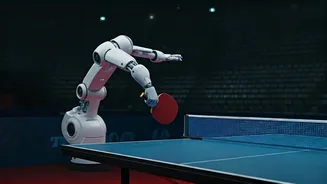
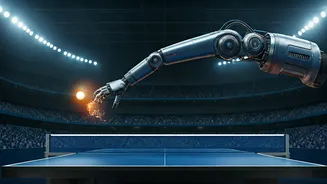
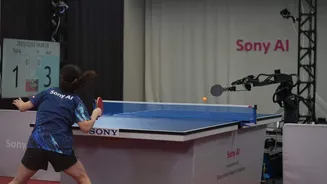
One of the clearest signs of this shift comes from Sony AI, where scientists have built a table tennis robot capable of competing with highly skilled players. Known as “Ace”, the system blends vision sensors, reinforcement learning and high-speed robotics into a crane-like arm fitted with a paddle.
Ace can track a fast-moving ball in real time, calculate its trajectory and respond with precise returns, all without prior knowledge of its opponent’s style. This level of adaptability marks a significant step forward for AI systems operating in physical environments.
In testing, the robot won seven out of 13 matches against five elite players, each with over a decade of intensive training. Against two professional competitors, it secured one victory in seven games. While not yet dominant, the results place Ace well beyond amateur-level performance, something earlier robots failed to achieve.
The findings, published in Nature, highlight how table tennis has become a proving ground for robotics. The sport demands rapid reflexes, fine motor control and continuous decision-making, making it an ideal test of whether machines can function effectively in unpredictable, real-world conditions.
The research shows that an AI system can perceive, reason, and act effectively in complex, rapidly changing real-world environments that demand precision and speed, said Peter Stone, chief scientist at Sony AI, reports Bloombeg. “Once AI can operate at an expert human level under these conditions, it opens the door to an entirely new class of real-world applications that were previously out of reach," said Stone.
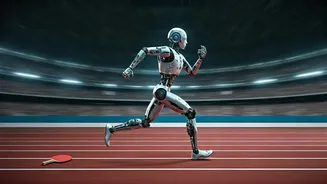
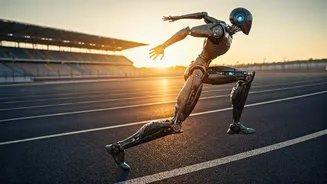
Beyond the lab, robots are increasingly stepping into public view. At a recent half marathon in Beijing, a humanoid robot named Lightning stunned observers by completing the course in just over 50 minutes, faster than the men’s human world record. Designed with long, runner-like legs and advanced cooling systems, the robot demonstrated how far hardware capabilities have come.
Yet the moment was not without flaws. During the race, Lightning collided with a barrier, fell, and required human assistance to continue, a reminder that physical endurance is improving faster than real-world judgement.
The event itself reflected both progress and limitation. More than 100 teams participated, but fewer than 40 per cent of the robots ran fully autonomously. Many relied on remote control, and all operated on carefully managed courses with support crews nearby.
Hardware innovation is clearly accelerating. Engineers are refining robot bodies with powerful leg motors, lightweight limbs and efficient cooling systems, enabling longer and faster movement. But translating that into safe, adaptable behaviour in everyday environments remains a major hurdle.
Meanwhile, China is showcasing robotic capabilities beyond endurance. During recent New Year celebrations, humanoid robots performed complex dance routines, martial arts moves and even comedic skits alongside humans. Compared to earlier displays, the movements were sharper, more fluid and far more coordinated, underscoring rapid progress in control systems.
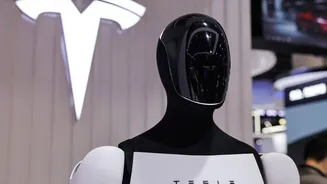
These advances have not gone unnoticed. Billionaire Elon Musk has previously warned that China is moving ahead in AI hardware and robotics, highlighting growing global competition in the field.
Together, these developments paint a nuanced picture. Robots can now rally with skilled athletes, run long distances and entertain audiences with intricate performances. But the leap from controlled demonstrations to fully autonomous, human-like intelligence in the real world remains unfinished, and that is where the real challenge lies.
From high-speed rallies on a table tennis court to long-distance running and choreographed performances, the gap between human and machine capability is narrowing in ways that feel both exciting and unsettling.
Robot beats human in a ping-pong game
One of the clearest signs of this shift comes from Sony AI, where scientists have built a table tennis robot capable of competing with highly skilled players. Known as “Ace”, the system blends vision sensors, reinforcement learning and high-speed robotics into a crane-like arm fitted with a paddle.
Ace can track a fast-moving ball in real time, calculate its trajectory and respond with precise returns, all without prior knowledge of its opponent’s style. This level of adaptability marks a significant step forward for AI systems operating in physical environments.
AI trained robot defeats an elite ping pong player, reacting in real time and handling fast rallies once dominated by humans 🏓 pic.twitter.com/5UBYN5icru
— Vivek Mishra (@Viveksagarbjp) April 22, 2026
In testing, the robot won seven out of 13 matches against five elite players, each with over a decade of intensive training. Against two professional competitors, it secured one victory in seven games. While not yet dominant, the results place Ace well beyond amateur-level performance, something earlier robots failed to achieve.
The findings, published in Nature, highlight how table tennis has become a proving ground for robotics. The sport demands rapid reflexes, fine motor control and continuous decision-making, making it an ideal test of whether machines can function effectively in unpredictable, real-world conditions.
The research shows that an AI system can perceive, reason, and act effectively in complex, rapidly changing real-world environments that demand precision and speed, said Peter Stone, chief scientist at Sony AI, reports Bloombeg. “Once AI can operate at an expert human level under these conditions, it opens the door to an entirely new class of real-world applications that were previously out of reach," said Stone.
Humanoids can race, dance and do martial arts, Elon Musk’s concern
Beyond the lab, robots are increasingly stepping into public view. At a recent half marathon in Beijing, a humanoid robot named Lightning stunned observers by completing the course in just over 50 minutes, faster than the men’s human world record. Designed with long, runner-like legs and advanced cooling systems, the robot demonstrated how far hardware capabilities have come.
Yet the moment was not without flaws. During the race, Lightning collided with a barrier, fell, and required human assistance to continue, a reminder that physical endurance is improving faster than real-world judgement.
This Chinese humanoid robot just broke the world record for a half marathon, finishing in 50 min 26 sec.
This video shows its crash just meters before the finish line. It's by Honor, the smartphone maker and was teleoperated while others were autonomous. pic.twitter.com/4NMZw6rKnh
— Massimo (@Rainmaker1973) April 19, 2026
The event itself reflected both progress and limitation. More than 100 teams participated, but fewer than 40 per cent of the robots ran fully autonomously. Many relied on remote control, and all operated on carefully managed courses with support crews nearby.
Hardware innovation is clearly accelerating. Engineers are refining robot bodies with powerful leg motors, lightweight limbs and efficient cooling systems, enabling longer and faster movement. But translating that into safe, adaptable behaviour in everyday environments remains a major hurdle.
What China showcased tonight to 1 billion viewers was not just technology, but a signal of a new era. In one year, robots evolved from basic movements to backflips and kung fu. This is not ordinary progress—it’s a terrifying leap in global technological power. pic.twitter.com/HrQsX7JFxF
— Ramy Abdu| رامي عبده (@RamAbdu) February 17, 2026
Meanwhile, China is showcasing robotic capabilities beyond endurance. During recent New Year celebrations, humanoid robots performed complex dance routines, martial arts moves and even comedic skits alongside humans. Compared to earlier displays, the movements were sharper, more fluid and far more coordinated, underscoring rapid progress in control systems.
These advances have not gone unnoticed. Billionaire Elon Musk has previously warned that China is moving ahead in AI hardware and robotics, highlighting growing global competition in the field.
Together, these developments paint a nuanced picture. Robots can now rally with skilled athletes, run long distances and entertain audiences with intricate performances. But the leap from controlled demonstrations to fully autonomous, human-like intelligence in the real world remains unfinished, and that is where the real challenge lies.