








What is the story about?
India has made considerable headway in the much-anticipated trade deal negotiations with the European Union as US trade talks drag on. India expects to conclude the trade deal by the end of January. India’s upcoming deal with the European Union stands out as a smart, deliberate step forward as India seeks new markets amid uncertainty over a trade deal with the US and mounting tariff pressures.
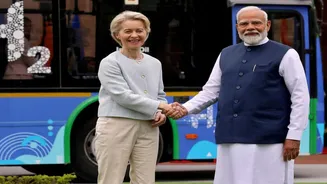
India and the European Union are working intensively to conclude the deal before European leaders arrive in New Delhi later this month. António Luís Santos da Costa, the President of the European Council, and the President of the European Commission, Ursula von der Leyen, are coming to India as chief guests at the Republic Day celebrations. If the deal is concluded, it is expected to deepen market access while reducing dependence on China and Russia.
For India, it is a chance to tap into the EU’s massive economy, with 27-member states, and for the EU, it would be its biggest trade deal, linking it to one of the world’s fastest-growing markets.
This agreement marks India’s shift from relying on unpredictable US ties towards a more sovereign, pragmatic approach. At a time when Western policies swing wildly, this pivot shows India stepping up as a mature player, building resilience through balanced relationships.
US President Donald Trump imposed crushing 50 per cent tariffs on most US imports from India to punish it over its purchase of Russian oil. President Trump followed through on his threat and imposed the tariff, upending a decades-long push by the US to forge closer relations with India. India is one of America’s most important strategic partners in Asia.
India and the United States have been brought together by mutual interests and common values in recent decades. This move endangered relations with one of America’s most important trading partners. Trump’s tariffs hit sectors such as textiles, apparel, and auto parts particularly hard.
Trump has also “greenlit” the Russia sanctions Bill. If passed, the bill would allow the US President to levy tariffs of up to 500 per cent on Moscow’s trading partners, including India. As India-US trade talks drag on amid growing uncertainty, India is seeking to explore new markets.
The India-EU deal offers a solid way out by opening doors to diversified markets. It could double India’s exports to the EU in key areas such as pharmaceuticals, electronics, and services. Indian firms would gain better access to European technology and capital, while European companies could invest more in India’s manufacturing boom.
For South Asia, this pact positions India as a regional anchor. Stronger EU ties could mean more aid, technology transfers, and investment spilling over to neighbouring countries through improved infrastructure and trade links. In the Indo-Pacific, it shifts dynamics by giving countries alternatives to US or Chinese dominance. It is a win for stability, reducing dependency on any single power.
The EU deal, however, has its hurdles. Negotiations have dragged on over sensitive issues such as agricultural subsidies, carbon border taxes, and automobiles. According to a report, the main sticking points are steel and cars. While India is concerned that its steel shipments to the EU will be restricted by the bloc’s carbon border fee and safeguards limiting overall EU steel imports, the EU wants India to drastically reduce import duties on European automobiles.
Still, this is India’s chance to own its future: a strategic turn towards partners who value long-term stability. In a world of quicksand alliances, India’s EU pivot could be the firm ground needed for real growth and security.
(The writer is a columnist. His articles have appeared in various publications like The Independent, The Globe and Mail, South China Morning Post, The Straits Times, etc. Views expressed in the above piece are personal and solely those of the author. They do not necessarily reflect Firstpost’s views.)