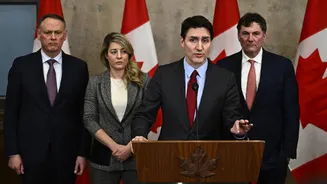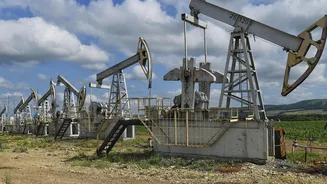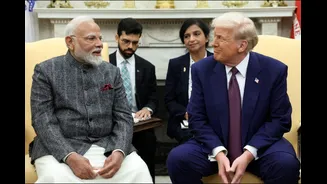

These orders and the other made by Trump have a wide-ranging impact both in the United States and the international arena. It is also noteworthy that some of Trump's policy decisions were also deeply influenced by the turbulent world order. While the world is currently witnessing two full-scale wars, international trading has dealt a blow as well.
There are 5 ways Trump timed his first year in the office. From pushing for economic nationalism to reigniting a nuclear military race, Trump 2.0 hit the world like a storm. Here are the five ways Trump changed the course of American politics in 2025.
5 ways Trump made an impact in 2025
1. Economic nationalism - Tariffs
One of the most talked-about economic policies introduced by Trump was his sweeping tariffs on international goods. In April, Trump announced a baseline of 10 per cent tariffs on foreign goods. However, the figure varied for different countries, with China at one point bearing the brunt of over 100 per cent duties.
Many believed that Trump used these tariffs as a tool to get his wishes fulfilled. While Trump said that the tariffs are being introduced to level the trade deficit between the US and countries around the world, economic experts pointed out that ultimately, it is the Americans who are ending up paying high prices for foreign products.
"They (tariffs) will make the US economy less competitive, and they will make US assets less attractive. Thus, they will slow US growth and raise US interest rates," renowned American economist
Trump often claimed that he used trade as a way to resolve the conflict between the two nations. However, many are still questioning the validity of such assertions. While this year, countries attempted to navigate the tariffs in one way or another, it will be interesting to see how 2026 will pan out.
2. Shifts in NATO dynamics
Just like his first term in the office, Trump maintained his demanding side towards Nato. Trump has often maintained that he wants Europe to take over the majority of NATO's conventional defence capabilities. He often demanded that
In light of this, European policymakers are exploring deeper coordination to form a “European pillar” inside NATO — an idea long backed by Paris and now gaining traction in Berlin. The question of unity within Nato became even more significant amid the Russia-Ukraine war. Many have also been wondering if Trump's laid-back approach towards the body is also enabling Russia to test the alliance's limits.
3. Immigration and border crises
One of the most visible and aggressive policies pushed by the Trump administration this year was its crackdown on immigration.
Not only this, but the Trump administration also introduced stringent visa policies, such as increasing the H1-B visa fee to a whopping $100,000 and restricting the list of countries from where refugees can seek asylum. Apart from this, the State Department also introduced arbitrary checks, such as monitoring the social media platforms of those planning to enter the US, and rejecting the visa based on their online activities.
The horrid conditions of the immigrants detained in ICE facilities have also raised concerns about human rights violations. The Trump administration has been clear on the matter from the get-go. Hence, they are most likely to pursue stringent immigration rules next year as well.
4 Foreign policy reset
Trump's foreign policy outlook has been dramatically different from that of his predecessor, Joe Biden. While Trump has been milder on both China and Russia, the US under him was seen as rebuilding ties with Pakistan and pushing away India.
When asked if Trump's close ties with Pakistan were a strategic rethinking, former US National Security Adviser
“It’s part of a strategy of flattery, which often works with Trump as well. So my suggestion to Prime Minister Modi is that when he talks to Trump next, he should offer to nominate him twice for a Nobel Peace Prize and to keep nominating him until he gets it. Maybe that’ll help,” he exclaimed.
When it comes to the Russia-Ukraine war, Trump has kept an ever-changing stance, with one thing clear on his mind: he wants to end the war. While he was often seen unleashing tirades against Russian President Vladimir Putin, he has yet to take any constructive measures against Russia.
Netizens even have an acronym to describe Trump's behaviour. They call it "TACO - Trump Always Chickens Out". In the Firstpost interview, Bolton shared his take on how Trump looks at Putin.
“Well, for most of the first six months, what Trump was trying to do was use what he thought was his friendship with Vladimir Putin to negotiate a ceasefire in Ukraine. Now I’ll just tell you from my own experience,” Ambassador Bolton explained.
“Putin doesn’t see Trump as his friend. He sees them as somebody that he thinks he can manipulate in true, true fashion of a former KGB agent. And I think he’s been pretty successful with it. But at some point toward the end of the first six months, whether intentionally or unintentionally, I think Putin pushed Trump a little too far, and Trump concluded that Putin wasn’t interested in a ceasefire.”
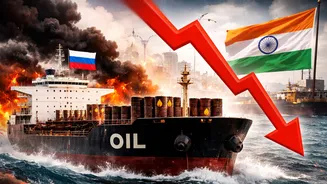
“That’s what angered him. He threatened tariffs on Russian exports to the US and secondary sanctions or tariffs on countries that were buying Russian oil and gas. So all of these issues with the secondary sanctions have arisen within the past 30 or 45 days,” he said in August.
In his second term in office, Trump has also been milder with the US and has been accused of spoiling ties with America's age-old allies.
5. Back to nuclear military race
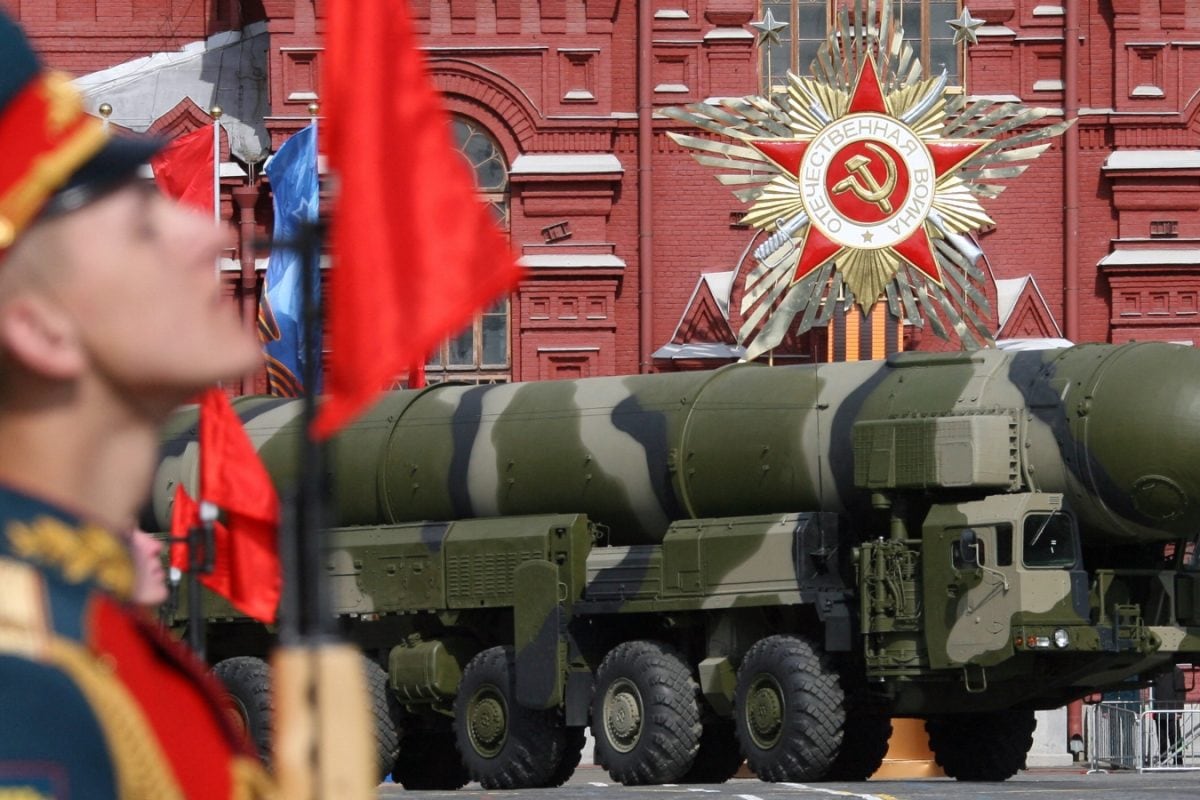
In November, Trump made many heads turn after he ordered the Pentagon to resume testing nuclear weapons. While what Trump meant by testing nuclear weapons was unclear, it came at an extremely turbulent time worldwide.
This was also pointed out by Melissa Parke, the executive director of the 2017 Nobel Peace Prize winner International Campaign to Abolish Nuclear Weapons (Ican), during her conversation with Firstpost. Parke said the current events in Gaza and Ukraine are “threatening to tear down the fabric of the international law that has been built over the centuries”.
“Just this year alone, there have been major conflicts or confrontations among five out of the nine nuclear-armed states. So that’s the US, Russia, Israel, India and Pakistan,” Parke told Firstpost.
“There’s been an increase in nuclear threats and rhetoric, including from very senior political leaders. There is an almost complete breakdown in arms control agreements. The last one, New START, between the US and Russia, is set to expire in February. And there’s a new nuclear arms race underway," she added.
When asked about Trump's assertion, Parke called it 'unnecessary'. “That is a very confused statement. Firstly, because Russia and China have not been carrying out nuclear weapons tests and also because it’s not the Department of War that would do any nuclear testing by the United States, but it would be the Department of Energy,” she said.
However, it brought some relief when the US Secretary of Energy Chris Wright announced that there would be no nuclear detonation tests. “It’s a testing of the systems, which is what we suspected,” Parke said. Despite the relief, Trump's provocative remarks have prompted American adversaries like China, Russia and even North Korea to ramp up their nuclear capabilities, with experts insisting that the world is on the verge of a nuclear catastrophe.
Overall, 2025, i.e. Trump's first year in office, has been filled with turbulence, most of which has been triggered by his own policies.