

The Danish toy maker has introduced “smart bricks” that light up. The company unveiled the Lego Smart Play at the CES 2026 in Las Vegas.
The line will be introduced from March 1, 2026, beginning with the popular Lego Star Wars toys. Lego, ahead of the event, had vowed that its bricks “bring Lego creations to life like never before.”
“For over 90 years, the Lego Group has sparked imagination and creativity in children around the globe. As the world evolves, so do we — innovating to meet the play needs of each new generation. Lego Smart Play is the next exciting chapter in our Lego System in Play and something we are super excited about being able to bring to the world at this scale,” said Julia Goldin, chief product & marketing officer of the Lego Group.
But what do we know? How does it work? Why are some unhappy?
Let’s take a closer look.
What we know
The pieces of the Lego Smart Play look exactly like the standard Lego bricks. However, these bricks have one major difference – they contain tiny pieces of microchips. The bricks will detect and respond to players’ actions with lights and colour. These bricks work via a built-in motion sensor which determines how a user is playing with it. It also comprises a miniature speaker that makes sound and a built-in synthesiser. It can be charged wirelessly.
The bricks, which are 1.6 cm by 3.2 cm, have been encoded to respond to other Lego figures. The company demonstrated this by attaching a smart brick to a Lego duck, which then made a quacking sound. It also emitted a sound when it was attached to a Lego figure that was hit by a car.
It does this through its sound tags, which determine how it will respond to other figures. All this allows for physical and interactive play without the use of a screen, phone or app. These bricks operate via Lego’s encrypted BrickNet system. While the Smart Play line is being released on March 1, pre-orders in certain areas will start being taken on January 9. The company says this is the biggest evolution in Lego toys since the introduction of its Lego figure in 1978.
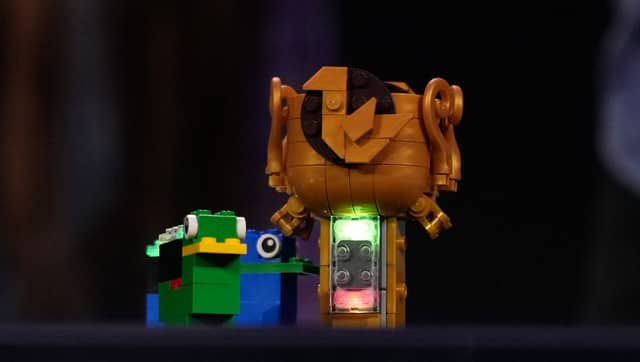
The bricks, which are 1.6 cm by 3.2 cm, have been encoded to respond to other Lego figures. AP
The first such smart bricks will be released for the popular Lego Star Wars line. These bricks have been developed in concert with Lucasfilm and Disney. The first set to be released will be Luke’s Red Five X-Wing, Darth Vader’s TIE Fighter and Throne Room Duel and A-Wing. The sets will be priced from $69.99 (Rs. 6,300) to $159.99 (Rs. 14,400).
The company says this is meant to encourage imaginative play without the use of AI, screens, and cameras.
“Each tag code, smart brick can become anything. Kids can combine to craft whatever they can do, mini figures contain codes, some are grumpy, but everyone is awesome,” Tom Donaldson, senior vice president at the Lego Group, told
“What makes it special is its size, sensing and smarts packed in; they [the smart bricks] collaborate with each other... Kids can reuse that smart brick in hundreds of ways. It’s limitless imagination in physical play,” he added.
Lego has said that this Smart Play sets, as of now, are mainly for younger children rather than adult collectors. It says this will add an extra dimension to the physical play.
Why people are unhappy
However, not everyone is happy with the development.
Some have argued that the bricks essentially take away the old-school charm of Lego toys.
“Children’s Lego creations already move and make noises through the power of their imagination,” Josh Golin, executive director of children’s wellbeing group Fairplay, told The Telegraph. “Lego’s new Smart Bricks are completely unnecessary and undermine what was once great about Legos.”
Sir Jeremy Wright, the former UK culture secretary, told The Times that he personally prefers the classic Lego figures.
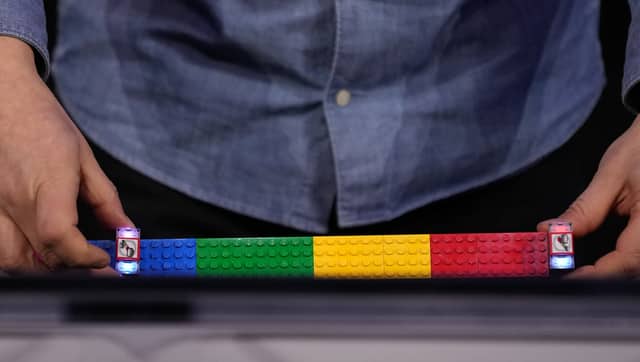
Lego has said that this Smart Play sets, as of now, are mainly for younger children rather than adult collectors. AP
“The reason I think lots of people do [Lego] is the same reason that lots of people put together jigsaw puzzles or take up crochet. It is good for putting your brain into neutral. It is therapeutic. There are huge mental health benefits to this, and if you introduce an electronic element I think you may take away from some of that.” He said he will “continue to buy the analogue version”.
Claire Fogel, owner of the Brick Stop Lego-themed café in Surrey, added: “Our ethos is calm from the chaos. It just wouldn't work here because of the noise levels. People come here for the calm and quiet.” However, she admitted that her own five-year-old son would “absolutely love” the new Lego bricks.
But Lego says that it will continue to put out analogue Lego sets, including many of its classics. It says it is evolving to meet the needs of children in today’s digital world.
“This is the beginning of an amazing journey. We can’t wait to see what actually happens next as there are so many opportunities of how this platform will evolve,” Goldin told
With inputs from agencies