








What is the story about?
EU chief Ursula von der Leyen on Tuesday announced that India and the European Union (EU) have reached the much-awaited trade deal.
Von der Leyen said that India-EU Free Trade Agreement (FTA) has created a free trade zone of 2 billion people in a win-win arrangement for both the sides.
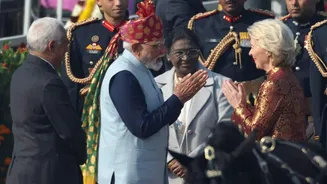
Von der Leyen is in New Delhi with European Council President Antonio Costa, EU foreign minister Kaja Kallas, and other top EU officials to attend the India-EU Summit. She and Costa were also the chief guests at the Republic Day celebrations on Monday.
In a statement, von der Leyen further said that the conclusion of the trade deal was only the beginning and that "we will grow our strategic relationship to be even stronger".
At the India-EU Summit, von der Leyen and Prime Minister Narendra Modi are set to formally announce the finalisation of the India-EU FTA, a security and defence partnership, and a mobility agreement. They are also set to adopt the 2026-2030 joint comprehensive strategic agenda for the India-EU relationship.
Ahead of von der Leyen's announcement, Kallas had told The Indian Express that the India-EU FTA would create a trading bloc with 25 per cent of the world's GDP.
Unlike the trade talks with the United States that have been contentious for both India and the EU, the India-EU negotiations were held in good faith. As a result, India’s red lines on agriculture and dairy have been respected and India has accommodated the EU’s concerns on automobiles, spirits, wines, and machinery.
Under the FTA, India will gain significantly from access to the EU market for textiles, seafood, and chemical exports, sectors that have been hit hard by Trump’s tariffs, and the EU will find easier access to Indian market for high-end machinery, aircraft and aircraft components, automobiles, electronics, and medical devices.
After Tuesday's formal announcement, the India-EU FTA is expected to be formally signed within five to six months after formal ratification and legal vetting, and the FTA is expected to come into effect early next year.
While India-EU trade talks had begun in 2022, after stalling in 2013, they acquired urgency early last year after US President Donald Trump waged a tariff war on the world and waged a coercive campaign against India and the EU. Analysts have said that the convergence of India and EU have not safeguarded their economic interests but have also turned them into a counterweight to the United States.
Von der Leyen said that India-EU Free Trade Agreement (FTA) has created a free trade zone of 2 billion people in a win-win arrangement for both the sides.
Von der Leyen is in New Delhi with European Council President Antonio Costa, EU foreign minister Kaja Kallas, and other top EU officials to attend the India-EU Summit. She and Costa were also the chief guests at the Republic Day celebrations on Monday.
In a statement, von der Leyen further said that the conclusion of the trade deal was only the beginning and that "we will grow our strategic relationship to be even stronger".
At the India-EU Summit, von der Leyen and Prime Minister Narendra Modi are set to formally announce the finalisation of the India-EU FTA, a security and defence partnership, and a mobility agreement. They are also set to adopt the 2026-2030 joint comprehensive strategic agenda for the India-EU relationship.
Europe and India are making history today.
We have concluded the mother of all deals.
We have created a free trade zone of two billion people, with both sides set to benefit.
This is only the beginning.
We will grow our strategic relationship to be even stronger. pic.twitter.com/C7L1kQQEtr
— Ursula von der Leyen (@vonderleyen) January 27, 2026
Ahead of von der Leyen's announcement, Kallas had told The Indian Express that the India-EU FTA would create a trading bloc with 25 per cent of the world's GDP.
Unlike the trade talks with the United States that have been contentious for both India and the EU, the India-EU negotiations were held in good faith. As a result, India’s red lines on agriculture and dairy have been respected and India has accommodated the EU’s concerns on automobiles, spirits, wines, and machinery.
Under the FTA, India will gain significantly from access to the EU market for textiles, seafood, and chemical exports, sectors that have been hit hard by Trump’s tariffs, and the EU will find easier access to Indian market for high-end machinery, aircraft and aircraft components, automobiles, electronics, and medical devices.
After Tuesday's formal announcement, the India-EU FTA is expected to be formally signed within five to six months after formal ratification and legal vetting, and the FTA is expected to come into effect early next year.
While India-EU trade talks had begun in 2022, after stalling in 2013, they acquired urgency early last year after US President Donald Trump waged a tariff war on the world and waged a coercive campaign against India and the EU. Analysts have said that the convergence of India and EU have not safeguarded their economic interests but have also turned them into a counterweight to the United States.