






What is the story about?
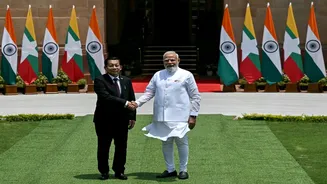
Prime Minister Narendra Modi and Myanmar President Min Aung Hlaing held wide-ranging talks in New Delhi on Monday, with security cooperation, border management and regional stability emerging as key areas of discussion.
Briefing reporters after the talks, Foreign Secretary Vikram Misri said that the two leaders held detailed discussions covering all major aspects of the bilateral relationship, including trade and economic cooperation, defence and security, border management and regional developments.
Both sides agreed on the need to further enhance cooperation and a comprehensive joint statement is expected to be issued later.
The meeting took place at Hyderabad House as the Myanmar leader began his five-day visit to India, his first foreign trip since assuming office as President earlier this year.
The visit is being closely watched as both countries seek to strengthen ties amid shifting geopolitical environment in the region and growing Chinese influence in Southeast Asia.
A key outcome of the talks was Myanmar's renewed assurance regarding India's security concerns. According to Misri, both countries stressed the importance of ensuring that their territories are not used for activities harmful to each other's security interests.
Significantly, President Min Aung Hlaing reiterated that Myanmar's territory would not be allowed to be used against India's security interests.
The assurance is particularly important for India, which shares a long and sensitive border with Myanmar through the northeastern states of Arunachal Pradesh, Nagaland, Manipur and Mizoram.
The issue has gained greater relevance in recent years due to instability inside Myanmar and concerns over cross-border movement of armed groups, illegal trafficking and other security challenges.
Developments in Myanmar have also had a direct impact on India's northeastern region, particularly Manipur, which is still recovering from a long period of ethnic conflict.
The two leaders also discussed the need to accelerate connectivity initiatives, including the strategically important Kaladan Multi-Modal Transit Transport Project.
Both sides stressed the importance of completing the project, which is expected to strengthen trade links and improve connectivity between India's northeast and Southeast Asia.
PM Modi reiterated India's support for Myanmar's sovereignty and territorial integrity, while both countries underlined the importance of maintaining close cooperation on regional issues.
The leaders also highlighted the need to expand people-to-people contacts and deepen engagement across multiple sectors. The discussions reflected a shared recognition that stronger bilateral ties are important not only for the security and development of both countries but also for stability across the wider region.
The visit is being seen as an important opportunity for India to reinforce its 'Act East' policy objectives while encouraging greater cooperation with a strategically important neighbour facing significant political and security challenges.
Briefing reporters after the talks, Foreign Secretary Vikram Misri said that the two leaders held detailed discussions covering all major aspects of the bilateral relationship, including trade and economic cooperation, defence and security, border management and regional developments.
Both sides agreed on the need to further enhance cooperation and a comprehensive joint statement is expected to be issued later.
The meeting took place at Hyderabad House as the Myanmar leader began his five-day visit to India, his first foreign trip since assuming office as President earlier this year.
The visit is being closely watched as both countries seek to strengthen ties amid shifting geopolitical environment in the region and growing Chinese influence in Southeast Asia.
Strong focus on security cooperation
A key outcome of the talks was Myanmar's renewed assurance regarding India's security concerns. According to Misri, both countries stressed the importance of ensuring that their territories are not used for activities harmful to each other's security interests.
Significantly, President Min Aung Hlaing reiterated that Myanmar's territory would not be allowed to be used against India's security interests.
The assurance is particularly important for India, which shares a long and sensitive border with Myanmar through the northeastern states of Arunachal Pradesh, Nagaland, Manipur and Mizoram.
The issue has gained greater relevance in recent years due to instability inside Myanmar and concerns over cross-border movement of armed groups, illegal trafficking and other security challenges.
Developments in Myanmar have also had a direct impact on India's northeastern region, particularly Manipur, which is still recovering from a long period of ethnic conflict.
Connectivity and regional cooperation
The two leaders also discussed the need to accelerate connectivity initiatives, including the strategically important Kaladan Multi-Modal Transit Transport Project.
Both sides stressed the importance of completing the project, which is expected to strengthen trade links and improve connectivity between India's northeast and Southeast Asia.
PM Modi reiterated India's support for Myanmar's sovereignty and territorial integrity, while both countries underlined the importance of maintaining close cooperation on regional issues.
The leaders also highlighted the need to expand people-to-people contacts and deepen engagement across multiple sectors. The discussions reflected a shared recognition that stronger bilateral ties are important not only for the security and development of both countries but also for stability across the wider region.
The visit is being seen as an important opportunity for India to reinforce its 'Act East' policy objectives while encouraging greater cooperation with a strategically important neighbour facing significant political and security challenges.