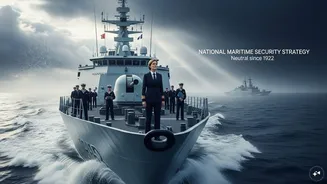








Neutral since 1922, Ireland is seeking deeper defence cooperation with the UK and France amid fears of potential Russian threats, as Minister for Defence Helen McEntee launched the country’s first National Maritime Security Strategy.
Unveiled aboard the naval vessel LÉ Samuel Beckett in Dublin, the five-year plan aims to safeguard Irish sovereignty, protect critical undersea infrastructure and strengthen naval coordination with Britain and France, reported RTE, an Irish public service broadcaster.
The move comes as Ireland prepares to host the EU presidency for six months from 1 July and faces mounting scrutiny over its defence capabilities.
“There is a backdrop of an ever-changing political and I think we all know that. We are for the first time, and for the past four years, witnessing a war taking place on the continent of Europe.
"We are seeing emerging and changing threats in terms of hybrid threats, hybrid warfare and shadow fleets. We're seeing an increasing volume of cyber attacks and security concerns. So the need to increase our focus on our security and defence is absolutely essential," RTE quoted McEntee as saying.
"This is not just a priority for Ireland. This is a priority for every European member state and for every country to increase and to highlight and to enhance our work when it comes to our security and defence," McEntee added.
A key element of the strategy is expanding regional partnerships, with British and French vessels potentially patrolling Irish-controlled waters during the EU presidency.
Chief of Staff of the Irish Defence Forces Rossa Mulcahy said security challenges could emerge in cyber space, air space and at sea.
"It's a significant opportunity for Ireland and the Defence Forces. An Garda Síochána have the lead for national security and we will provide all the resources they request of us. It will involve our army, our air force and our naval service capabilities and personel," RTE quoted Mulcahy as saying.
"There's been a lot of commentary in the media about the capacity of the Defence Forces to meet those tasks, I'm confident that the asks of An Garda Síochána's requests, that we will be able to meet those.
"We'll have challenges in our cyber space, potentially in our air space and at sea, but we'll have a plan in place.
"I'm confident we'll be able to provide the supports for An Garda Síochána," Mulcahy added.
Under the strategy, Ireland will explore links with the UK-led Joint Expeditionary Force (JEF) through a broader JEF-Plus format, while rolling out military radar and sonobuoy programmes.
Legislation is also expected before the Dáil’s summer recess to expand Naval Service powers to board and inspect suspected Russian “shadow vessels” within Ireland’s territorial waters and its 420,000 sq km Exclusive Economic Zone.
Opposition parties welcomed the focus on maritime security but raised concerns over neutrality. Sinn Féin defence spokesperson Donnchadh Ó Laoghaire said: "We absolutely accept we share our seas with our neighbouring countries, there needs to be cooperation, but that should be on a bi-lateral basis - between Ireland and France, between Ireland and Britain - not with Nato.
"We shouldn't be meshing ourselves with international organisations like that."
People Before Profit TD Paul Murphy described the strategy as "a shameful abandonment of any independent foreign policy", claiming it commits Ireland to deep military cooperation and increased arms spending.
Responding in the Dáil, Taoiseach Micheál Martin rejected the criticism.
"If anything happened to the cables, if anything happened to the gas connectors with Britain, we wouldn't have an economy in ten days.
"Are you saying we shouldn’t cooperate with Britain to protect the gas interconnectors with the UK?
"Are you saying we should ignore all of our European partners in protecting undersea critical infrastructure - such as subsea cables, such as the interconnector with France that will be completed in a year or two?
"What planet are you on?"