
For those who don’t know, that boom is the 21-gun salute, which has now has become a constant feature of all our Republic Days — a day of patriotic fervour, parade and celebration.
But have you ever wondered what’s the history of the 21-gun salute? And why is it 21 and not any other number? Here’s the history behind it.
History behind the 21-gun salute
The origins of the 21-gun salute at the Republic Day parade can be traced back to the British colonial era, dating back to the 17th century. Defence history reveals that at the time naval forces at sea demanded an enemy to show peaceful intent by firing the ammunition.
Even the Arlington National Cemetery website states that the 21-gun salute was a naval custom for when a warship wanted to signal it wasn’t seeking a confrontation, it would fire its cannons out to sea until all ammunition was spent.
It is said that British naval ships fired seven shots — a number considered significant in astrological and biblical traditions — to show peaceful intent. In turn, shore weapons, which had abundant gunpowder, fired three shots for every shell fired by the warship and hence, the 21-gun tribute came into existence as a salutatory tradition.
By 1818, the US naval regulations provided the first written instructions on the 21-gun salute and by 1875, the United States formally adopted the 21-gun salute, the same number used by Britain, France and other nations.
But there’s also the 19-gun and 17-gun salute
While the 21-gun salute is considered the highest honour and is reserved for the president of India and for special occasions such as Republic Day, other gun-salutes also exist. The number of gun-salutes indicate the rank and importance.
For instance, in pre-Independent India, there was a 101-gun salute, known as the Imperial Salute, which was reserved for the King-emperor. There’s also the 31-gun salute for members of the royal family and governor general of India.
Indian rulers were accorded a 21-, 19-, 17-, 15-, 11- and 9-gun salutes, depending on their relationship with the British Raj.
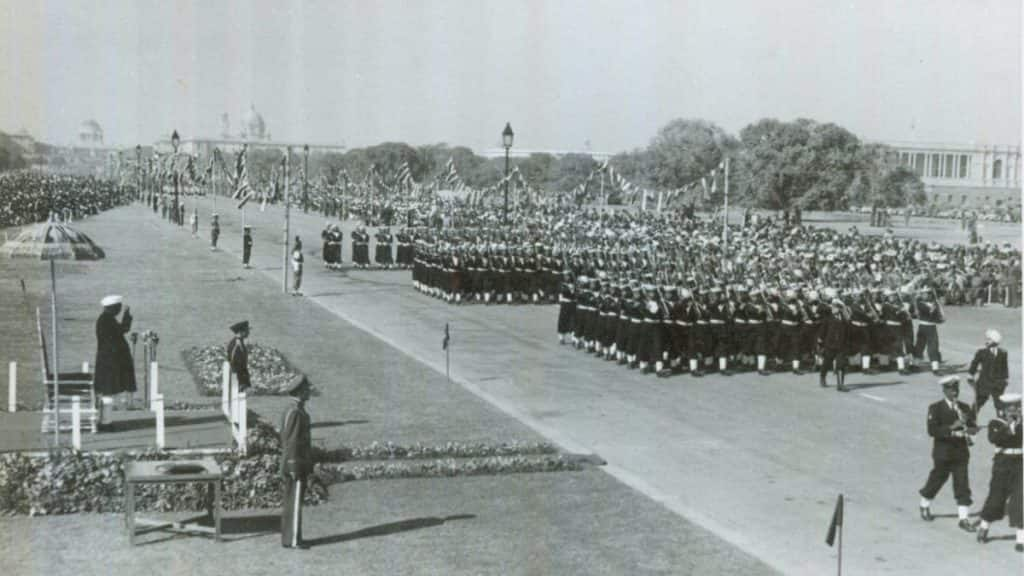
India's first President Dr Rajendra Prasad is seen saluting during the first Republic Day parade. Image Courtesy: @DDNewslive/X
Interestingly, when Dr Rajendra Prasad became India’s first president of India in 1950 and he drove down Rajpath, as Kartavya Path was formenrly known, in his gold buggy on January 26, he was accorded a 31-gun salute.
Now, the gun-salute is no longer an indication of position in a colonial hierarchy. Rather, the salute is an acknowledgement of the sovereignty of the people. Today, only the President is accorded with a 21-gun salute when he/she is sworn in. Also, during Independence and Republic Day, the Indian flag and the President are both honoured with a 21-gun salute.
It is also accorded to foreign head of states visiting the country. The 21-gun salute is also performed on Army Day, which falls on January 15 and Martyrs’ Day on January 30.
The 21-gun salute at R-Day
Every January 26, on Republic Day, the 21-gun salute is carried out with precision. The time of the gun salute matches the length of the national anthem — Jana Gana Mana. The first firing occurs at the start and the last firing coincides with the end of the national anthem.
Interestingly, the task is carried out with the use of special clocks to measure smaller time units. Moreover, backup guns are readied in case the selected guns do not go off. Seven cannons are fired at an interval of 2.25 seconds for three rounds each, to cover the duration of the anthem.
The 21-gun salute begins when the sword of the Commandant of President’s Body Guards (PBG) comes down at the shout of ‘Rashtriya Salute’ for the President and is carried out through the duration the National Anthem is played. No shells are fired, and a specifically-designed cartridge—commonly referred to as blank round — is used to create the sound of firing.
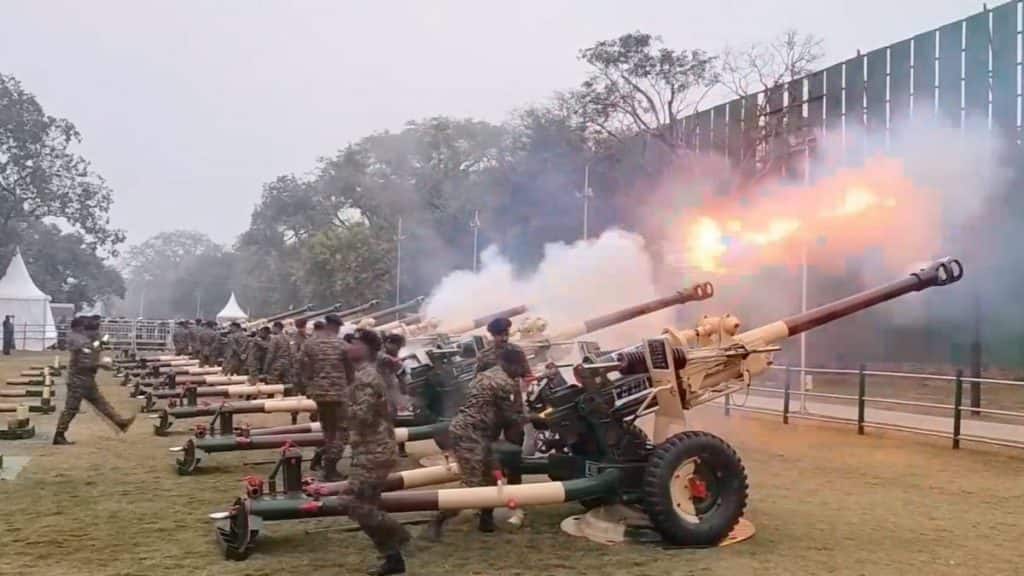
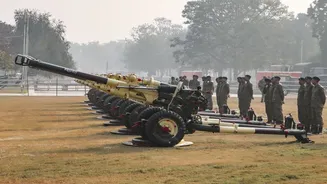
Indian Army personnel fire the 105mm light field guns that replaced the British-era 25-pounder guns for the 21-gun salute. File image/PTI
Until 2023, the 21-gun salute at the Republic Day was fired using the Indian Army’s British-era 25-pounder guns. However, since then they have been replaced by the
The British-era guns were designed and made in the 1940s by the British and were put to action in the 1965 and 1971 wars with Pakistan. They were decommissioned only in the early 1990s and since then used for ceremonial purposes such as the 21-gun salute on Republic Day and Independence Day.
However, now, Indian made 105 mm field guns are used for the 21-gun salute. They were designed and developed by the Armament Research and Development Establishment (ARDE) in 1972 and have been produced at the Gun Carriage Factory (GCF), Jabalpur, since 1984.
This Republic Day, these guns will boom again at Kartavya Path during the 90-minute parade that exhibits India’s military might as well as cultural diversity.
With inputs from agencies