




What is the story about?
Ever since AI models came into the picture, the key benchmarks have always been science, coding and mathematics. While we have already explored how AI is transforming coding, we now turn to how it is reshaping the discipline of mathematical research.
Since 2022, artificial intelligence has made a decisive entry into mathematics, a field long considered resistant to automation. What began as unreliable attempts at symbolic reasoning has evolved into systems that can assist with proofs, generate conjectures, and tackle increasingly complex problems.
Last year, an artificial intelligence system built by Google DeepMind, the tech giant’s primary artificial intelligence lab, achieved “gold medal” status in the annual International Mathematical Olympiad, a premier mathematics competition for high school students.
It was the first time a machine, which solved five of the six problems at the 2025 competition held in Australia, reached that level of success, the company said in a blog post.
The development is another sign that leading companies are continuing to improve their AI systems in areas such as mathematics, science and computer coding. This kind of technology could accelerate the research of mathematicians and scientists, while streamlining the work of experienced programmers.
Two days before Google revealed its feat, a researcher from OpenAI said in a social media post that the start-up had built a system that achieved a similar score on the same set of questions, though it did not officially enter the competition.
While companies continue to showcase benchmark success, questions remain around real-world application. To understand the crux of this shift, Firstpost spoke to mathematicians working at the forefront of the field.
Conversations with Gurpreet Singh, former Isro scientist and now Math Lead at Newton School of Technology, along with IISc professors Harish Seshadri and Siddhartha Gadgil, reveal a shared sentiment: AI is now embedded in everyday mathematical work. Beyond that, however, opinions begin to diverge.
The shift over the past few years has been less about replacement and more about transformation. AI tools have moved from being basic computational aids to active collaborators in the research process.
Researchers now use AI to explore multiple solution pathways quickly, test hypotheses, and identify patterns that may not be immediately obvious. “It accelerates exploration,” says Singh, pointing out that tasks which once took days can now be compressed into hours.
Gadgil also said that AI is now a routine work for the researchers. “Using AI at work is now a routine task. During our research, if, for instance, you are stuck at a place, AI helps solve it much quicker than our manual checks. Its knowledge is so vast, that it is easier for the bit to highlight what is missing,” said Gadgil.
However, Seshadri cautions against overstating the shift. “Mathematics is not just about solving problems, it is about understanding them deeply,” he says. While AI can assist with steps, the conceptual grounding still rests with humans.
After trying and testing OpenAI ChatGPT, Google Gemini and Anthropic Claude, Seshadri is convinced that the advanced thinking or reasoning mode in all of these models bring a lot of new aspects into the research. "Earlier, AI models were just churning out right words. But, for mathematics, it was mostly useless. However, now things have turned around," he said.
The only caveat, Seshadri said, is how to skillfully recheck what AI throws on your plate.
All in all, the experts agree that AI has changed how mathematics is done, if not fundamentally, then certainly in how research is now performed.
Unlike in language or creative tasks, hallucinations in mathematics take on a subtler form. AI models may not fabricate facts outright, but they can produce flawed reasoning, skip steps, or present arguments that appear valid but do not hold under scrutiny.
According to Singh, AI hallucination in mathematics is, in some sense, more dangerous than in ordinary language.
“In literature, a hallucination may be a fabricated quote or a false reference. In mathematics, hallucination can take the form of a plausible but invalid proof, a theorem invoked under the wrong conditions, an unjustified algebraic step, a hidden contradiction, or a conclusion that is true for the wrong reasons,” Singh told Firstpost.
This makes mathematical hallucination especially deceptive. The answer can look beautifully written, technically worded, and entirely convincing to a non-expert, and yet be false.
On the other hand, Seshadri and Gadgil do not flag it as a major risk.
Seshadri said that while AI models tend to hallucinate, they can also rectify the problems easily. He shared an example of AI hallucination in mathematical research: “A while ago, we were using the OpenAI ChatGPT Pro version. In between one of the results, we found that the chatbot was referring to a paper that does not exist. To my surprise, the publication name was real, the authors were real, however, the results of the paper were made up, all thanks to the AI imagination.”
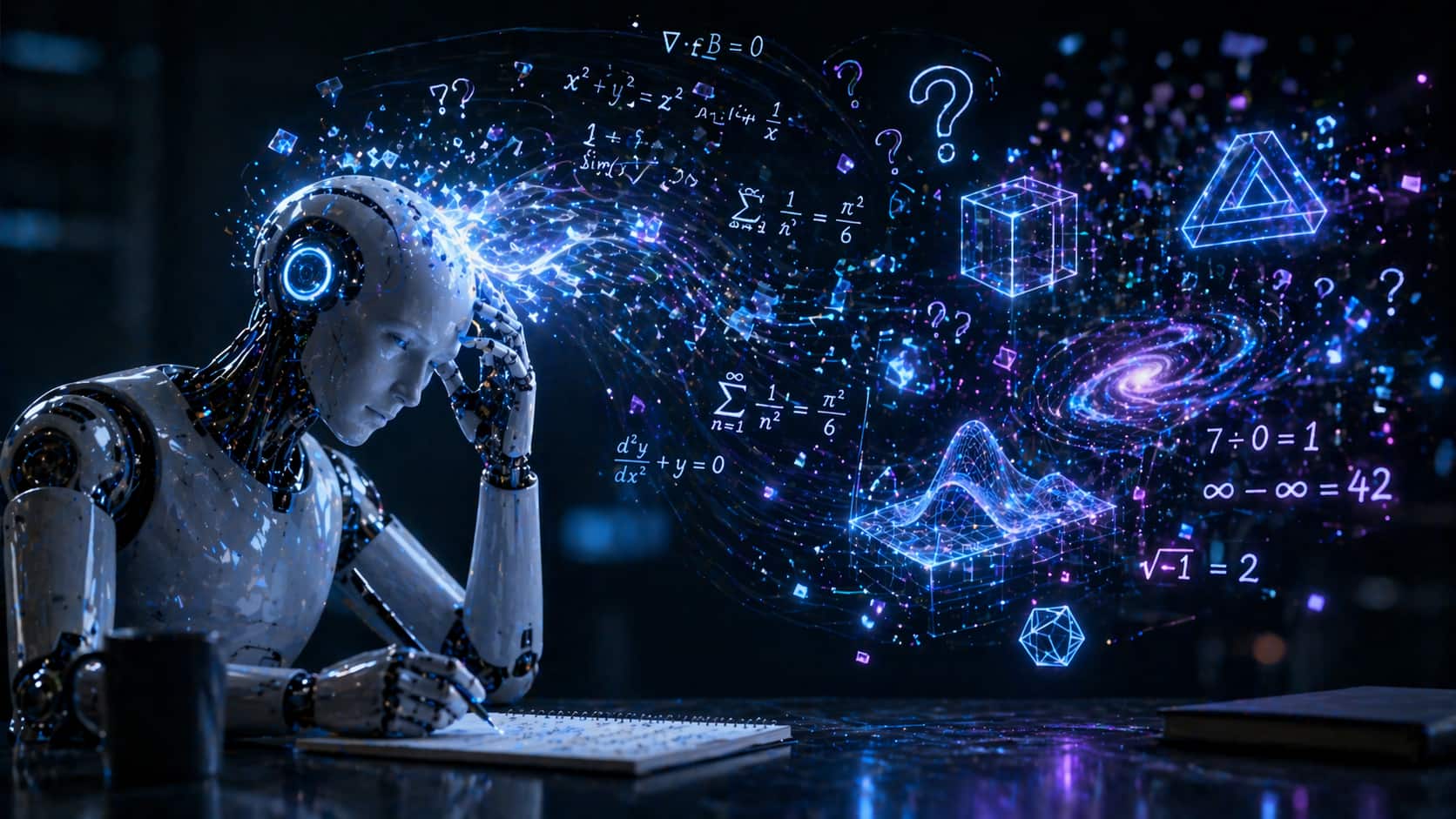
The experts also noted that the hallucination risk is higher in thinking tools. “Thinking tools help us draft a new idea, however, the chatbots tend to give up without any result. So, for example, if I want a new idea to solve a problem, the chatbot says something on the lines of it is unknown currently. So, we have to find a different way to draft the prompt, where the bot understands the question and answer intelligently, after all it is intelligence.”
However, according to Gadgil, hallucinations now occur mainly in very difficult situations. “When we say AI hallucinations, we are still thinking about the initial AI models. With new updates almost every week, the rate of hallucination is very low today. And this is not just the case in mathematical research. I think the hallucination rate has dipped across disciplines,” he emphasised.
Despite rapid progress, none of the experts see AI as a replacement for mathematicians.
Singh said that while AI cannot replace mathematicians, it will change what it means to be one in the near future. “If by mathematician one means a person who performs routine symbolic manipulation, then yes, AI will increasingly take over much of that surface-level work. But mathematicians do much more than manipulate symbols.
“I do think AI will become a serious collaborator,” Singh said.
Singh gave an example. “One of the most striking recent examples is Donald Knuth’s note Claude’s Cycles, where interaction with Anthropic’s Claude helped push forward a combinatorial problem he had been studying. That episode is important not because it proves that mathematicians are obsolete, but because it shows a new mode of mathematical work: iterative dialogue between human depth and machine exploration,” he said.
“So no, AI will not replace mathematicians. But mathematicians who know how to use AI well may replace mathematicians who do not,” he said.
The consensus is that AI will reshape the discipline, not displace it. It can assist with routine work, suggest novel approaches, and speed up computation, but it lacks intuition, creativity, and the ability to frame meaningful problems.
Seshadri noted that there is considerable uncertainty among the youth. “In 2022, it was inconceivable that any computer could perform conceptual arguments. But now, since technology has evolved so much, it is certain that the work we used to do will also change. But in the near future, I do not see AI models replacing mathematicians.”
Gadgil echoed this view, adding that in the coming five years, mathematical research will have to evolve alongside AI. “Since advanced AI is beating humans on many parameters, it is very important for mathematicians to work with it,” he said.
On whether entry-level roles will be affected as in other professions, Gadgil does not think so. “I don’t think AI will have a direct impact on our profession. Mathematical research has very different economic dynamics. Our field is publicly funded and entry-level roles do not necessarily support the veterans here. Even those who have just entered the field bring in their ideas and work on them.”
For Gadgil, the future lies in collaboration. As AI takes over repetitive tasks, mathematicians may shift their focus towards higher-level thinking, theory-building, and conceptual breakthroughs.
The experts’ views suggest that we are entering a fascinating phase in the history of mathematics. AI will likely take on more of the exploratory and computational labour, and may even assist in proof discovery at increasingly advanced levels.
But the essence of mathematics, the creation of meaning through structure and necessity, remains deeply human. The mathematician of the future may not work alone. However, the future of mathematics will still depend on minds that can distinguish between what is merely impressive and what is actually true.
Since 2022, artificial intelligence has made a decisive entry into mathematics, a field long considered resistant to automation. What began as unreliable attempts at symbolic reasoning has evolved into systems that can assist with proofs, generate conjectures, and tackle increasingly complex problems.
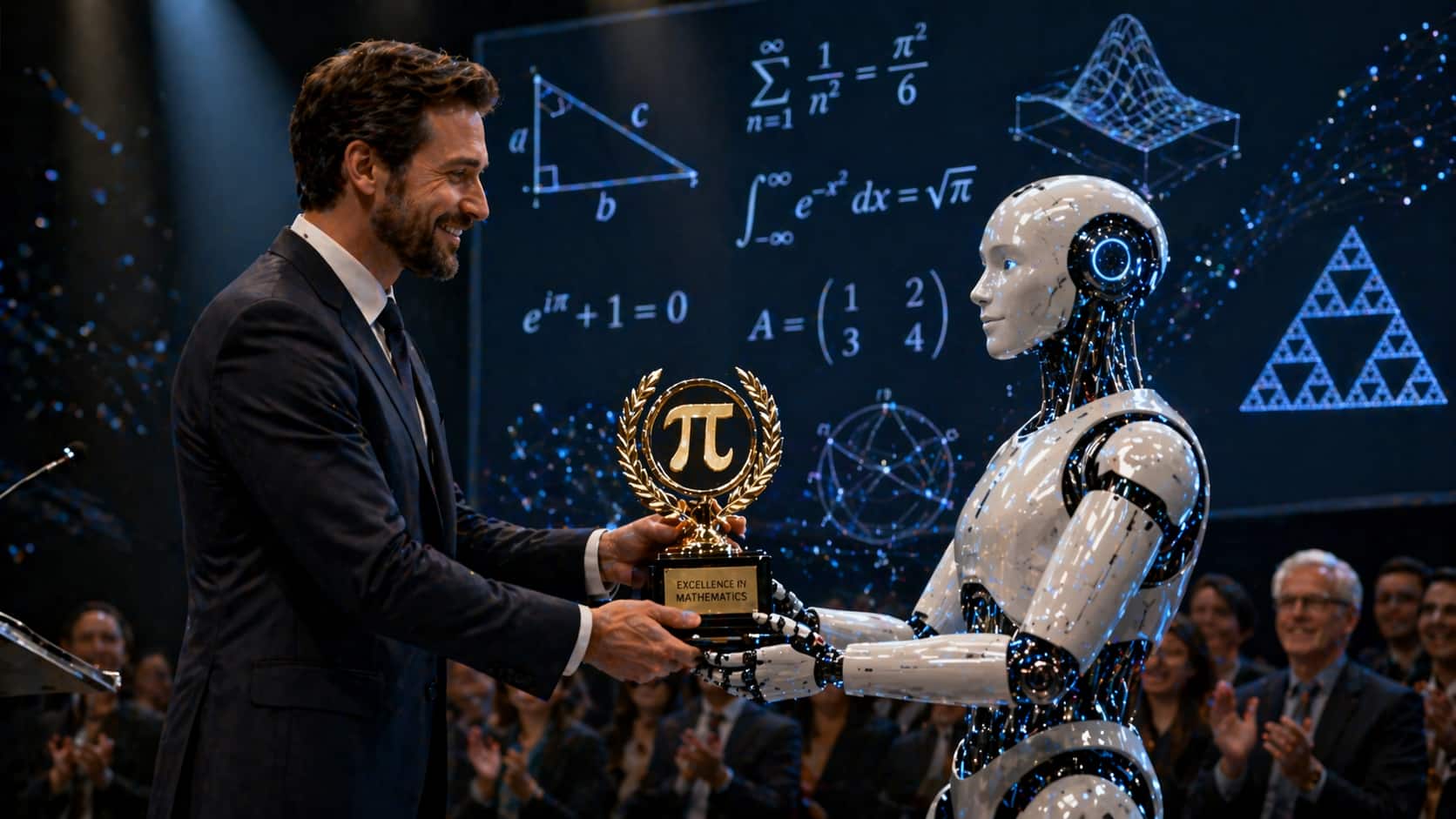
Last year, an artificial intelligence system built by Google DeepMind, the tech giant’s primary artificial intelligence lab, achieved “gold medal” status in the annual International Mathematical Olympiad, a premier mathematics competition for high school students.
It was the first time a machine, which solved five of the six problems at the 2025 competition held in Australia, reached that level of success, the company said in a blog post.
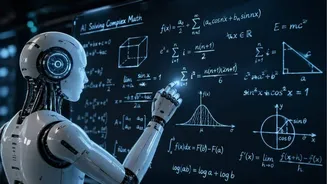
In 2025, AI won the mathematical olympiad (AI created image)
The development is another sign that leading companies are continuing to improve their AI systems in areas such as mathematics, science and computer coding. This kind of technology could accelerate the research of mathematicians and scientists, while streamlining the work of experienced programmers.
Two days before Google revealed its feat, a researcher from OpenAI said in a social media post that the start-up had built a system that achieved a similar score on the same set of questions, though it did not officially enter the competition.
While companies continue to showcase benchmark success, questions remain around real-world application. To understand the crux of this shift, Firstpost spoke to mathematicians working at the forefront of the field.
Conversations with Gurpreet Singh, former Isro scientist and now Math Lead at Newton School of Technology, along with IISc professors Harish Seshadri and Siddhartha Gadgil, reveal a shared sentiment: AI is now embedded in everyday mathematical work. Beyond that, however, opinions begin to diverge.
Has AI changed how math is done?
The shift over the past few years has been less about replacement and more about transformation. AI tools have moved from being basic computational aids to active collaborators in the research process.
Researchers now use AI to explore multiple solution pathways quickly, test hypotheses, and identify patterns that may not be immediately obvious. “It accelerates exploration,” says Singh, pointing out that tasks which once took days can now be compressed into hours.
Gadgil also said that AI is now a routine work for the researchers. “Using AI at work is now a routine task. During our research, if, for instance, you are stuck at a place, AI helps solve it much quicker than our manual checks. Its knowledge is so vast, that it is easier for the bit to highlight what is missing,” said Gadgil.
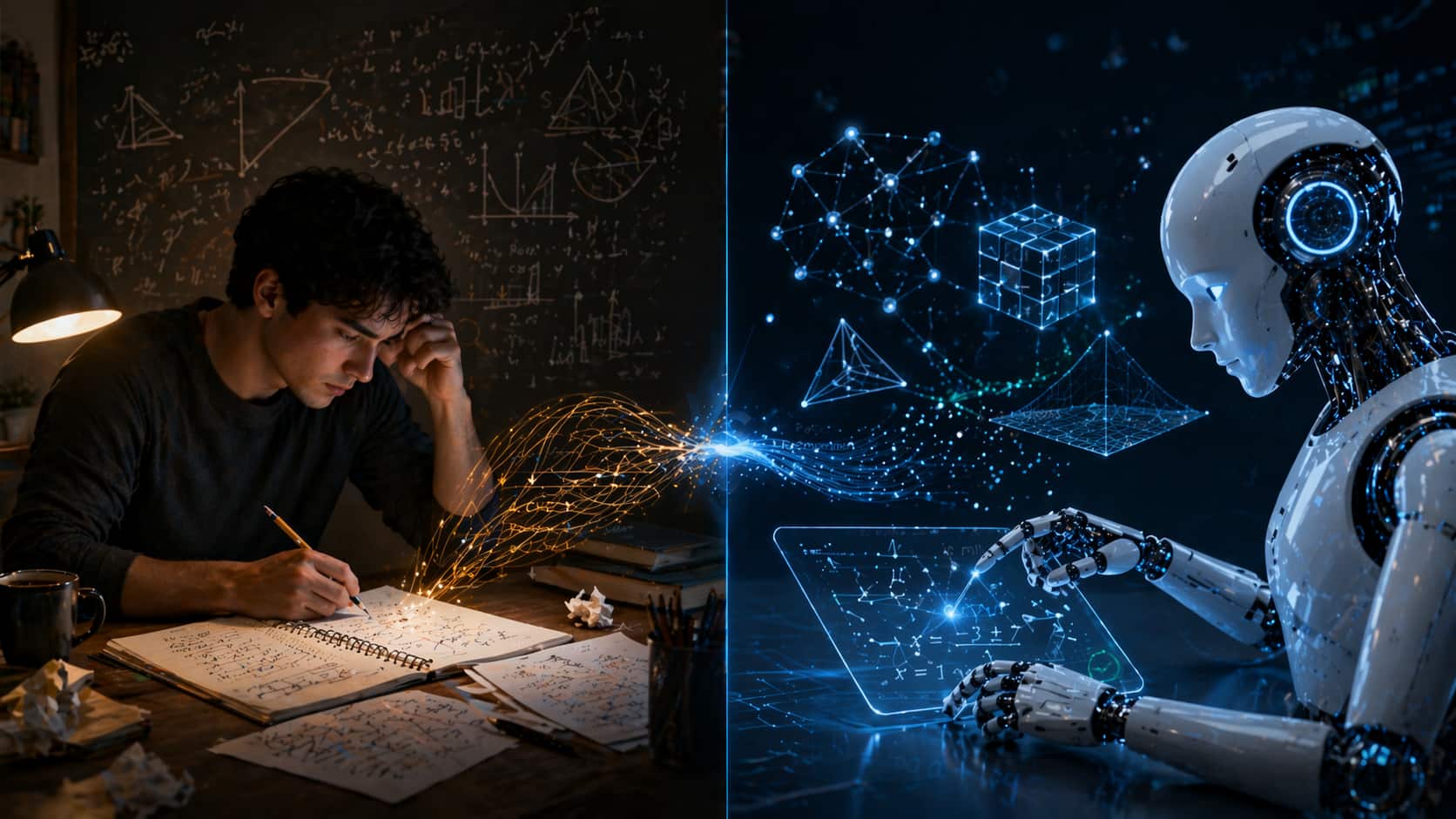
However, Seshadri cautions against overstating the shift. “Mathematics is not just about solving problems, it is about understanding them deeply,” he says. While AI can assist with steps, the conceptual grounding still rests with humans.
After trying and testing OpenAI ChatGPT, Google Gemini and Anthropic Claude, Seshadri is convinced that the advanced thinking or reasoning mode in all of these models bring a lot of new aspects into the research. "Earlier, AI models were just churning out right words. But, for mathematics, it was mostly useless. However, now things have turned around," he said.
The only caveat, Seshadri said, is how to skillfully recheck what AI throws on your plate.
All in all, the experts agree that AI has changed how mathematics is done, if not fundamentally, then certainly in how research is now performed.
AI hallucinations in mathematical research
Unlike in language or creative tasks, hallucinations in mathematics take on a subtler form. AI models may not fabricate facts outright, but they can produce flawed reasoning, skip steps, or present arguments that appear valid but do not hold under scrutiny.
According to Singh, AI hallucination in mathematics is, in some sense, more dangerous than in ordinary language.
“In literature, a hallucination may be a fabricated quote or a false reference. In mathematics, hallucination can take the form of a plausible but invalid proof, a theorem invoked under the wrong conditions, an unjustified algebraic step, a hidden contradiction, or a conclusion that is true for the wrong reasons,” Singh told Firstpost.
This makes mathematical hallucination especially deceptive. The answer can look beautifully written, technically worded, and entirely convincing to a non-expert, and yet be false.
On the other hand, Seshadri and Gadgil do not flag it as a major risk.
Seshadri said that while AI models tend to hallucinate, they can also rectify the problems easily. He shared an example of AI hallucination in mathematical research: “A while ago, we were using the OpenAI ChatGPT Pro version. In between one of the results, we found that the chatbot was referring to a paper that does not exist. To my surprise, the publication name was real, the authors were real, however, the results of the paper were made up, all thanks to the AI imagination.”
The experts also noted that the hallucination risk is higher in thinking tools. “Thinking tools help us draft a new idea, however, the chatbots tend to give up without any result. So, for example, if I want a new idea to solve a problem, the chatbot says something on the lines of it is unknown currently. So, we have to find a different way to draft the prompt, where the bot understands the question and answer intelligently, after all it is intelligence.”
However, according to Gadgil, hallucinations now occur mainly in very difficult situations. “When we say AI hallucinations, we are still thinking about the initial AI models. With new updates almost every week, the rate of hallucination is very low today. And this is not just the case in mathematical research. I think the hallucination rate has dipped across disciplines,” he emphasised.
Can AI replace mathematicians ever?
Despite rapid progress, none of the experts see AI as a replacement for mathematicians.
Singh said that while AI cannot replace mathematicians, it will change what it means to be one in the near future. “If by mathematician one means a person who performs routine symbolic manipulation, then yes, AI will increasingly take over much of that surface-level work. But mathematicians do much more than manipulate symbols.
“I do think AI will become a serious collaborator,” Singh said.
Singh gave an example. “One of the most striking recent examples is Donald Knuth’s note Claude’s Cycles, where interaction with Anthropic’s Claude helped push forward a combinatorial problem he had been studying. That episode is important not because it proves that mathematicians are obsolete, but because it shows a new mode of mathematical work: iterative dialogue between human depth and machine exploration,” he said.
“So no, AI will not replace mathematicians. But mathematicians who know how to use AI well may replace mathematicians who do not,” he said.
The consensus is that AI will reshape the discipline, not displace it. It can assist with routine work, suggest novel approaches, and speed up computation, but it lacks intuition, creativity, and the ability to frame meaningful problems.
Seshadri noted that there is considerable uncertainty among the youth. “In 2022, it was inconceivable that any computer could perform conceptual arguments. But now, since technology has evolved so much, it is certain that the work we used to do will also change. But in the near future, I do not see AI models replacing mathematicians.”
Gadgil echoed this view, adding that in the coming five years, mathematical research will have to evolve alongside AI. “Since advanced AI is beating humans on many parameters, it is very important for mathematicians to work with it,” he said.
On whether entry-level roles will be affected as in other professions, Gadgil does not think so. “I don’t think AI will have a direct impact on our profession. Mathematical research has very different economic dynamics. Our field is publicly funded and entry-level roles do not necessarily support the veterans here. Even those who have just entered the field bring in their ideas and work on them.”
For Gadgil, the future lies in collaboration. As AI takes over repetitive tasks, mathematicians may shift their focus towards higher-level thinking, theory-building, and conceptual breakthroughs.
The experts’ views suggest that we are entering a fascinating phase in the history of mathematics. AI will likely take on more of the exploratory and computational labour, and may even assist in proof discovery at increasingly advanced levels.
But the essence of mathematics, the creation of meaning through structure and necessity, remains deeply human. The mathematician of the future may not work alone. However, the future of mathematics will still depend on minds that can distinguish between what is merely impressive and what is actually true.