
The United Arab Emirates on Tuesday said it would withdraw its remaining forces from Yemen after Saudi Arabia issued a 24-hour demand for their exit, as tensions rose over a major offensive by separatist forces backed by Abu Dhabi.
According to AFP, the UAE defence ministry said it was pulling out its "counter-terrorism teams… of its own volition," while rejecting allegations that it was behind the separatists’ advance.
Earlier in the day, both Yemen’s presidential council and Saudi Arabia — Abu Dhabi’s rival powerbroker in Yemen — called for the immediate withdrawal of Emirati troops.
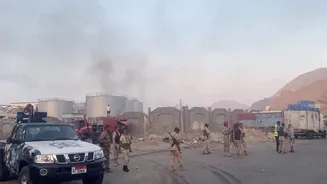
The announcement followed pre-dawn air strikes by the Saudi-led coalition against an Emirati shipment at Mukalla port. The coalition said the cargo was carrying weapons for separatist fighters, a claim the UAE strongly denied.
AFP footage from the port showed dozens of military vehicles and pick-up trucks at the site, with several left burnt out and smouldering as workers doused them with water.
The fast-moving developments on Tuesday follow advances this month by the UAE-backed Southern Transitional Council (STC) across the resource-rich Hadramawt and Mahra provinces, reigniting instability after more than a decade of civil war.
The offensive has revived fears of a return to a divided Yemen, with South Yemen having existed as a separate state between 1967 and 1990, while also delivering a setback to already fragile peace talks with Iran-backed Houthi rebels.
Emirati forces first entered Yemen as part of the Saudi-led coalition fighting the Houthis, who ousted the internationally recognised government from the capital, Sanaa, in 2014 and went on to seize much of the country.
The UAE scaled back most of its military presence in 2019, retaining only a limited force in the government-controlled south, where a complex network of militias continues to exert influence.
'Unreasonable'
Its final withdrawal follows a rare public dispute with Riyadh, which accused Abu Dhabi of pressuring STC forces "to conduct military operations" on Saudi Arabia's southern border.
"The steps taken by the UAE are considered highly dangerous," a foreign ministry statement said, adding: "The Kingdom stresses that any threat to its national security is a red line."
Also on Tuesday, the leader of Yemen's presidential council dissolved a defence pact with the UAE and declared a 90-day state of emergency.
Abu Dhabi denied being behind the separatist advance and insisted the shipment targeted at Mukalla contained only vehicles destined for its own forces.
The UAE "condemns the claims made regarding the exertion of pressure or direction on any Yemeni party to carry out military operations", a statement said.
It added: "The shipment in question did not contain any weapons, and the vehicles unloaded were not intended for any Yemeni party."
Both the UAE and Saudi Arabia expressed a willingness to engage in dialogue.
"Diplomacy is still an option to stop any further escalation," a source close to the Saudi military coalition told AFP.
However, the STC remained defiant, insisting there was "no thinking about withdrawal" from its newly seized positions.
"It is unreasonable for the landowner to be asked to leave his own land. The situation requires staying and reinforcing,"
'Unacceptable to God'
"We are in a defensive position, and any movement toward our forces will be responded to by our forces," he added.
Tamimi said Saudi Arabia had moved around 20,000 security forces along its border with Hadramawt, adjacent to positions held by the STC.
The STC is also a key member of the government - a fractious alliance held together by its opposition to the Houthis.
Mukalla resident Abdullah Bazuhair, whose home overlooks the port, showed AFP the damage to his property, with windows blasted clear out of the walls and glass strewn across the floor.
"The children were terrified and the women frightened," he said, calling the strikes "unacceptable to God".
The Saudi-led coalition had warned that it would back Yemen's government in any military confrontation with separatist forces, and urged them to withdraw.
Tuesday's strike came days after reported Saudi air raids on separatist positions in resource-rich Hadramawt last week.
A Yemeni military official said on Friday that around 15,000 Saudi-backed fighters were massed near the Saudi border but had not been given orders to advance on separatist-held territory.
With inputs from agencies