








What is the story about?
Union Finance Minister Nirmala Sitharaman said the government does not see an immediate need to revise its Budget estimates, despite risks from higher global oil prices, geopolitical tensions and an erratic monsoon.
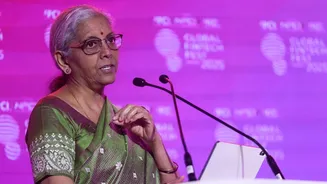
Speaking at the NDTV Profit Business Leadership Awards 2026 in Mumbai, Sitharaman said the government had built sufficient buffers into the Budget to deal with potential external and domestic shocks.
“At this stage, I don't think I look at my budget number for readjusting,” Sitharaman said when asked whether renewed tensions in West Asia and an uneven monsoon could affect the government's fiscal calculations.
The Finance Minister said the government had made provisions to deal with the impact of higher oil prices, increased fertiliser import costs and disruptions to global shipping.
“We've made a provision, there's some resource kept aside for it,” she said.
Sitharaman said the government could absorb higher import costs for fertilisers while continuing to provide them to farmers at existing prices.
“Similarly, for oil, support for import at a higher price for fertilizer import, but yet give it to the farmers at the same price since COVID. So, all this, I have kept buffers which can take care of it,” she said.
Her comments come as renewed geopolitical tensions have raised concerns over global energy prices and the potential impact on India's import bill, inflation and fiscal position.
India remains heavily dependent on imports to meet its crude oil requirements. A sustained rise in international oil prices can increase the country's import bill and put pressure on inflation, the current account and the rupee.
Sitharaman said inflationary pressures were not solely the result of external factors. Weather conditions and rainfall patterns could also affect prices, particularly through their impact on agricultural production and food supplies.
“Inflation, therefore, cannot be just imported, it's also our own want of rain and the monsoon being less than normal, can also add to the inflation,” she said.
The Finance Minister also pointed to the challenges posed by El Nino, which can affect rainfall patterns and create pressure on irrigation and drinking water availability.
A below-normal or uneven monsoon can affect crop output and food prices, potentially adding to inflationary pressures even if global commodity prices remain stable.
Sitharaman also said private-sector investment in India had begun to improve, with companies increasing spending in sectors considered critical to the country's long-term economic and strategic priorities.
“Industry has started investing, the numbers are improving. In fact, it's very encouraging to know that they are investing in sectors which are very critical to India's Atmanirbhar Viksit Bharat,” she said.
She invited industry to engage with the government on issues that could require policy intervention or further facilitation.
“I would certainly invite industry to engage with the government and see if there are any points of concern or any further facilitation that would be needed,” Sitharaman said.
Earlier, addressing the event, Sitharaman said India's economic growth continued to remain broad-based despite challenges in the global economy.
“India's growth momentum remains broad-based and resilient despite external challenges,” she said.
She pointed to indicators including GST collections, export orders, e-way bill generation, electricity demand, digital payments, and vehicle and tractor sales as signs of sustained economic activity.
The Finance Minister's comments suggest that the government currently intends to stay with its existing fiscal calculations rather than make an immediate adjustment in response to global uncertainty or weather-related risks.
However, the outlook could still be influenced by the trajectory of crude oil prices, the performance of the monsoon and the extent to which geopolitical tensions affect global trade and commodity markets.
Speaking at the NDTV Profit Business Leadership Awards 2026 in Mumbai, Sitharaman said the government had built sufficient buffers into the Budget to deal with potential external and domestic shocks.
“At this stage, I don't think I look at my budget number for readjusting,” Sitharaman said when asked whether renewed tensions in West Asia and an uneven monsoon could affect the government's fiscal calculations.
‘Buffers’ to absorb oil, fertiliser shocks
The Finance Minister said the government had made provisions to deal with the impact of higher oil prices, increased fertiliser import costs and disruptions to global shipping.
“We've made a provision, there's some resource kept aside for it,” she said.
Sitharaman said the government could absorb higher import costs for fertilisers while continuing to provide them to farmers at existing prices.
“Similarly, for oil, support for import at a higher price for fertilizer import, but yet give it to the farmers at the same price since COVID. So, all this, I have kept buffers which can take care of it,” she said.
Her comments come as renewed geopolitical tensions have raised concerns over global energy prices and the potential impact on India's import bill, inflation and fiscal position.
India remains heavily dependent on imports to meet its crude oil requirements. A sustained rise in international oil prices can increase the country's import bill and put pressure on inflation, the current account and the rupee.
Erratic monsoon could add to inflation
Sitharaman said inflationary pressures were not solely the result of external factors. Weather conditions and rainfall patterns could also affect prices, particularly through their impact on agricultural production and food supplies.
“Inflation, therefore, cannot be just imported, it's also our own want of rain and the monsoon being less than normal, can also add to the inflation,” she said.
The Finance Minister also pointed to the challenges posed by El Nino, which can affect rainfall patterns and create pressure on irrigation and drinking water availability.
A below-normal or uneven monsoon can affect crop output and food prices, potentially adding to inflationary pressures even if global commodity prices remain stable.
‘Industry investment has started improving’
Sitharaman also said private-sector investment in India had begun to improve, with companies increasing spending in sectors considered critical to the country's long-term economic and strategic priorities.
“Industry has started investing, the numbers are improving. In fact, it's very encouraging to know that they are investing in sectors which are very critical to India's Atmanirbhar Viksit Bharat,” she said.
She invited industry to engage with the government on issues that could require policy intervention or further facilitation.
“I would certainly invite industry to engage with the government and see if there are any points of concern or any further facilitation that would be needed,” Sitharaman said.
India’s growth momentum remains resilient
Earlier, addressing the event, Sitharaman said India's economic growth continued to remain broad-based despite challenges in the global economy.
“India's growth momentum remains broad-based and resilient despite external challenges,” she said.
She pointed to indicators including GST collections, export orders, e-way bill generation, electricity demand, digital payments, and vehicle and tractor sales as signs of sustained economic activity.
The Finance Minister's comments suggest that the government currently intends to stay with its existing fiscal calculations rather than make an immediate adjustment in response to global uncertainty or weather-related risks.
However, the outlook could still be influenced by the trajectory of crude oil prices, the performance of the monsoon and the extent to which geopolitical tensions affect global trade and commodity markets.