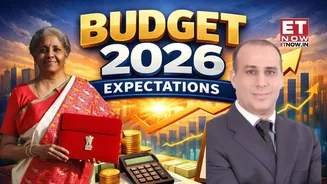

Budget 2026 Expectations: Market volatility ahead of the Union Budget 2026 is being driven more by global geopolitical developments than domestic policy
expectations, according to Dhiraj Relli, Managing Director & CEO, HDFC Securities. Despite global uncertainties, Relli underscored the importance of the Union Budget for Indian markets and investors.
“The volatility in the market at the moment is largely attributed to the geopolitical events,” Relli said in an interaction with ET Now Swadesh. He added that frequent and unpredictable comments from the U.S. President have made market direction difficult to assess. “The market is moving in any direction. It is very difficult to predict the markets at the moment.”
Budget Remains a Key Event for Indian Markets
“The budget is an important event in India and it gives a lot of hope to all sectors and viewers,” he said.
Five Key Expectations: The ‘5 Cs’ Framework
Outlining his expectations from Budget 2026, Relli said the government should focus on what he termed the “five Cs”.
“I will summarise it in five Cs. We need clarity, continuity, a capex-oriented budget, a consumption-oriented budget, and if the budget is capital-market-friendly, it will be very good,” he said.
Full Interaction;
Limited Scope for Taxation Changes in Capital Markets
On expectations around capital market taxation-particularly long-term capital gains (LTCG), short-term capital gains (STCG), and Securities Transaction Tax (STT)-Relli indicated that major changes are unlikely.
“I don’t think you will see any major changes in the taxation side this year,” he said, pointing to the importance of continuity. “We saw a lot of favourable changes last year. There was a little dampener for the capital markets, but if you keep continuity, it will be fine.”
Case for STT Relief on Delivery Trades
However, Relli did flag STT as an area where limited relief could be considered, especially for long-term investors.
“If you reduce or abolish the STT on the delivery trade, it will be favourable for long-term investors,” he said. Explaining the rationale, Relli noted that STT was introduced when capital gains tax did not exist. “At the time of buying and selling, you were collecting a tax. Now, you are collecting tax on both buying and selling, and tax on capital gains as well, and that has also been increased.”
“According to that, I think a little relief should be given on STT,” he added.
FPI Inflows Driven by Earnings, Macros-Not STT Alone
Addressing whether changes in STT could bring foreign portfolio investors (FPIs) back to Indian markets, Relli said taxation is not the primary driver of FPI decisions.
“The FPIs that will take their decision to invest again in India, that taxation will not be dependent on STT in particular,” he said.
Instead, he highlighted earnings growth, macroeconomic stability, and the global environment as key factors. “It will depend on how your earnings growth remains and how your macros are placed, and overall, what is the global environment.”
He added that easing geopolitical tensions and greater clarity in global trade relations would support foreign inflows. “If there is a little clarity on the geopolitical issues and tensions… then the FPIs will invest in India.”
Domestic Flows Expected to Remain Strong
Relli also emphasised the growing role of domestic investors in supporting Indian markets.
“Domestic flows are very strong, and I think domestic flows are going to be very strong in the future as well,” he said, noting a structural shift over the past two decades.
“Retail investors and HNIs, who were afraid of volatility, have now understood that volatility is part and parcel of investing in equity markets,” Relli said, adding that sustained domestic participation has reduced dependence on foreign capital.
According to him, FPIs are likely to return once earnings visibility improves. “As soon as our decisive earnings growth is visible and the macro environment is stable, you will see that foreign portfolio investors will start investing in the Indian market.”