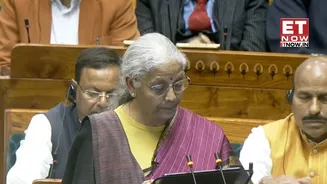

Finance Minister Nirmala Sitharaman, while presenting the Union Budget 2026, proposed a Rs 100 crore incentive for municipal corporations issuing a single
bond of over Rs 1,000 crore, aiming to deepen the municipal bond market and boost urban infrastructure financing.
"...strengthen the corporate bond market by introducing a market-making framework with access to funds and derivatives on corporate bond indices. Total return swaps on corporate bonds will be introduced. To promote the municipal bond market, larger cities issuing high-value bonds will be incentivised with Rs 100 crore for a single bond issuance exceeding Rs 1,000 crore, building on the existing Amrit scheme," she said.
Union Budget 2026
Finance Minister Sitharaman presented the Union Budget 2026-27 in Parliament today, February 1. The Budget 2026 began at 11 am Indian Standard Time (IST). The Budget laid out the key economic figures and the government's development plans for the upcoming fiscal year 2026-27. The Union Budget 2026 serves as the primary document outlining the Centre’s fiscal strategy, economic priorities, and policy direction. This is record ninth consecutive Budget presentation by FM Sitharaman since 2019.
Why Budget 2026 on Sunday?
In recent history, this will be the first time that the Union Budget will be presented on a Sunday. The date of the presentation of the budget, however, wasn’t always fixed to February 1. Traditionally, it was introduced on the final working day of February -- a practice that held until 2017. The PM Narendra Modi government, led by Finance Minister Arun Jaitley, brought the change by shifting the date forward to accelerate the rollout of new policies before the start of the financial year. This was a significant shift from India’s origins. R.K. Shanmukham Chetty presented Independent India’s very first budget on November 26, 1947.
Why is Budget 2026 important?
The Budget 2026 aims to outline measures to strengthen India's long-term growth potential by building a robust and deep consumption class, boosting self-reliance, providing better access to credit to support self-employment opportunities and preventing the Indian economy from external shocks like Donald Trump-led US tariffs and geopolitical tensions. It also comes at a time when the government is balancing fiscal discipline with the need for continued public spending.
Most famous Budgets in history
Several Budgets are remembered for their lasting impact, including the 1973 “Black Budget” during a period of economic stress, the 'Epochal Budget' of 1991, which set the benchmarks for the economic reforms, the reform-oriented “Dream Budget” of 1997 and the “Carrot and Stick” Budget of 1986 and Millennium Budget of 2000, paved way for making India a global IT and software development hub.