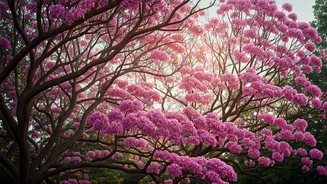







A Rare Pink Bloom
For the first time in about nine years since their planting, Kochi has witnessed an extraordinary and widespread blooming of the pink trumpet trees, scientifically
known as Tabebuia rosea. This natural phenomenon has adorned the city's landscape, creating a stunning visual treat for residents and commuters. The vibrant pink hues have particularly captivated onlookers during Valentine's Week, adding a romantic and refreshing ambiance to the urban environment. This expansive display offers a rare opportunity for people to pause and appreciate the natural beauty that has suddenly emerged across various parts of the city, from busy thoroughfares to serene walkways, turning ordinary commutes into moments of picturesque enchantment.
Origins and Comparisons
The pink trumpet tree, a native of Central America, is an exotic species that reaches up to 30 meters in height and is famously the national tree of El Salvador. While planted in Kochi around nine years ago, the current year marks its most significant bloom. This visual spectacle has drawn immediate comparisons from residents to other renowned floral displays. Many have likened the sight to Japan's iconic cherry blossoms, while younger individuals have been reminded of the similar, though perhaps more mature, Tabebuia rosea blooms found in Bengaluru. This comparison highlights the universal appeal of these trees and their ability to evoke familiar beauty in a new context, making the Kochi experience uniquely delightful yet universally recognized.
Urban Transformation
The presence of these blooming trees has profoundly impacted Kochi's urban scenery. As petals gently fall onto roads, they create a mesmerizing carpet of pink, transforming everyday locations like Sahodaran Ayyappan Road, Panampilly Nagar, and the Chambakkara Walkway into breathtaking vistas. Even casual observations, like those from a Kochi Metro window or during a drive along Container Road, have been described as a 'refreshing delight' that offers a momentary escape from the urban heat and bustle. The visual impact is so striking that aerial videos of the pink canopy have gained significant traction on social media, underscoring how a natural element can dramatically enhance an urban environment and uplift the spirits of its inhabitants.
Beyond Pink Trumpets
It's important to note that the striking pink floral display in Kochi isn't solely attributed to the Tabebuia rosea. Trees like manimaruthu have also been planted as part of compensatory afforestation efforts, notably for the Kochi Metro rail project. These trees, along with red trumpet trees, contribute to the overall pink hue seen across the city. Experts, such as Rajan Chembedath from C-HED, clarify that while manimaruthu flowers bear a resemblance to pink trumpet trees, they are distinct species contributing to the city's floral beauty. This distinction ensures a more accurate appreciation of Kochi's diverse urban greenery and the specific contributions of different tree species to its aesthetic appeal.
Ecological Considerations
Regarding the Tabebuia rosea's origin as a foreign species, ecologists assure that it is not considered invasive in India. Dr. E Kunhikrishnan, a Kerala-based ecologist, explains that while the tree is native to South America, its introduction as an avenue tree has not resulted in harmful effects on the local ecosystem. He points out that many common avenue trees in Kerala, including economically significant ones like rubber, cinchona, and mahogany, also hail from South America and are not detrimental. This perspective helps to allay concerns about exotic species, differentiating between those that integrate benignly and true invasive species like Senna spectabilis (rakshasa konna) or water hyacinth, which have demonstrable ecological and economic damage.