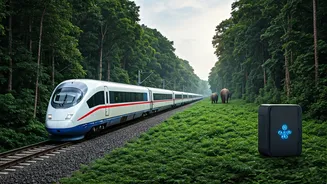









A Deadly Intersection
The predicament faced by both elephants and railway systems in regions where their habitats overlap is serious. Elephants, known for their immense size
and migratory patterns, frequently cross train tracks, leading to tragic collisions. These incidents result in the death of these majestic creatures and present considerable risk to train passengers and staff. Such accidents bring about delays, damage to railway infrastructure, and loss of life. Consequently, the railway authorities are constantly seeking innovative methods to minimize these risks and ensure the safety of both animals and commuters.
AI's Clever Intervention
The heart of this novel solution is an AI-enabled Intrusion Detection System (IDS). This system integrates advanced technologies to monitor and analyze the environment surrounding railway tracks. It employs a combination of sensors, cameras, and sophisticated algorithms to identify potential threats, such as the presence of elephants near the tracks. The system works by collecting real-time data from various sources and then uses AI to analyze this data, quickly identifying anomalies that suggest an impending danger. The beauty of the system is its capability to learn and adapt, which allows it to refine its accuracy over time.
How It Works: Sensors
The system heavily relies on an array of sensors strategically placed along the railway tracks. These sensors can detect various parameters, including sound, movement, and vibration. Acoustic sensors can pick up the distinct sounds of elephants, such as trumpeting or the breaking of branches. Vibration sensors detect the ground tremors created by large animals walking nearby. Advanced thermal imaging cameras are also used. These cameras can identify the heat signatures of animals even in low-light conditions or during adverse weather. All the data collected by these sensors is transmitted to a central processing unit for further analysis.
The Brains: AI Algorithms
Once data is gathered by the sensors, the AI algorithms take center stage. These algorithms are designed to process the information, identify patterns, and distinguish between regular environmental occurrences and potential threats. For instance, the system is trained to recognize the distinct sounds made by elephants, differentiating them from other animals or environmental noises. Machine learning models continuously refine their analysis based on new data, improving their ability to accurately identify the presence of elephants near the tracks. This constant learning allows the IDS to adapt to changing environments and conditions, leading to more accurate alerts.
Alerts and Prevention
When the AI algorithms detect a potential threat, the system immediately issues an alert. This alert is sent to the train operators and railway authorities. The alert includes specific information about the location of the threat and its potential severity. Upon receiving an alert, train operators can take immediate action to mitigate the risk. This includes reducing the train's speed, stopping the train, or rerouting it, if necessary. The system also enables the railway authorities to deploy appropriate personnel to the affected areas, such as forest officials or railway protection force, to monitor the situation and take preventive measures.
Successes and Impact
The implementation of the AI-enabled IDS has shown promising results in areas where it has been deployed. There have been fewer accidents involving elephants and trains, demonstrating the effectiveness of the system. The system's ability to provide timely alerts has given train operators time to react and avoid collisions, which resulted in the saving of precious animal lives and the protection of passengers. Furthermore, the system is designed to minimize disruptions to train schedules, as it allows for quicker and more informed decision-making. The overall impact includes improved safety and a more sustainable approach towards wildlife preservation.
Beyond the Rails
The principles and technologies used in this AI-enabled IDS have the potential to be adapted and implemented in other areas. The same technology can be applied to detect and prevent other intrusions, such as unauthorized access to railway tracks, thereby improving overall safety and security. Moreover, the system's ability to analyze large amounts of data can provide valuable insights into wildlife behavior and migration patterns. These insights can be used to inform conservation efforts and assist in managing the interactions between humans and wildlife. The success of this system can serve as a model for using AI in other critical infrastructure applications.