




Illuminating Earth's Night
A groundbreaking venture is exploring the revolutionary concept of bringing sunlight to Earth even after dusk, utilizing an array of satellites equipped
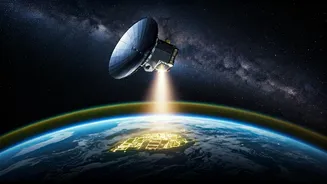
with expansive reflective surfaces. This ambitious project, spearheaded by a California-based company, aims to redefine nighttime illumination by redirecting solar energy from space. The core technology revolves around strategically positioned satellites in a specific orbital path, enabling them to continuously capture sunlight. These celestial mirrors, designed to be lightweight yet substantial, will be capable of unfurling once in orbit. Their programmed and motorized nature will allow for precise tilting, directing beams of sunlight toward designated terrestrial locations. This futuristic vision suggests a potential paradigm shift in how we manage and utilize light resources on our planet, opening up novel possibilities for various sectors and everyday life.
Requesting A 'Spotlight'
The proposed system allows users to request a 'sunlight spotlight' via a digital interface, accessible through an app or website. Once a request is registered, the system would command the orbiting satellite to adjust its mirror and precisely aim a beam of sunlight at the specified GPS coordinates on Earth. However, the duration of this illumination at any single point would be brief, typically around four minutes per satellite pass, due to the high velocity of satellites in Low Earth Orbit. To ensure continuous coverage or extended lighting, a coordinated network of multiple satellites would be necessary, effectively passing the light beam from one to another. This dynamic 'on-demand' lighting system offers a unique approach to targeted illumination, promising to deliver light precisely where and when it's needed, albeit for short, controlled intervals.
Brightness and Reach
When directed towards the Earth's surface, the reflected sunlight from these space-based mirrors is projected to create a circular illuminated patch spanning approximately 3 to 5 miles (about 5 kilometers) in diameter. The intensity of this artificial daylight is estimated to range between 0.8 and 2.3 lux, a level comparable to the ambient glow of a full moon. In certain optimal conditions, the brightness could even surpass natural moonlight by a factor of four. The rapid movement of satellites in orbit presents a significant challenge for sustained illumination in a single location. Overcoming this requires a sophisticated constellation of numerous satellites working in concert, each handing off the light beam to the next as they traverse the sky, thereby maintaining a consistent light presence over a designated area.
Diverse Applications
The company envisions a wide array of practical applications for this satellite-based sunlight technology. A primary use case is in the renewable energy sector, where solar farms could extend their electricity generation periods significantly by utilizing the reflected sunlight during nighttime hours. Furthermore, the system could offer substantial benefits to industrial operations and agricultural practices, enabling extended working hours in remote areas or precisely controlling lighting cycles for crop cultivation. In critical emergency scenarios, these satellites could provide essential temporary illumination over disaster-stricken regions or during search-and-rescue missions, dramatically enhancing visibility and operational effectiveness at night. On a more common level, the concept could also be applied to illuminate large outdoor events or specific public spaces, offering a novel solution for nighttime ambiance and utility.
Prototype and Funding
A prototype satellite, named Earendil-1, is already in the development pipeline, designed to operate at an altitude of approximately 400 miles (640 kilometers) above Earth. This initial spacecraft is slated to carry a mirror measuring around 60 feet (18.3 meters) in diameter. If successfully deployed, it is projected to illuminate a ground area of approximately three miles (4.8 kilometers) wide with light intensity similar to moonlight. The venture has garnered significant financial backing, raising over US$28 million from investors, including notable support from Sequoia, marking their first space investment since SpaceX. The company has also reported receiving over 10,000 inquiries about its innovative concept, demonstrating substantial market interest in this unique technological pursuit.
Concerns and Future Plans
Despite enthusiastic investor interest, the proposed system has sparked debate among scientists and astronomers. A primary concern revolves around the potential impact of large mirrors reflecting sunlight back to Earth, which could disrupt the natural darkness of the night sky. This interference could significantly affect astronomical observations and research. The company has formally applied to the US Federal Communications Commission for the necessary approvals to proceed. Looking ahead, the startup has ambitious expansion plans. The cost for this service is projected to be around $5,000 (approximately Rs 4.59 lakh) per hour under an annual contract of at least 1,000 hours. Following the initial prototype, two more satellites are planned for launch within the next year. The long-term vision includes deploying a massive constellation of approximately 1,000 larger satellites by 2028, scaling to 5,000 by 2030, and ultimately aiming for a staggering 50,000 satellites by 2035.