





The Viral 'Cromun'
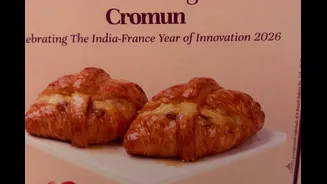
A novel dessert creation, aptly named the 'Cromun,' has become an internet sensation, blurring the lines between French patisserie and Indian confectionery.
This innovative pastry, featuring a classic croissant enveloped around a sweet, syrupy gulab jamun, first gained widespread attention through social media. A user on platform X shared an image of this intriguing treat, sparking immediate reactions. While some were captivated by the sheer audacity of the combination, others expressed apprehension, questioning the marriage of such distinct culinary traditions. The baker described the experience as interesting, noting the gulab jamun's spongy texture within the croissant, though it didn't quite replicate the traditional essence of either component on its own. This bold concept, introduced by a local patisserie, is positioned as a testament to cross-cultural culinary exploration, aligning with broader initiatives celebrating India-France innovation.
A Culinary Collision
The emergence of the 'Cromun' has ignited a passionate discourse online, highlighting the delicate balance between culinary evolution and the reverence for established classics. At its core, this fusion dessert marries the buttery, flaky layers of a French croissant, a symbol of refined baking, with the dense, sugar-syrup soaked goodness of gulab jamun, a cornerstone of Indian sweet traditions. This unexpected pairing has naturally polarized opinions. On one side, there's a wave of curiosity and excitement, with many eager to sample this novel creation and embrace the spirit of culinary experimentation. Comments reveal a keen interest in the textural interplay and the unique flavor profile the 'Cromun' might offer. Conversely, a significant portion of the online community expresses strong reservations, viewing the dessert as an unnecessary deviation from cherished culinary legacies. Debates have surfaced about respecting the integrity of traditional recipes and the potential for such fusions to detract from their original essence.
Internet Divided
The digital landscape has become a battleground for opinions regarding the 'Cromun,' with reactions spanning the full spectrum from enthusiastic embrace to outright dismay. Social media platforms are abuzz with commentary, reflecting a broader societal tension between innovation and tradition in the food world. Some users have reacted with a mix of humorous shock and intrigue, questioning the very concept of combining these distinct items. Phrases like 'how could they do this!' capture a sentiment of playful disbelief. Others have voiced a more earnest curiosity, probing the specifics of the dessert's texture and taste, eager to understand the culinary alchemy at play. However, the conversation also includes more pointed critiques. A segment of users feels that certain culinary icons should remain sacrosanct, with one comment humorously suggesting legal action for 'hurting the sentiments of real gulab jamuns.' This intense reaction underscores the emotional connection many people have with traditional foods and the strong opinions that arise when these are reimagined.
Tradition vs. Trend
The 'Cromun' incident serves as a compelling case study in the ever-evolving landscape of food trends, where innovation often walks a tightrope between exciting novelty and respectful adaptation. While this particular fusion dessert may prove to be a fleeting moment in the culinary spotlight or a lasting testament to creative blending, its impact is undeniable in generating conversation. The debate it has sparked reflects a fundamental human connection to food, tied to memory, culture, and identity. For some, the appeal lies in the thrill of the new, the exploration of unconventional flavor pairings, and the breaking of culinary boundaries. For others, the emphasis remains on preserving the authenticity and cultural significance of traditional dishes, viewing any significant alteration as a potential dilution of heritage. Regardless of its long-term success, the 'Cromun' has successfully captured public attention, igniting a dialogue about what constitutes culinary progress and the enduring value of culinary heritage.