





Secret Ingredients & Speedy Foundations
The Mumbai-Ahmedabad High Speed Corridor, a 508-km undertaking, is a testament to ambitious infrastructure development, with its progress finally materializing
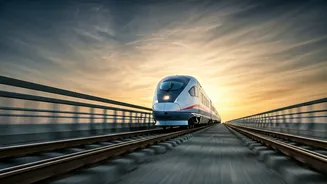
nearly a decade after its inception. This pioneering project, costing Rs 1.98 lakh crore, is the vanguard of India's high-speed rail ambitions, with plans for seven more lines totaling 4,000 km slated for a Rs 16 lakh crore investment. Japan is a pivotal collaborator, providing financial backing through the Japan International Cooperation Agency (JICA) and crucial technical expertise to train Indian engineers. Initially, Japan was set to supply its renowned Shinkansen trains, but indications suggest India is now developing its own bullet trains at a BEML facility in Bengaluru, adapting to evolving project dynamics. The corridor is projected to commence operations by 2029, with the initial 48 km stretch from Surat to Bilimora anticipated for completion by August 2027. A key element in ensuring smooth, high-speed operation involves a specialized Cement Asphalt Mortar (CAM) injection car, a Japanese innovation deployed for the first time in India. This machine meticulously lays a 40-100 mm vibration-dampening layer between the track bed and the rail-supporting slabs. The CAM mixture comprises nine components, three of which—cement, sand, and water—are locally sourced, while the rest, including a proprietary element in the asphalt emulsion, are imported from Japan. This secret ingredient, currently under study by researchers at IIT Kharagpur, is crucial for absorbing the significant vibrations generated by trains traveling at speeds up to 320 km per hour, ensuring both passenger comfort and track integrity.
Elevated Tracks & River Crossings
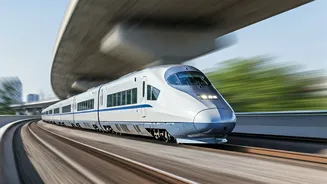
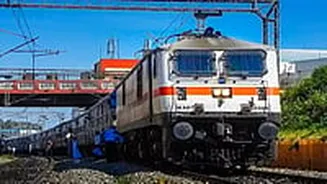
A significant portion of the Mumbai-Ahmedabad High Speed Rail corridor, over 90% of its 508-km length, will be elevated. These viaducts, soaring over 20 meters above ground, will offer passengers a unique perspective, akin to traveling through the sky. This elevated design is a safety imperative, differentiating India's approach from that in some European countries where high-speed trains might run closer to the ground. Unlike conventional broad-gauge lines, which operate at speeds up to 160 kmph and require side barricades, the 300 kmph+ speeds of the bullet train necessitate elevated tracks to prevent any risk from pedestrians or animals crossing. In Ahmedabad, a 480-meter viaduct overlooking the Sabarmati River exemplifies this elevated construction. Building the seven piers for this viaduct involved challenging underwater pile foundations, a complex task requiring the casting of 16 piles for each pier beneath the riverbed. The structural integrity of these bridges is paramount, designed to withstand not only the train's weight but also significant dynamic forces like air resistance, vibrations, and centrifugal effects. Further along the route, a 80-meter-long steel bridge, one of 28 planned, crosses over a road bridge. This 1,004-metric-tonne structure, held together by over 36,000 bolts, is equipped with seismic stoppers to ensure stability during earthquakes. India's railway development journey has been gradual, moving from narrow and metre gauges to broad gauge (up to 160 kmph), and now embarking on high-speed networks. The Ahmedabad station itself is being constructed at an elevated level above existing broad-gauge lines, reflecting this progressive evolution.
Precision Manufacturing & Japanese Expertise
The meticulous construction of the Mumbai-Ahmedabad high-speed rail line relies heavily on precision manufacturing, particularly for its track slabs. At a 14-acre facility in Kim, Surat, workers like Arjun Yadav ensure each track slab, the foundational bed for the high-speed rails, meets exacting standards. A deviation as small as a millimeter in thickness can render a slab unusable. This factory, operational since September 2023, is one of two in Gujarat dedicated to producing these critical components, with a capacity to cast 120 slabs daily. The Vapi-Vadodara stretch alone requires 96,000 track slabs. The manufacturing process integrates Japanese, Italian, and Indian machinery, significantly outperforming Japanese factories in terms of daily output. Japanese collaboration extends to training, with over 1,000 individuals educated by JARTS (Japan Railway Technical Service) for this specific work. Furthermore, 16 Japanese engineers were sent to the Kim facility to train local engineers. This knowledge transfer is also evident at the HSR Depot in Surat-Niyol, where Japanese engineers Hokutu and Nake Mura are training Indian counterparts to operate sophisticated machinery like the wheel lathe. This machine is essential for maintaining the steel wheels of the bullet trains; it reprofiles them by shaving off a thin outer layer to restore their shape, a process crucial as wheels wear down from constant high-speed contact with tracks. A new wheel starts at 860 mm diameter and is retired when it reaches 790 mm. This technology, originating in Germany and refined by Japan, is now being shared with India.
Tunnels & Underground Challenges
As the high-speed rail project ventures into Maharashtra, the terrain shifts dramatically, introducing new engineering complexities. In the Sahyadri foothills near Dahanu, tunnels replace viaducts, with approximately 26.22 km of the 508-km route passing through tunnels, the majority of which—21 km—are located within Mumbai. This includes India's first 7-km undersea tunnel beneath Thane Creek. Excavating through the region's geologically challenging mix of young basalt rock and soil has proven difficult. Tunnel No. 6, a 380-meter mountain tunnel near Basantwadi, faced particular challenges due to minimal overburden, sometimes as little as 14 meters, making excavation precarious. To address this, an advanced automatic, real-time monitoring system has been implemented to preempt potential tunnel collapses. The tunnel's horseshoe-shaped entrance is designed with a hood to gradually release the pressure wave and noise generated by a high-speed train entering the confined space, mitigating sonic booms. Nearby, a massive launching gantry at Gowana village is instrumental in lifting and placing 980-tonne, 40-meter-long girders to construct viaducts. A specially designed 400-tonne, 216-wheel girder transporter facilitates this process, moving girders from casting yards to the gantry. In Mumbai, the tunnel construction beneath Shilphata faced the critical challenge of navigating under vital urban infrastructure, including major water and gas pipelines. Excavation in certain sections with only 20 meters of rock cover, and as little as 4 meters above pipelines, necessitated manual excavation to prevent damage. The tunnel employs an Ethylene Vinyl Acetate membrane from South Korea for waterproofing, an upgrade from earlier PVC membranes. Extensive pre-blast monitoring, involving crackmeters, tiltmeters, and seismometers across nearly 50 buildings, was conducted to assess and mitigate vibrations, ensuring minimal impact on surrounding structures and underground utilities. The project culminates at the Bandra Kurla Complex (BKC), the only underground station, a vast cavernous site that will serve as the terminus, echoing the historic beginning of India's railway journey in Mumbai.