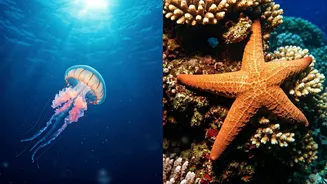







Jellyfish: Ocean Drifters
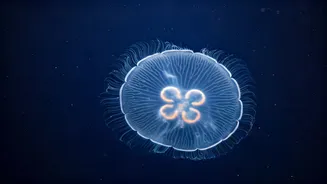
Imagine floating effortlessly through the vast ocean, powered by nothing more than gentle water currents. Jellyfish embody this serene existence, and remarkably,
they do so without a heart. Their translucent, soft bodies are perfectly adapted to a life where circulation isn't driven by a central pump. Instead, the movement of seawater itself is what facilitates the transport of vital oxygen and nutrients throughout their simple structures. This energy-efficient strategy allows them to maintain their slow, deliberate pace of life, a testament to the diverse ways life can flourish in aquatic environments.
Sponges: Ancient Life
As some of the most ancient inhabitants of our planet, sponges offer a profound glimpse into early life forms. These organisms are truly fundamental in their design, completely lacking both a heart and any discernible blood vessels. Their survival hinges on a constant, passive flow of water through myriad tiny pores that perforate their bodies. This continuous aqueous stream serves a dual purpose: it diligently brings essential oxygen and nourishment to their cells, while simultaneously flushing away accumulated waste products. This simple yet highly effective mechanism has allowed sponges to persist and evolve over eons.
Starfish: Water Power
The iconic starfish, with its radial symmetry, navigates its marine world without the need for a pulsating heart. Its secret lies in a sophisticated yet elegant system known as the water vascular system. This network of internal canals allows seawater to circulate, playing a crucial role in movement, enabling the starfish to glide across the seabed. Furthermore, this internal water flow is instrumental in the absorption of oxygen directly from their surroundings and is key to how they capture and process their food. It's a remarkable adaptation for a creature that doesn't have a dedicated circulatory organ.
Sea Urchins: Aquatic System
Similar to their starfish relatives, sea urchins also leverage the power of water to sustain their existence. These spiny marine invertebrates employ a water-based system that is perfectly suited to their slow-paced life on the ocean floor. Seawater is drawn into and circulates throughout their bodies, effectively acting as their circulatory medium. This circulating water is responsible for delivering the necessary oxygen and nutrients required for their metabolic processes, mirroring the function of blood in more complex organisms and ensuring their survival in their specific niche.
Flatworms: Simple Diffusion
Flatworms are masters of simplicity, featuring incredibly thin and flattened bodies that eliminate the need for complex internal transport systems. Their anatomy is so streamlined that essential gases and nutrients can directly diffuse through their cells from the surrounding environment. This direct absorption and distribution process means they don't require a heart or any specialized circulatory network. This efficient diffusion mechanism is a hallmark of their evolutionary path, allowing them to thrive in various environments where such a straightforward biological approach is sufficient.
Hydra: Surface Exchange
The humble hydra, a freshwater invertebrate, demonstrates that a heart is not a universal requirement for life. Its survival is attributed to its remarkably simple body plan. Oxygen and nutrients are readily absorbed and distributed across its entire body surface directly from the surrounding freshwater. This direct exchange mechanism negates the need for a circulatory organ like a heart, proving that basic biological principles can be incredibly effective in sustaining life in suitable habitats.
Roundworms: Tube of Life
Roundworms, also known as nematodes, are a diverse group of creatures found in almost every conceivable habitat on Earth. Their success in such varied environments is partly due to their simplicity, including the absence of a heart. They rely heavily on the process of diffusion within their characteristically tube-like bodies. This allows for the direct uptake and distribution of necessary gases and nutrients, enabling them to survive and reproduce without the need for a complex circulatory system, highlighting the adaptability of simpler life forms.