





Train Travel Overwhelmed
The festive spirit of Holi has triggered an unprecedented demand for train travel, with popular long-distance routes experiencing severe booking constraints.
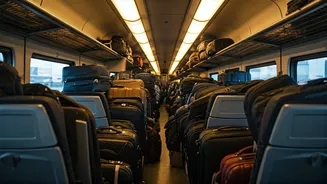
Trains such as the Rajdhani express, vital for connecting major cities, are showing waitlists exceeding a hundred passengers for journeys departing on dates close to Holi. For instance, the Delhi to Patna route on March 2 and 3 has waitlists of 114 and 113 for the DBRT Rajdhani (12424), and 130 and 95 for the Patna Rajdhani (12310) in 3AC respectively. Even specially introduced trains by Indian Railways, designed to alleviate the festive congestion, are finding themselves completely booked. A dedicated train between Delhi and Danapur (Patna) for March is already full, with a waitlist of 10 for 3AC on March 2. Similarly, the Vande Bharat Express on the Delhi-Lucknow route has a waitlist of 74 for March 2 and 42 for March 3 in 3AC, while the Shatabdi Express shows 66 waiting for CC on March 2. A Holi Special train (04214) for March 2 is also fully booked, with a waitlist of 9. The extensive waitlists extend to routes like Delhi to Dibrugarh, where the DBRT Rajdhani (12424) has 97 passengers waiting on March 2 and 49 on March 3 for 3rd AC, and the DBRG Rajdhani (20504) has 84 and 87 waiting for the same dates. This widespread booking crunch underscores the immense pressure on the railway network during peak festival periods.
Airfare Surge Explained
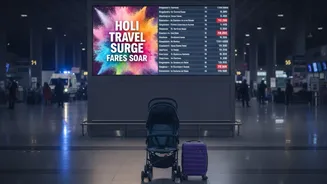
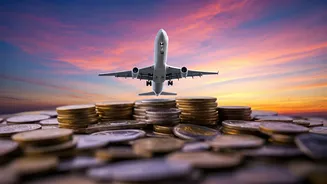
The overwhelming demand for travel during the Holi season has not spared air routes, with significant increases in flight ticket prices observed. Passengers looking to travel from Delhi to Patna on March 2 are facing prices exceeding ₹9,000 for airlines like Indigo and SpiceJet. This trend continues on March 3, with fares escalating to around ₹12,000 during peak morning hours. Journeys from Delhi to Guwahati also see substantial price hikes, with tickets costing over ₹6,000 and ₹7,000 for morning departures on March 2, a similar situation persisting on March 3. Even the popular Delhi to Mumbai route is experiencing a surge, with ticket prices reaching up to ₹5,000 per seat on March 2 and approximately ₹5,400 on March 3. These elevated fares reflect the classic supply and demand dynamics at play during major Indian festivals, where a large number of people aim to travel simultaneously, leading airlines to adjust prices upwards to manage capacity and capitalize on the peak demand. This makes last-minute travel plans exceptionally costly for many.
Special Trains' Limited Impact
In an effort to accommodate the surge in travelers during the Holi festival, Indian Railways had announced the operation of 1244 special train services. These additional trains were scheduled to run from February 25 to March 18, connecting various major cities and regional hubs across different Railway Zones. The aim was to ease the pressure on regular services and provide more options for passengers. Key long-distance connections included routes from Mumbai, Pune, and Nagpur to destinations such as Danapur, Gorakhpur, Hazrat Nizamuddin, Samastipur, and Barauni, catering to a broad swathe of the country. However, despite these augmented services, the sheer volume of passengers intending to travel home for Holi has overwhelmed even these special provisions. Reports indicate that these special trains are also experiencing full bookings and accumulating significant waitlists, demonstrating that the demand for festive travel continues to outstrip the available capacity, even with the introduction of extra services. This highlights the persistent challenge of managing peak travel periods effectively.