




A New Political Challenger
For decades, Tamil Nadu's political arena has been largely defined by a two-party system. However, the emergence of the Tamilaga Vettri Kazhagam (TVK),
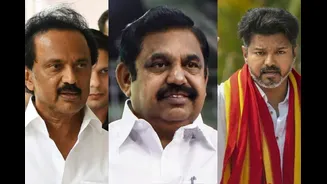
spearheaded by actor Vijay, signals a significant shift, introducing a multi-polar dynamic to the upcoming Assembly elections. Projections suggest that TVK could capture a substantial vote share, potentially ranging from 10% to 20%. While this might not translate into outright victory in its inaugural election, such a bloc of votes holds considerable power to sway results in a state where electoral margins are often razor-thin. This potential disruption is particularly noteworthy given that a significant portion of seats, over 200 out of the state's 234, are mathematically susceptible to the influence of 'third front' parties, a category into which TVK now squarely fits. The analysis of past election data, specifically the 2021 polls, reveals that in a considerable number of constituencies, the combined votes of smaller parties significantly exceeded the winning margin, highlighting the vulnerability of the established political order and the fertile ground for new entrants like TVK.
Demographic Appeal
The TVK's strategy is clearly focused on capturing the youth vote, positioning the 2026 elections as a "generational election." Their manifesto is tailored to attract first-time voters and the crucial 20-40 age bracket, promising initiatives like unemployment support, internship opportunities, interest-free loans, and the establishment of youth advisory councils. This demographic focus is strategically aligned with Tamil Nadu's electoral landscape, where approximately 12.5 lakh individuals are first-time voters, and a substantial 2.28 crore voters fall within the 20-40 age range, constituting nearly 40% of the total electorate. Political observers note that even without the extensive organizational machinery to fully leverage its popularity, TVK's strong connection with the youth could secure it between 10% and 20% of the votes, potentially impacting both the Dravida Munnetra Kazhagam (DMK) and the All India Anna Dravida Munnetra Kazhagam (AIADMK). This broad appeal among younger voters, including first-generation graduates facing job scarcity, young women disillusioned with the major parties, and individuals in regions feeling marginalized by economic development, makes TVK a formidable new force.
Impact on Margins
The influence of third parties in Tamil Nadu's electoral contests has historically been significant, often deciding the fate of seats where margins are narrow. In the 2021 Assembly elections, for instance, there were 127 constituencies where the combined votes of smaller parties like the Naam Tamilar Katchi (NTK), Makkal Needhi Maiam (MNM), and the Amma Makkal Munnetra Kazhagam (AMMK) surpassed the winning margin. The NTK alone achieved this in 83 constituencies. Furthermore, an additional 76 seats saw these smaller parties collectively polling between 50% and 100% of the victory margin. This data underscores the potential for a party like TVK, with its youth-focused agenda, to significantly alter outcomes. For example, in Ponneri, a reserved constituency, the DMK-backed Congress candidate won by just 9,689 votes, while the NTK garnered over 19,000 votes, and the MNM and AMMK combined added more than 8,000 – a total nearly three times the margin of victory. Similarly, in Thiyagarayanagar, a mere 137 votes separated the DMK and AIADMK, while the NTK and MNM together polled over 15,000 votes, illustrating how third-front support can drastically influence close contests. This pattern was observed across various constituencies, indicating that TVK, by tapping into a similar pool of disillusioned voters, could transform bipolar contests into truly multi-cornered fights.
A Different Third Front
Unlike previous third-front initiatives such as the NTK's strong Tamil nationalist stance or the MNM's urban technocratic appeal, the TVK is charting a distinct path. It prioritizes a youth-centric and welfare-oriented agenda with a less pronounced ideological bent. The TVK's manifesto resonates with the language of job creation and career advancement, rather than traditional Dravidian politics or ethnic nationalism. This approach, combined with Vijay's extensive recognition from his decades-long film career, provides him with a level of widespread familiarity that earlier third-front leaders lacked. The TVK's appeal is also broad, resonating with first-generation graduates struggling with unemployment, young women skeptical of the two dominant Dravidian parties, and segments of the population in regions that feel overlooked by the state's development narrative. This differentiated strategy makes TVK a more complex challenge for the established Dravidian parties, as it threatens to draw support from across their traditional voter bases rather than consolidating a niche protest vote. The implications are profound: if TVK garners significant votes, it could potentially redraw the electoral map in ways that current projections, based on the established bipolar dynamic, may not fully capture.