




Understanding the Celestial Dance
A solar eclipse is a captivating astronomical event where the Sun, Moon, and Earth align perfectly. During this cosmic ballet, the Moon journeys between
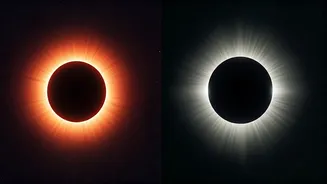
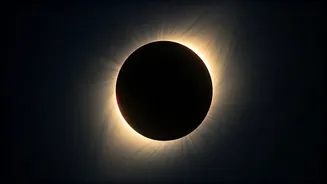
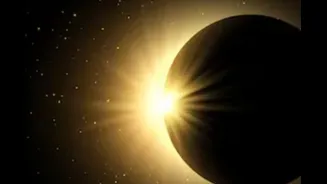
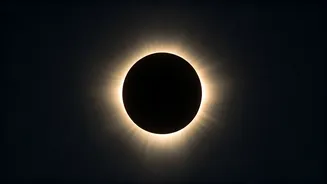
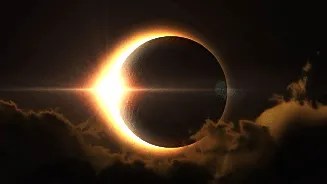
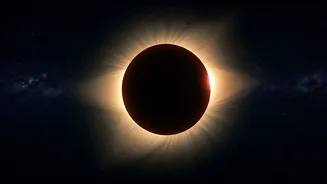
the Sun and our planet, casting a shadow that can obscure the Sun. The intensity of this shadow, and thus the type of eclipse observed, depends on the precise distances and alignment of these celestial bodies. When the Moon is at its farthest point from Earth in its orbit, it appears smaller in the sky and cannot entirely cover the Sun. This particular alignment results in an annular solar eclipse, famously nicknamed the 'Ring of Fire.' Instead of complete darkness, observers are treated to a stunning visual where the Moon creates a dark silhouette against the Sun's bright disc, leaving a brilliant, fiery ring of sunlight visible around its edges. This distinct appearance is what gives the annular eclipse its dramatic and memorable moniker. Unlike a total solar eclipse, daylight never fully vanishes during an annular event because the Sun's disc is only partially hidden.
Key Timings of the Eclipse
Mark your calendars for February 17, 2026, as the first solar eclipse of the year unfolds. This significant celestial event commences at 07:01 UTC, which translates to 12:31 PM in India. The highly anticipated 'Ring of Fire' phase, where the annular effect is most prominent, will begin its spectacle at 11:42 UTC, corresponding to 5:12 PM IST. The eclipse will reach its zenith, showcasing the most dramatic 'Ring of Fire' formation, at 12:12 UTC (5:42 PM IST). This peak moment, however, will be fleeting, lasting for a mere 2 minutes and 20 seconds, emphasizing the importance of precise timing for those hoping to witness it. The entire astronomical display will draw to a close at 14:27 UTC, or 7:57 PM IST, concluding a remarkable celestial performance.
India's Viewability
Regrettably, skywatchers in India will not have the opportunity to witness the February 17, 2026, solar eclipse firsthand. The eclipse's trajectory is primarily situated over the Southern Hemisphere, and at the time of the event, the Sun will be positioned below the horizon for observers in India. This geographical and temporal alignment means that the dramatic 'Ring of Fire' will not be visible from the Indian subcontinent. While the rest of the world might be captivated by this astronomical marvel, India will miss out on this particular celestial show. However, dedicated enthusiasts can still follow the event through live online broadcasts provided by various space agencies and astronomical websites, offering a virtual viewing experience.
Regions Experiencing the Eclipse
The annular solar eclipse of February 17, 2026, promises a spectacular show for numerous locations across the globe, particularly within the Southern Hemisphere. Countries and territories poised to witness this celestial phenomenon include parts of Antarctica, Argentina, Botswana, Chile, and various island nations like the British Indian Ocean Territory, Comoros, Mauritius, Mayotte, and Réunion Islands. Additionally, viewers in Eswatini (Swaziland), Lesotho, Madagascar, Malawi, Mozambique, Namibia, South Africa, South Georgia/Sandwich Islands, Tanzania, and Zambia will also have the chance to experience either the full 'Ring of Fire' or a partial eclipse, contingent on their specific geographical vantage point. The broad visibility across these diverse regions ensures that many can partake in this rare astronomical event.
Live Broadcast Opportunities
For those outside the direct visibility path or who simply wish to experience the event from the comfort of their homes, numerous avenues exist to watch the 'Ring of Fire' solar eclipse live. Major space agencies, including NASA, are committed to broadcasting the event across their official platforms. This live stream is expected to be disseminated through a wide array of reputable astronomy websites globally, making the celestial spectacle accessible to a vast international audience. These online broadcasts offer a safe and convenient way to witness the annular solar eclipse and its awe-inspiring 'Ring of Fire' phenomenon without the need for any specialized viewing equipment. It ensures that everyone with an internet connection can participate in this remarkable astronomical event.