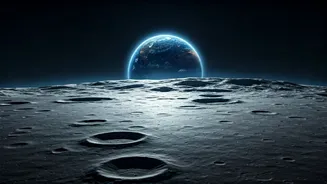

Lunar Laboratory Approach
NASA's strategy involves viewing the Moon as a research base, a strategic location offering a unique perspective on Earth's history. The goal is to study
the lunar surface, specifically searching for clues about the presence of water, frozen or otherwise. The Moon's untouched environment can preserve traces of water-bearing asteroids and comets that collided with both celestial bodies billions of years ago. These impacts could have delivered water to both the Moon and Earth. By analyzing the lunar regolith and its composition, scientists expect to find evidence that helps them trace water's source, composition, and distribution patterns across the solar system, which includes the planet we call home.
Water's Interstellar Journey
The research focuses on the idea that much of Earth's water may have originated from space, perhaps brought here by asteroids and comets. Studying the lunar samples, scientists intend to compare their composition with the water found on Earth. This comparison helps establish connections and potentially trace the source of our planet's oceans, lakes, and rivers. This requires careful analysis of isotopes within water molecules. Isotopes are variations of an element that have different masses. By identifying the specific isotope signatures in both lunar and terrestrial water, researchers can better determine whether they share a common origin. This process might involve detailed examination of lunar rocks and ice deposits.
Decoding Lunar Clues
NASA utilizes advanced technologies and extensive data analysis to extract hidden information. The Lunar Reconnaissance Orbiter (LRO) is a critical part of this. LRO collects detailed images and data about the lunar surface, including the distribution of hydrogen, a key element in water. This information is vital for identifying potential water ice deposits in permanently shadowed craters. Moreover, other instruments, such as the Neutron Detector on LRO, detect the presence of hydrogen by measuring the number and speed of neutrons reflected from the lunar surface. These measurements show areas that have elevated amounts of hydrogen, suggesting the possible existence of water ice. Ground-based telescopes and robotic missions are also deployed to gather data, providing a comprehensive understanding of the Moon.
Impact and Timeline
The analysis of the Moon also helps understand the chronology of water delivery to Earth. Scientists believe that the bombardment of asteroids and comets occurred during a period called the Late Heavy Bombardment, roughly 4.1 to 3.8 billion years ago. By dating the lunar samples, researchers can estimate when water-bearing objects impacted the Moon and, by implication, Earth. Understanding the timing and intensity of this bombardment is vital. This knowledge offers insight into the evolution of Earth's early atmosphere and the conditions that might have facilitated the emergence of life. This can give clues about the evolution of Earth's atmosphere and the conditions required for life to flourish. The lunar research thus offers essential clues regarding this critical time in planetary development.
Future Mission Relevance
NASA's work on the Moon doesn't just benefit its own understanding of Earth; it also lays the groundwork for future space exploration. The data gathered from the Moon will guide the development of technologies needed to find and use water in space. For example, knowing the location of water ice on the Moon is critical for building lunar bases and supporting long-duration missions to other planets. Water can be converted into breathable air, rocket fuel, and drinking water, making it a valuable resource. NASA's commitment to the Moon is thus a part of its wider vision of space exploration, including sending humans to Mars and beyond. The lunar missions are therefore stepping stones toward more extensive and sustainable space operations.