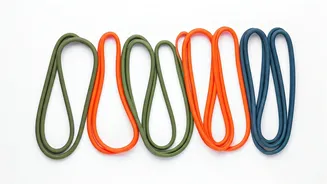

Introduction: Why Bands?
Resistance bands are a versatile and accessible way to exercise. They're beneficial for diverse fitness levels, from beginners looking to start gentle
movement to experienced individuals who need to maintain their activity level during the winter. Their portability also allows people to continue their workouts even when they are unable to go to the gym. These bands assist in muscle engagement and can be incorporated into a daily routine, offering a practical tool to keep your body active during winter months.
Band Option 1: Fabric Bands
Fabric resistance bands are known for their durability and comfortable grip. These bands are crafted with durable fabric and are suitable for exercises such as squats, glute bridges, and leg exercises. The fabric material avoids the band rolling up while exercising and the robust build can handle extensive use. Their design makes them very effective for lower-body workouts, helping to build strength in the glutes, thighs, and hamstrings. These bands are usually color-coded, allowing users to select the band based on the level of resistance they want for their workout.
Band Option 2: Loop Bands
Loop resistance bands are the most common type, and they are lightweight and perfect for a range of activities. Their simple design makes them easy to use, while the rubber design gives them a lot of flexibility. Typically, they come in different resistance levels, which makes them suitable for a wide range of exercises. These bands are often used for warm-up exercises, helping to activate and prepare muscles before more intensive exercises. Loop bands can enhance the intensity of exercises like lateral walks, bicep curls, and shoulder exercises, promoting strength and flexibility.
Band Option 3: Tube Bands
Tube resistance bands feature handles, making them ideal for upper-body workouts. The handles provide a comfortable grip, enabling a wider range of exercises such as chest presses, rows, and shoulder raises. These bands provide an efficient way to tone the muscles. They are often favored for their versatility. Tube bands are a step-up from loop bands because of their handles. They can be anchored to a door or other stable objects, allowing more complex and advanced workouts. This adds an additional level of difficulty to the exercises. This option is great for those who want a varied upper-body exercise that is simple to incorporate into a home setting.
Band Option 4: Figure-8 Bands
Figure-8 resistance bands are perfect for targeted exercises aimed at the arms and shoulders. The unique figure-8 design provides handles for each end, which aids in controlled movements and isolation. Exercises that use this band can include bicep curls, tricep extensions, and shoulder rotations. The shape of the band makes it easy to hold and use, which keeps them user-friendly for people who are new to fitness training. These bands are a good choice to build targeted muscles and improve posture. Their ability to isolate muscles makes them an important tool for strengthening and toning the upper body in a simple manner.
Band Option 5: Therapy Bands
Therapy resistance bands, often thin and flat, are designed for rehabilitation and gentle exercises. They're excellent for flexibility and improving range of motion without putting stress on joints. These bands often come in a set with varying resistance levels, allowing users to adapt the exercise intensity based on their needs. The gentle resistance makes them an ideal choice for people recovering from injuries, seniors, or anyone seeking a low-impact form of exercise. These bands are used to improve flexibility and aid in the recovery process, which makes them a beneficial tool for overall wellness.
Band Option 6: Mini Bands
Mini bands, also known as short loop bands, are similar to loop bands but smaller in size. They are mainly used for lower-body workouts, focusing on glutes, hips, and legs. Because of their portability, they make it easy for users to incorporate them into workouts for a high intensity exercise with minimal space. They are often used for lateral walks, clam shells, and glute bridges. Mini bands can easily add extra resistance to exercises. The compact design makes them a good option for travelers and individuals with limited space, which makes them a flexible option for people who want to stay active, regardless of their location or available space.
Band Option 7: Adjustable Bands
Adjustable resistance bands usually come with a set of handles and resistance tubes that can be swapped out. This option offers a wide range of resistance levels, adapting to the user's progress. This versatility makes them suitable for multiple exercises involving the whole body. The bands are durable and provide a stable workout experience. They're often bundled with door anchors and ankle straps, expanding the exercises people can do. This allows people to progressively increase their workout intensity. Adjustable bands help users to customize their workouts to match their individual fitness goals.
Band Option 8: Power Bands
Power bands, also known as pull-up assist bands, are generally thicker and stronger than other bands, offering a higher level of resistance. They're often used to assist with pull-ups, dips, and other bodyweight exercises. Also, they can be utilized for strength training exercises. They give a higher level of support to people as they develop their strength. These bands can be used to add resistance to exercises like squats and bench presses. Power bands, due to their strength and versatility, are an ideal option for people who want to enhance the intensity of their workouts and develop their strength.