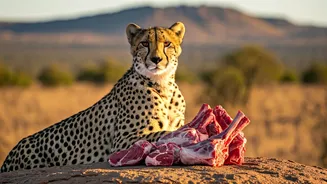








The Costly Cat Diet
In an astonishing revelation that has ignited a political debate, Madhya Pradesh's Chief Minister, Mohan Yadav, disclosed the substantial expenditure allocated
for the sustenance of cheetahs at Kuno National Park. Answering queries in the State Assembly, it was stated that a sum of Rs 1,27,10,870 was allocated for the purchase of goat meat during the 2024-25 fiscal year. When this figure is averaged across 365 days, it translates to an average daily expenditure of roughly Rs 34,825, rounding up to an impressive Rs 35,000 per day. This significant outlay is specifically for the meat required to feed the cheetah population, which currently comprises 35 individuals, including adults, semi-adults, and those born within India. The figures emerged in response to specific questions raised by Congress MLA Mukesh Malhotra concerning the financial aspects of Project Cheetah.
Funding Unveiled
A crucial detail emerging from the government's statement is the absence of a dedicated budget specifically earmarked for cheetah food. Instead, funds are reportedly reallocated from other budgetary heads as and when the need arises. This financial flexibility, while perhaps ensuring the animals' needs are met, has also become a point of contention. Furthermore, the government indicated that there isn't a rigidly fixed number of goats supplied for consumption each day. The feeding regimen is dictated by veterinary assessments and ongoing monitoring, ensuring that the quantity of meat provided aligns with the specific health and dietary requirements of each cheetah. This approach suggests a tailored feeding plan rather than a one-size-fits-all solution, with the primary objective being the well-being of the relocated big cats.
Project Cheetah's Journey
Kuno National Park embarked on its ambitious journey as India's inaugural sanctuary for African cheetahs on September 17, 2022, when Prime Minister Narendra Modi ceremonially released eight cheetahs that had been brought from Namibia. This initial introduction was followed by a significant expansion of the program in February 2023, with an additional twelve cheetahs arriving from South Africa. These arrivals marked a pivotal moment in India's extensive efforts to reintroduce cheetahs into the wild. The project continues to evolve, with plans for further translocations. Currently, eight more cheetahs from Botswana are scheduled to arrive, further diversifying the genetic pool. Beyond Kuno, the Gandhi Sagar Wildlife Sanctuary in western Madhya Pradesh has also been identified as a secondary habitat for these big cats, currently housing a male coalition and a female cheetah from South Africa, underscoring the multi-faceted approach to cheetah conservation in India.
Addressing Concerns
In response to questions about potential food scarcity impacting the cheetahs, the government firmly denied any such allegations, asserting that a dedicated monitoring team is actively engaged in round-the-clock surveillance to ensure the animals' welfare. The specific query regarding the death of a leopard in a road accident on December 6, 2025, was clarified by the government, attributing the fatality solely to the accident and explicitly ruling out any connection to food shortages. While acknowledging that leopards, in their natural roaming patterns, might occasionally prey on cattle in nearby villages, the government stated that no punitive actions would be taken against officials. This statement aims to reassure the public and address any concerns that might arise from the proximity of wildlife to human settlements.