


A Diminished Arrival
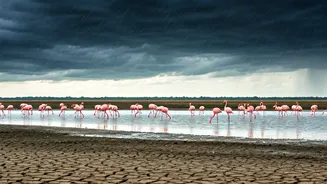
Each year, the Ujani dam's shallow waters near Kumbhargaon transform into a dazzling pink panorama, attracting thousands of greater flamingos from November
to April. This avian spectacle is a crucial economic driver for local communities, supporting boatmen, hoteliers, and guides. However, this past season, the anticipated avian guests were conspicuously absent, with only a fraction of the usual numbers observed. Nitin Dole, a local bird guide, reported sightings of merely 200 to 250 greater flamingos, a stark contrast to previous years, and even these were transient, staying only a few days. This drastic reduction has severely impacted tourism and livelihoods dependent on the flamingo season, leaving many local businesses struggling.
Data and Observations
The Bombay Natural History Society (BNHS) has been meticulously tracking flamingo populations in the Bhigwan area since 2021, consistently recording over 1,000 bird visits annually, with some years exceeding 2,000. However, their data from June 2025 to April 2026 reveals a significant downturn, with only small, fleeting flocks of 20 to 30 individuals observed from January onwards. While the forest department acknowledges the decrease, exact figures are unavailable. Range Forest Officer Bhagyashree Thakur attributes the decline primarily to the unusually heavy rainfall during the preceding monsoon. This deluge led to significantly elevated water levels in the Ujani dam, creating conditions unsuitable for flamingos, as the increased depth hinders their access to algae, their primary food source, prompting them to seek alternative habitats.
Migratory Triggers Unmet
Greater flamingos typically journey south to regions like Maharashtra, Karnataka, and Tamil Nadu from their primary breeding grounds in Gujarat's Rann of Kutch and Rajasthan's Sambhar Lake. This southward migration is usually triggered when water levels in these northern wetlands recede, reducing food availability. This year, the critical trigger point for migration was not reached in time. Wildlife photographer Sanjeev Phadtare, a long-time visitor to Bhigwan, corroborates this, noting that water is usually released from the Ujani dam in late January, lowering the water levels to the flamingos' preferred shallow conditions. Despite water release this season, the levels remained elevated, deterring the birds. By the time conditions might have become slightly more favorable, the main migration season had already passed, leading to disappointment among both wildlife and enthusiasts.
Climate and Habitat Shifts
Beyond the immediate impact of the wet monsoon, deeper environmental concerns are at play. Climate change is increasingly influencing migratory bird patterns, with monsoons arriving earlier and persisting longer, as seen with last year's rainfall extending into November. Furthermore, rising temperatures in regions like Siberia mean flamingos can find adequate food further north, reducing their impetus to undertake long-distance migrations. Phadtare also highlights the impact of habitat loss due to development. Grasslands around Baramati, crucial for various species including raptors and harriers, are being disrupted by projects like solar plant installations. This encroachment on natural habitats contributes to a steady decline in sightings of many bird species, underscoring the urgent need for development practices that prioritize environmental conservation alongside progress.
A Hopeful Wait
For the residents of Kumbhargaon, the current season has been one of quiet anticipation. The boat guides, hoteliers, and photographers who rely on the annual flamingo influx are now looking towards the next winter with hope. Their collective wish is for more favorable water levels in the Ujani dam, conditions that will once again draw the thousands of greater flamingos that have long been a signature of Bhigwan's landscape. The community remains optimistic that the natural cycle will reassert itself, bringing back the vibrant pink spectacle and the economic vitality it represents.