







The Melody Road Concept
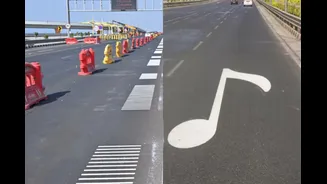
Mumbai embarked on a unique infrastructure endeavor, aiming to be the first in India to feature a 'musical road.' This innovative concept involved meticulously
crafting rumble strips on a specific stretch of the Coastal Road, between Nariman Point and Worli. The intention was for these precisely cut grooves to interact with vehicle tires traveling at an optimal speed of 70 to 80 kmph, producing the iconic notes of AR Rahman's Oscar-winning song, 'Jai Ho.' The auditory experience was designed to be so potent that the melody would remain discernible even with car windows closed. This ambitious project, brought to life with technical collaboration from Hungarian specialists and commissioned by the Brihanmumbai Municipal Corporation (BMC), cost an estimated Rs 6.21 crore. The underlying principle of melody roads originated in Japan in 2007, where engineer Shizuo Shinoda observed that road surface grooves could generate musical tones when traversed at specific speeds. Following this discovery, several countries, including Hungary, South Korea, and the UAE, have implemented similar road features, with Mumbai's installation marking the fifth known instance globally. The inauguration itself was a significant event, with Chief Minister Devendra Fadnavis personally experiencing the sonic drive.
When Music Became Noise
The initial excitement surrounding Mumbai's musical road proved short-lived for the residents living in close proximity to the innovation. The enchanting melody, intended to enhance the driving experience, quickly transformed into a significant disturbance. Noise levels within residential homes along the stretch were recorded between 60 to 65 decibels, leading to an overwhelming surge of over 650 formal complaints lodged by aggrieved residents. The severity of the issue prompted the Advanced Locality Management of Breach Candy to formally address the Maharashtra government and the BMC Commissioner, urgently requesting intervention. Following a thorough review of the situation and a pilot study involving weekend barricading, the civic body made the decisive move to implement nightly closures of the musical road. Consequently, this particular segment of the Coastal Road is now entirely inaccessible to traffic from 10 pm to 7 am. While this measure has brought much-needed quiet to the residents' evenings, it introduced a new, unforeseen operational challenge: the daily deployment and management of staff to erect and dismantle barricades. This ongoing logistical cost was an aspect that apparently was not factored into the initial planning or budget of the project.
Public Outcry and Online Debate
The repercussions of the musical road project extended beyond local complaints, igniting a widespread discussion and criticism across social media platforms. Online commentary ranged from dry observations to outright condemnation, with many users questioning the rationale and execution of the project. One prominent sentiment, expressed by X user @RoadsOfMumbai, highlighted the perceived absurdity: 'First create a problem that does not exist, then create a solution to that problem. Petty planning, petty infrastructure.' The origins of the idea also came under scrutiny, as @ugach_kahitarii pointed out that the proposal had originated from the Hungarian Consulate to the BMC, with an assurance that it would enhance the driving experience. The user lamented, '6.21 crore down the drains.' The cost associated with the project became a focal point, especially when contrasted with the prevalent issues faced by Mumbai's roads. User @priya_27_ drew a stark comparison, criticizing the allocation of funds towards 'unnecessary stuff' while basic road repairs were neglected. The sentiment that the project's beneficiaries were those in affluent areas was also voiced, with @iNikhilsaini advocating that the individual responsible for the concept should personally bear the Rs 6 crore expenditure. Some users even invoked economic principles, like @asthan82911 referencing Austrian economist Ludwig von Mises to argue that the fiasco exemplified a common governmental failing in decision-making without adequate market feedback mechanisms.
Misplaced Priorities Symbol
The Rs 6.21 crore musical road project in Mumbai has become a potent symbol of misplaced priorities, particularly when viewed against the backdrop of the city's notoriously poor road conditions. Mumbai's roadways are frequently characterized by deep potholes, susceptibility to flooding during the monsoon season, and persistent, often prolonged, repair work. In this context, a significant sum was allocated to an installation that was intended to play music at a specific speed, only to require silencing during nighttime hours due to noise pollution. The initiative, therefore, serves as a stark reminder of where public funds are being directed. While the residents living near the Coastal Road have regained their peace and quiet evenings, the broader public is left with a tangible example of what could have been achieved with the same financial outlay. The Rs 6 crore could have potentially addressed numerous critical infrastructure needs, such as repairing extensive stretches of damaged roads, improving drainage systems to mitigate waterlogging, or enhancing other essential public amenities that directly impact the daily lives of millions of Mumbaikars. The musical road, therefore, represents not just a flawed engineering project, but a more significant commentary on urban planning and resource allocation within the city.