







The Purity Code
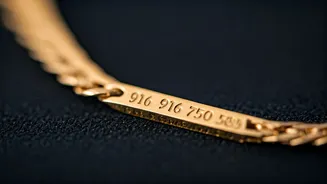
Tiny engravings on your cherished gold pieces, like rings and necklaces, often go unnoticed or are mistaken for simple serial numbers. However, these small
markings are actually crucial indicators of the gold's purity, directly influencing its value and suitability for various jewelry types. Understanding these numerical codes is your key to making informed decisions when buying gold, ensuring you receive genuine value for your investment. It’s a simple yet powerful way to navigate the world of precious metals with confidence and clarity.
916: India's Gold Standard
In India, the number 916 is a familiar sight on gold jewelry, signifying that the piece is composed of 91.6 percent pure gold. This proportion is equivalent to 22 karats on the traditional purity scale. The remaining 8.4 percent is intentionally alloyed with other metals, such as copper, silver, or zinc, to enhance the jewelry's durability and make it more robust for everyday wear. This specific purity level is the most commonly chosen for crafting traditional Indian ornaments, balancing beauty with resilience.
750: The Gemstone Setter's Choice
When you encounter the marking 750 on gold jewelry, it indicates a composition of 75 percent pure gold. This translates to 18 karats on the karat scale. This particular blend is highly favored for settings that feature diamonds and other precious gemstones. The reason behind this preference lies in its enhanced hardness and greater resilience compared to higher karat gold. This makes it a more secure and durable choice for holding intricate and valuable stones in place without compromising the overall integrity of the piece.
585: Modern Elegance
A gold item stamped with 585 is made up of 58.5 percent pure gold, which corresponds to 14 karats. This alloy is frequently utilized in the creation of contemporary and lighter-weight jewelry designs. Its composition offers a good balance between purity, durability, and affordability, making it a popular choice for fashion-forward pieces that are designed for both style and everyday wearability.
999: Purest Gold
The marking 999 denotes the highest level of gold purity available, consisting of 99.9 percent pure gold. This is referred to as 24-karat gold. While this is the purest form of the precious metal, it is exceptionally soft and malleable, making it unsuitable for most intricate jewelry designs that require structural integrity. Consequently, 24-karat gold is more commonly found in investment forms like coins and bars, where its purity is the primary consideration.
BIS Hallmarking Assurance
In India, gold jewelry's purity is officially guaranteed through the hallmarking system, which is overseen by the Bureau of Indian Standards (BIS). A BIS hallmark serves as an independent verification that the declared purity of the gold has been rigorously tested and confirmed. Modern hallmarked jewelry typically displays the official BIS logo, the precise purity mark (such as 916 or 750), and a unique six-digit Hallmark Unique Identification (HUID) code. This HUID code allows consumers to verify and trace their jewelry's authenticity, adding a layer of trust and transparency to the purchase.