



The Allure of the Parade
February is set to be a banner month for stargazers, largely due to the widespread excitement surrounding a phenomenon described as a "rare planetary alignment"
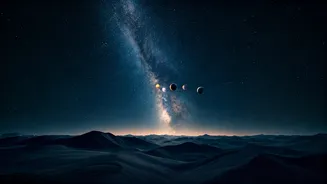
or, more dramatically, a "planet parade." This phrase has rapidly become a popular astronomy term, joining other well-known celestial events like supermoons, meteor showers, and solar eclipses. The current focus is on multiple planets becoming visible in the sky concurrently after sunset, inspiring people to look upward. The concept of a planet parade isn't entirely novel; a similar surge of public interest occurred in early 2025 when Mars, Jupiter, Saturn, Venus, Uranus, and Neptune were technically positioned above the horizon on the same nights. However, the reality of observation often means that only a select few of these distant worlds can be clearly discerned without specialized equipment, setting the stage for the February 2026 event where Mercury will substitute for Mars in the lineup, once again prompting questions about practical viewing expectations.
What the Alignment Truly Offers
Astronomers have pinpointed Saturday, February 28, as the prime date for this month's significant planetary alignment. In the period shortly after the sun dips below the horizon, an impressive six planets—Mercury, Venus, Saturn, Jupiter, Uranus, and Neptune—will be situated within the evening sky. While this arrangement sounds magnificent, experts advise caution regarding the interpretation of the word "see." Several of these planets will be positioned very low on the western horizon, close to the fading glow of the setting sun. Consequently, achieving clear skies, possessing an unobstructed view of the west, and precise timing will be absolutely crucial for any chance of observation. Even with these ideal conditions, it's improbable that the average observer will be able to identify all six planets using only their unaided eyes. Venus and Mercury will be the lowest in the sky and among the first to vanish into the twilight. Venus, though brilliantly luminous, will be very near the horizon, while Mercury, considerably dimmer, might offer a slightly better chance of spotting earlier in the month. Saturn will be in proximity, but its diminishing brightness renders it less conspicuous than in the past. Neptune and Uranus present even greater viewing challenges; binoculars or a small telescope will be necessary for their detection. Jupiter, notably bright and easily visible, is anticipated to be the most straightforward planet to locate and will likely serve as the highlight for the majority of viewers. Further enhancing the spectacle, the Moon, in its bright phase, will ascend later in the evening, illuminating the eastern sky. While its presence might pose a minor obstacle for those intently searching for planets, it will undoubtedly add its own beauty to the night.