



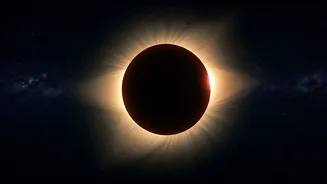

Virtual Eclipse Experience
For those eager to witness the awe-inspiring celestial event of the annular solar eclipse, aptly nicknamed the 'Ring of Fire,' Google has introduced an engaging
interactive animation. This feature allows anyone with a desktop to simulate the phenomenon, offering a dynamic visual representation of the Moon traversing the Sun. To access this digital spectacle, users simply need to open the Google Chrome browser and search for 'solar eclipse' or 'Surya Grahan.' Upon entering the query, a compelling graphic overlay materializes, depicting the Moon obscuring the Sun and vividly illustrating the Sun's outer atmosphere, known as the corona. This innovative tool serves as an educational aid, demystifying the mechanics of such astronomical alignments for a wider audience.
Understanding Annular Eclipses
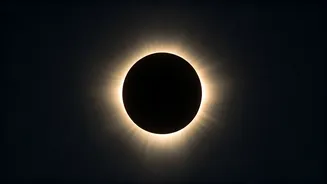
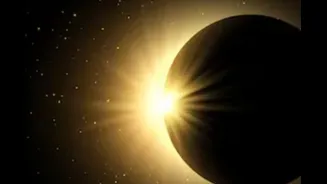
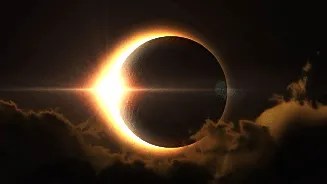
An annular solar eclipse, like the one captivating observers, occurs under specific orbital conditions. According to NASA's explanations, this phenomenon happens when the Moon is positioned at or near the furthest point in its orbit around Earth. Due to this increased distance, the Moon appears smaller in the sky, and consequently, it cannot completely obscure the Sun. Instead, a sliver of the Sun remains visible around the Moon's silhouette, creating a striking visual effect that resembles a fiery ring. This distinctive appearance is the origin of the popular moniker, the 'Ring of Fire.' It's a precise alignment where the Sun, Moon, and Earth form a nearly perfect line, with the Moon positioned centrally in front of the Sun.
Visibility & Indian Perspective
It is important to note that the February 17th annular solar eclipse will not be visible from India. The specific celestial alignment is taking place in the Southern Hemisphere, meaning it will occur below the horizon for Indian viewers. The primary locations expected to witness the maximum phase of this eclipse are research stations in Antarctica, such as Concordia and Mirny. Additionally, parts of southern Africa will have the opportunity to observe the event. Countries like South Africa, Tanzania, Zambia, and Zimbabwe are anticipated to experience varying degrees of partial visibility, offering a glimpse of this rare cosmic dance for those fortunate enough to be in these regions.
Superstitions vs. Science
Alongside the scientific fascination surrounding eclipses, particularly in India where they are known as 'Surya Grahan,' various beliefs and superstitions often surface. In Hindu mythology, the Sun is revered as a fundamental life-giving force. Consequently, its temporary disappearance during an eclipse is sometimes interpreted as an inauspicious omen, potentially signifying misfortune. To counteract these perceived negative influences, traditional rituals are frequently performed by many individuals. It is crucial to distinguish these cultural beliefs from factual information regarding the event itself.
Essential Viewing Safety
From a medical and scientific standpoint, the genuine risk associated with observing a solar eclipse, or 'Surya Grahan,' lies in looking directly at the Sun without appropriate eye protection. Even when the Sun is partially covered, its intense ultraviolet (UV) rays can inflict severe damage on the retina, a condition known as solar retinopathy. This can manifest as blurred vision, the appearance of blind spots, or in severe cases, permanent visual impairment. Standard sunglasses are entirely inadequate and unsafe for eclipse viewing. Experts universally recommend the use of certified solar eclipse glasses or specialized solar filters designed to block harmful radiation. Furthermore, protecting your skin from UV exposure by applying sunscreen, wearing protective clothing, and limiting direct time spent under the sun is also advisable.