






V2V Technology Explained
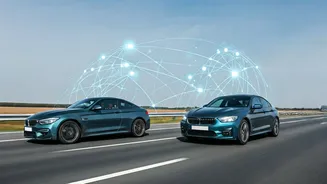
Vehicle-to-vehicle (V2V) technology represents a significant advancement in automotive safety. At its core, V2V facilitates communication between nearby
vehicles using wireless signals. These signals transmit data about a vehicle's speed, location, direction, and braking status. This information is constantly exchanged, creating a real-time network of awareness on the road. For instance, if a vehicle suddenly brakes or encounters a hazard, it immediately broadcasts a warning to other V2V-equipped vehicles in the vicinity. This allows drivers to react more quickly to potential dangers, such as sudden stops, blind spots, or approaching emergency vehicles. The technology aims to prevent collisions by providing drivers with advanced warnings, thereby increasing reaction time and reducing the likelihood of accidents. It’s a proactive measure designed to create a safer driving environment for all road users.
How It Works
The functionality of V2V technology depends on dedicated short-range communications (DSRC), a type of wireless communication. Vehicles equipped with DSRC transceivers constantly exchange data, typically several times per second. This rapid exchange ensures that all participating vehicles possess an up-to-date awareness of their surroundings. When a vehicle detects a potential hazard, such as a sharp turn or an icy patch, the V2V system broadcasts an alert, which is received by other vehicles nearby. These alerts are displayed through in-vehicle systems, such as dashboards or heads-up displays, providing drivers with crucial warnings. This allows drivers to take corrective actions, such as slowing down or changing lanes, to avoid potential collisions. The continuous exchange of information and real-time alerts form the foundation of a comprehensive safety network, aiming to reduce the risk of accidents by providing drivers with critical information about road conditions and the behavior of other vehicles.
Potential Benefits
The introduction of vehicle-to-vehicle (V2V) technology promises a multitude of benefits for road users in India. One of the most significant advantages is the potential for a substantial reduction in accidents. By providing drivers with real-time warnings of potential hazards, V2V can significantly increase reaction times and reduce the likelihood of collisions. This proactive approach to safety could be particularly beneficial in congested urban areas, where accidents are more common. Another advantage of V2V is its ability to enhance traffic flow. By enabling vehicles to communicate and coordinate their movements, the technology can help to reduce traffic congestion and improve overall efficiency on roadways. Furthermore, V2V systems can improve driver awareness by providing information about blind spots, approaching emergency vehicles, and upcoming road conditions. This enhanced awareness can also lead to a more relaxed and less stressful driving experience, contributing to overall safety. The widespread adoption of V2V technology could result in a more efficient, safer, and user-friendly driving experience for all.
Implementation Challenges
While the benefits of vehicle-to-vehicle (V2V) technology are clear, several challenges must be addressed to ensure successful implementation in India. One primary concern is the cost of integrating V2V systems into existing and future vehicles. The technology requires specific hardware, including transceivers and onboard computers, which can add to the overall cost. Additionally, there are infrastructure-related challenges. For V2V technology to function optimally, a robust network of roadside units and data collection systems is needed. These units must be strategically placed to ensure adequate coverage and reliable communication. Another concern revolves around cybersecurity. As V2V systems rely on wireless communication, they are vulnerable to hacking and cyberattacks. Security protocols must be developed to protect against unauthorized access and data breaches. Addressing these challenges is crucial to ensuring that the rollout of V2V technology is both effective and sustainable.
Future Outlook
The future of vehicle-to-vehicle (V2V) technology in India appears promising, with the potential to reshape the landscape of road safety. As the technology matures, it is anticipated to become more affordable and widely adopted. Government initiatives and public-private partnerships will likely play a key role in promoting its implementation. Integration with autonomous driving systems could be the next logical step, where V2V data could significantly enhance the capabilities of self-driving vehicles, providing them with more comprehensive information about their surroundings. Furthermore, advances in wireless communication, such as 5G, may further improve the performance and reliability of V2V systems. The evolution of V2V technology is expected to create a safer, more efficient, and connected transportation ecosystem, benefiting both drivers and society as a whole. As India embraces technological advancements, V2V could become a cornerstone of the nation’s efforts to reduce road accidents and improve overall road safety.