






Dramatic Dark Foliage
The Black Elephant Ear presents a striking departure from typical greenery with its almost entirely black leaves. This deep pigmentation isn't a natural
occurrence but rather a result of careful breeding, lending the plant a distinct, almost gothic aesthetic. This unique characteristic sets it apart, creating a visually arresting specimen that often becomes a focal point in gardens and collections, demonstrating how selective cultivation can lead to dramatic alterations in plant appearance.
Carnivorous Cobra Lily
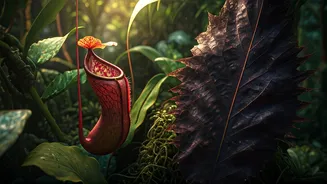
Evolving into a sophisticated predator, the Cobra Lily features uniquely shaped, tubular leaves that strongly resemble a striking snake. These modified leaves act as a trap, luring unsuspecting insects into their depths with visual cues and a slippery interior. Once inside, downward-pointing hairs prevent escape, effectively ensnaring the prey. This remarkable adaptation allows the plant to supplement its nutrient intake, particularly in environments where soil nutrients are scarce, showcasing a fascinating example of floral ingenuity.
Ethereal Ghost Plant
The Ghost Plant possesses an otherworldly appearance due to its pale, nearly transparent leaves, a direct consequence of its lack of chlorophyll. Unlike most plants, it foregoes photosynthesis as its primary survival strategy. Instead, it thrives by parasitically drawing sustenance from surrounding fungal networks. This unusual lifestyle gives it a spectral, almost luminous quality, making it a truly unique and intriguing botanical specimen that challenges our perception of plant life.
Fiery Japanese Grass
Japanese Blood Grass introduces a vibrant splash of color with its blades tipped in a vivid red, creating the illusion of a plant aflame. This striking visual display, while eye-catching, carries a cautionary note. Related varieties of this grass are known for their invasive tendencies and high flammability, suggesting that its dramatic appearance might be linked to more complex ecological behaviors and potential risks in certain environments.
Camouflaged Living Stones
Living Stones, or Lithops, are masters of disguise, featuring thick, fleshy leaves that bear an uncanny resemblance to ordinary pebbles. This remarkable camouflage is a critical survival mechanism in their arid native habitats, effectively shielding them from herbivores eager to consume their succulent tissues. Their ability to blend seamlessly with their surroundings highlights one of the most ingenious forms of natural deception found in the plant kingdom.
Parasitic Witches' Hair
Witches' Hair presents a foliage form that is almost unrecognizable as traditional leaves, appearing more like a tangled mass of spaghetti. This highly specialized plant operates as a parasite, twining itself around other host plants to extract essential nutrients. Its survival strategy is further enhanced by an advanced ability to 'smell' and identify suitable hosts, demonstrating a complex interaction within its ecosystem.