



Amritsar to Attari: A Historic Hop
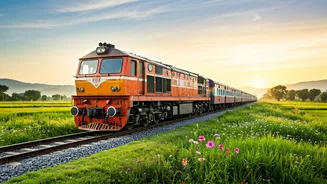
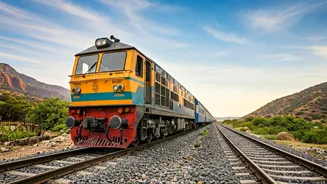
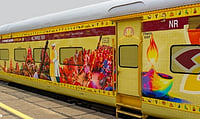
This brief 25-kilometer rail excursion from Amritsar to Attari, costing a mere ₹10, unfolds in about 40-45 minutes. The train makes intermediate stops
at Chheharta and Khasa before arriving at Attari, a town situated remarkably close to the international frontier. Historically, this very railway line served as a crucial link between Amritsar and Lahore before the subcontinent's division in 1947. Were it not for the present-day border, Lahore would be a mere 30-minute extension of this same track. The journey itself offers expansive vistas of verdant agricultural fields and quaint rural hamlets. Near Khasa, passengers might even observe training exercises conducted by the Border Security Force. The Attari railway station is a testament to colonial-era architecture, featuring an international platform that once facilitated cross-border train services between India and Pakistan. The primary draw for visitors here is the renowned Attari–Wagah border ceremony. Surrounding areas of interest include the village of Sarai Amanat Khan, Pul Kanjri constructed by Maharaja Ranjit Singh, and Sham Singh Attari Park, which houses a museum dedicated to the celebrated Sikh general. The train services operate twice daily in each direction: from Amritsar to Attari at 07:30 am and 06:20 pm, and from Attari to Amritsar at 08:20 am and 07:15 pm.
Amritsar to Dera Baba Nanak: Pastoral Charm
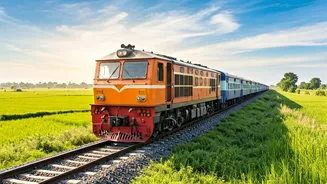
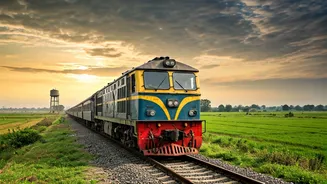
Traversing approximately 55 kilometers, the railway route from Amritsar to Dera Baba Nanak provides a serene countryside experience, taking around 1 hour and 20 minutes to complete for a ticket price of just ₹15. Along its course, the train pauses at several stations, including Verka, Majitha, Ramdas, Rattar Chattar, and Hardowal, en route to the historically significant town in the Gurdaspur district. Many of the stations encountered on this route boast attractive colonial-era buildings, often adorned with vibrant bougainvillea. Verka station, in particular, evokes the ambiance of a hill station bungalow, while Hardowal offers a tranquil rural setting. Through the carriage windows, travelers are treated to scenes of agricultural land, farmers tending to their fields with tractors, and the daily life of villagers across the picturesque landscape. Dera Baba Nanak holds profound religious importance, being closely associated with the concluding years of Guru Nanak Dev Ji's life. The town is situated across the Ravi River from Kartarpur in Pakistan, the location of the revered Gurdwara Darbar Sahib Kartarpur. A key attraction here is the Kartarpur Corridor, which, when operational, enables Indian Sikh pilgrims to visit the holy shrine in Pakistan without the need for a visa. Other points of interest include the Darbar Sahib gurdwara, Sri Chohla Sahib, and the local marketplace. Train schedules from Amritsar/Verka to Dera Baba Nanak are at 04:20 am, 10:30 am, 02:15 pm, and 05:50 pm, with return journeys departing at 06:05 am, 12:15 pm, 04:00 pm, and 07:20 pm.
Amritsar to Khem Karan: Echoes of Conflict
The most extensive of the trio of routes, stretching 77 kilometers from Amritsar to Khem Karan, requires approximately two hours of travel and comes with a ticket cost of ₹20. Some services originate from Bhagtanwala station, located near Amritsar. This train meanders through numerous minor halts within the Taran Taran district, offering an intimate perspective on the rural expanses of Punjab. Khem Karan is etched in history as the location of the pivotal Battle of Asal Uttar during the 1965 Indo-Pakistani War. It was here that Indian forces successfully halted a significant Pakistani armored advance, resulting in numerous abandoned tanks scattered across the terrain, a battlefield subsequently dubbed the 'Graveyard of Tanks'. In proximity to the border fence, two unique spiritual sites are accessible: Gurdwara Sahib Singh Shaheed and Sheikh Braham Dargah. Reaching these destinations necessitates passing through Border Security Force checkpoints. Visitors are subject to stringent security protocols, including the mandatory deposit of electronic devices before entering the vicinity, and photography is strictly prohibited in the area. The train timings from Amritsar/Bhagtanwala to Khem Karan are at 04:40 am, 09:15 am, 01:35 pm, and 06:10 pm, with return services scheduled for 06:50 am, 11:25 am, 03:35 pm, and 08:10 pm.
Cinematic Routes & Heritage Stops
The railway line connecting Amritsar and Attari has also served as a backdrop in Indian cinema. Scenes in 'Bajrangi Bhaijaan' utilized these tracks to symbolize the emotional bonds that transcend the India-Pakistan border. Attari station itself was a filming location for 'Veer-Zaara,' a cinematic narrative centered on love across national divides, capturing the poignant atmosphere of separation and remembrance. The modest railway station at Dera Baba Nanak has likewise garnered attention on screen, notably in 'Gustaakh Ishq,' which celebrated the charm of small-town Punjab and its vintage railway architecture. Beyond their cinematic appeal, these routes are dotted with colonial-era railway stations, many of which retain their architectural charm. While some historic buildings have unfortunately fallen into disrepair or been demolished, such as the former stations at Chheharta and Khasa on the Attari route, the surviving structures, especially along the Dera Baba Nanak line, present a visually compelling argument for preservation as heritage attractions. These journeys, costing less than a typical city meal, offer travelers an affordable gateway to scenic rural landscapes, historically resonant border towns, and significant cultural sites, all experienced via everyday trains that continue to serve their local communities.