




Ancient Life Forms
Commence your journey with cyanobacteria, which, though technically bacteria, are frequently categorized with algae due to their photosynthetic capabilities.
These ancient organisms represent some of the earliest forms of life to grace our planet, laying the groundwork for complex ecosystems to evolve over eons. Their presence underscores the deep historical roots of life's photosynthetic engine, a process fundamental to the oxygenation of Earth's atmosphere and the sustenance of countless subsequent life forms. Understanding cyanobacteria offers a profound glimpse into the planet's primordial history and the very origins of biological energy conversion.
Ocean's Brown Giants
Next, we explore brown algae, a group predominantly found in cooler oceanic waters. These include substantial seaweeds, with kelp being a prime example. Their distinctive brownish hue is attributed to a pigment called fucoxanthin, which plays a vital role in their photosynthesis. These organisms are not merely passive inhabitants but actively shape their environments, forming dense underwater forests that serve as critical habitats, providing shelter and sustenance for a myriad of marine species. Their structural complexity and ecological impact are immense.
Microscopic Glass Wonders
Venture into the microscopic realm with diatoms, a unique class of algae characterized by their intricate, glass-like cell walls composed of silica. These tiny powerhouses are a cornerstone of marine life, forming a significant portion of phytoplankton. Their immense numbers and photosynthetic activity are crucial for global oxygen production, making them silent but essential contributors to the air we breathe. The delicate yet robust structure of their silica shells is a marvel of natural engineering.
Mobile and Luminescent
Encounter the fascinating dinoflagellates, single-celled algae distinguished by their ability to move using whip-like appendages called flagella. These mobile microorganisms exhibit a captivating phenomenon: some species possess bioluminescence, capable of causing the ocean's surface to glow with an ethereal light during nighttime hours. This natural spectacle is a testament to the diverse and sometimes magical adaptations found within the algal kingdom, transforming the night sea into a canvas of light.
Freshwater Golden Hues
Shift focus to golden algae, a group primarily inhabiting freshwater environments, though some species can also be found in saltwater. These algae are characterized by their distinct golden-brown coloration, a result of specific pigments that differentiate them from other algal groups. Their presence in lakes and rivers adds to the rich biodiversity of these aquatic ecosystems, contributing to the food web and nutrient cycling in ways unique to their physiology.
Verdant Aquatic Life
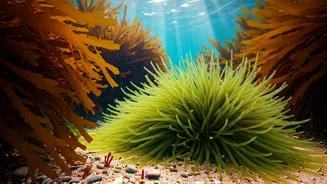
Delve into the familiar world of green algae, ubiquitous in both freshwater and marine settings. Their vibrant green appearance is due to the presence of chlorophyll, the same pigment essential for photosynthesis in land plants. Indeed, green algae are considered closely related to terrestrial flora, representing an ancestral lineage from which many plants evolved. Their widespread distribution and photosynthetic prowess make them foundational elements of aquatic food chains.
Kelp: Underwater Forests
Revisit the impressive brown algae by focusing on kelp, a specific type that forms vast underwater forests. These towering structures are more than just visually striking; they are vital ecosystems in themselves. Kelp forests provide essential shelter, foraging grounds, and nursery areas for a wide array of marine life, from small invertebrates to larger fish and marine mammals. Their presence significantly influences the biodiversity and health of coastal marine environments.
Deep Sea Red Treasures
Conclude by examining red algae, which flourish in deeper oceanic zones where sunlight penetration is limited. Their survival in these low-light conditions is made possible by pigments that can efficiently absorb the blue light wavelengths available at greater depths. Beyond their ecological significance, red algae are remarkably valuable to humans, serving as a source for widely used food ingredients like agar and carrageenan, demonstrating a direct link between marine biodiversity and culinary applications.