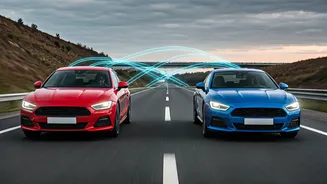







Understanding V2V
Vehicle-to-Vehicle (V2V) technology is a communication system that enables vehicles to exchange data wirelessly. It operates by equipping vehicles with
dedicated short-range communication (DSRC) devices, which continuously broadcast information such as speed, location, and direction. Other vehicles within a certain range receive and process this data, providing drivers with real-time alerts about potential dangers. These alerts could warn drivers of upcoming traffic congestion, accidents, or even approaching emergency vehicles. The underlying principle is to provide drivers with increased situational awareness, enabling them to make timely decisions and avoid accidents. By sharing critical information, V2V technology fosters a safer driving environment for everyone on the road. The system constantly monitors the vehicle's surroundings and can anticipate potential hazards, alerting the driver before they become visible. V2V technology goes beyond existing driver-assistance systems by offering a proactive safety net, rather than reacting only after a critical situation unfolds.
How V2V Works
The core of V2V technology lies in its ability to facilitate seamless communication among vehicles. Each vehicle equipped with V2V technology acts as a node in a wireless network. The DSRC devices transmit data packets at regular intervals, typically several times per second. These packets contain crucial details like the vehicle's speed, heading, and GPS coordinates. Nearby vehicles receive these broadcasts and analyze the data to identify potential hazards. The system can assess risks such as impending collisions, dangerous lane changes, or the presence of pedestrians or cyclists. When a potential threat is detected, the system alerts the driver through audio-visual warnings, giving them precious time to react. The technology utilizes a range of sensors and algorithms to ensure the accuracy and reliability of the data transmitted. The constant exchange of information creates a dynamic safety net that adapts to evolving road conditions. By providing timely warnings, V2V technology empowers drivers to make informed decisions and prevent accidents before they occur. The system's ability to communicate with other vehicles, infrastructure, and even traffic management systems further enhances its effectiveness.
Benefits for India
The introduction of V2V technology promises significant benefits for India, a country grappling with a high rate of road accidents. By providing drivers with advanced warnings, V2V can reduce collisions, injuries, and fatalities. The ability to anticipate hazards, such as vehicles braking suddenly or entering intersections, can prevent accidents. Moreover, V2V can improve traffic flow by enabling vehicles to adjust their speeds and maintain safe distances, reducing congestion. This leads to reduced fuel consumption and lower emissions, contributing to a greener environment. In addition, V2V technology can work in conjunction with existing infrastructure, such as traffic lights and road signs, to provide drivers with a comprehensive view of road conditions. This includes alerts about upcoming construction zones, speed limits, and even weather-related hazards. The implementation of V2V technology aligns with the Indian government's efforts to modernize its transportation infrastructure and improve road safety. The technology offers the potential to save lives, reduce accidents, and create a safer, more efficient road network for all. The benefits extend beyond immediate safety, contributing to a more sustainable and economically productive society.
Potential Challenges
While the potential of V2V technology is promising, its implementation in India is expected to face certain challenges. One of the main hurdles is the cost of equipping all vehicles with the necessary hardware. The government might need to provide incentives or subsidies to encourage the widespread adoption of this technology. There are also concerns about data privacy and security, as V2V systems collect and share vehicle data. Robust cybersecurity measures are essential to prevent hacking and protect sensitive information. In addition, the effectiveness of V2V technology relies on the adoption rate. To realize its full potential, a significant portion of vehicles on the road must be equipped with V2V systems. This requires collaboration among various stakeholders, including government agencies, automotive manufacturers, and technology providers. Another challenge is the need for standardization. Interoperability is important, ensuring that vehicles from different manufacturers can communicate with each other seamlessly. This requires establishing uniform communication protocols and data formats. Addressing these challenges is critical to ensure a successful deployment of V2V technology in India, paving the way for safer and more efficient roads.