






Public Transport Surge
The Delhi Economic Survey 2023-24 reveals a significant and encouraging trend: a substantial increase in the utilization of public transportation, encompassing
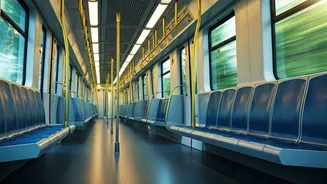
the extensive Delhi Metro network and the city's bus services. This upward trajectory in public transit ridership is a direct consequence of deliberate governmental strategies, including the remarkable expansion of the Metro's reach and continuous enhancements to bus services. Coupled with policies designed to temper the growth of private vehicle usage, these initiatives have nudged commuters towards more sustainable and efficient travel alternatives. Residents are increasingly recognizing the multifaceted advantages of opting for the Metro, valuing its punctuality, cost-effectiveness, and crucially, its positive environmental impact, making it the preferred choice for daily journeys across the bustling metropolis.
Private Vehicle Slowdown
Concurrently, the rate at which new private vehicles are being registered in Delhi has notably decelerated. While the total number of private vehicles on the road continues to grow, the pace of this expansion has diminished considerably. This slowdown suggests that the city may be approaching a point of saturation in terms of private car ownership, or perhaps, a more conscious choice by citizens to scale back their dependence on personal automobiles. This development is viewed as a particularly positive outcome for Delhi, a city that has long been burdened by the twin challenges of severe traffic congestion and pervasive air pollution. The reduced influx of private vehicles is a critical step towards alleviating these persistent urban issues and fostering a more breathable environment.
Environmental Impact Gains
The evolving travel patterns documented in the economic survey have a direct and beneficial effect on Delhi's environmental health. The observed shift towards public transport, coupled with a potential reduction in the number of private vehicles navigating the city's streets, is anticipated to significantly cut down on vehicular emissions. This reduction in pollutants is a vital contribution to improving air quality across Delhi, addressing one of its most pressing environmental concerns. Moreover, the government's active promotion of electric vehicles (EVs) and cycling as alternative modes of transport appears to be resonating with the population, further bolstering the city's sustainability efforts and encouraging a move away from traditional, more polluting forms of mobility.
Economic Implications Bloom
Beyond the environmental benefits, these transformations in travel habits also carry important economic implications for Delhi. The escalating ridership on public transport systems translates into enhanced revenue streams for the transport agencies. This increased financial capacity allows for crucial reinvestment into service upgrades and infrastructure development, further improving the commuter experience. Furthermore, the alleviation of traffic congestion leads to tangible economic advantages. Improved traffic flow enhances overall productivity by reducing commute times and minimizes fuel consumption, thereby contributing to economic efficiencies and potentially lowering operational costs for businesses and individuals alike.
Decline in Vehicle Density
A striking statistic highlighted by the survey is the substantial decrease in vehicle density per 1,000 residents. Over the five-year period from 2020-21 to 2025-26, this figure has fallen from 655 to 522. This sharp decline is primarily attributed to the significant deregistration of older vehicles that have exceeded their permissible lifespan, a policy implemented to phase out polluting automobiles. Specifically, the Delhi government has banned diesel vehicles over 10 years old and petrol vehicles over 15 years old. As a result, an impressive 66,20,160 vehicles (6.6 million) have been deregistered up to March 19, 2026. While two-wheelers continue to constitute the largest segment of registered vehicles at approximately 68%, this overall reduction in vehicle numbers is a key factor in Delhi's cleaner mobility narrative.
Metro Ridership Soars
In stark contrast to the decline in private vehicle numbers, daily Metro ridership in Delhi, including services on the Airport and Rapid Metro lines, has experienced dramatic growth over the last seven years. From an average of 25.9 lakh daily passengers in 2018-19, the numbers have surged to over 63 lakh in 2024-25. This remarkable increase has occurred without any expansion in the operational route length, underscoring the growing preference for Metro travel. This surge demonstrates the Metro's effectiveness as a mass transit solution, catering to a rapidly increasing demand for efficient and reliable urban commuting.
Bus Service Evolution
The public bus system, comprising Delhi Transport Corporation (DTC) and cluster buses, presents a more nuanced picture. While DTC bus ridership saw a decrease from 33.39 lakh daily passengers in 2019-20 to 24.28 lakh in 2025-26, this is largely due to the phasing out of older buses. Concurrently, cluster bus daily passenger numbers were 15.25 lakh in 2024-25, a slight dip from 17.71 lakh in 2019-20. However, the significant modernization of the bus fleet, with over 100 electric buses being inducted monthly, signals a positive shift towards cleaner bus operations. As of March 2026, the combined fleet size of DTC and Delhi Integrated Multi-Modal Transit System (DIMTS) stands at 6,100 buses, with a substantial portion, 2,750 and 1,588, being AC low-floor electric models of varying capacities, indicating a strong push towards electrification.
Electric Vehicle Adoption
The adoption of electric vehicles (EVs) has seen a rapid ascent in Delhi. From just two electric buses in April 2021, the city now boasts an impressive fleet of 4,338 electric buses as of March 2026. This growth extends to private EVs as well, with a total of 4.7 lakh electric vehicles registered in the National Capital Territory of Delhi as of March 19, 2026. To support this burgeoning EV ecosystem, the Delhi government has significantly expanded its charging infrastructure. By March 31, 2025, the city had established 3,100 charging stations and 893 battery-swapping stations, indicating robust support for electric mobility and a commitment to a cleaner transportation future.