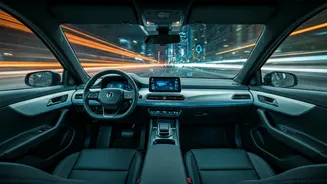







Autonomous Journey Begins
Dubai has officially embraced the future of transportation with the commencement of its driverless taxi service, a significant milestone powered by advanced
technology. The inaugural ride was taken by Sheikh Hamdan bin Mohammed bin Rashid Al Maktoum, the Crown Prince of Dubai, who experienced the autonomous vehicle firsthand. This initiative, a collaboration between Dubai's Roads and Transport Authority and Baidu's Apollo Go, signifies a bold stride towards integrating artificial intelligence into daily commutes. The service is slated for public accessibility starting in the first quarter of 2026, following fruitful discussions that originated during the 2025 World Governments Summit. This strategic partnership aims to revolutionize urban mobility, making journeys more efficient and potentially safer, paving the way for a new era of smart city living where technology seamlessly enhances public services.
How It Works & Safety
The sophisticated autonomous taxis are equipped with an array of advanced sensors, including cameras, radars, and laser tools, allowing them to perceive their surroundings with remarkable precision. This sensory input is processed by intelligent software that analyzes real-time data and detailed digital maps to navigate roads, detect obstacles like other vehicles and pedestrians, and adhere to traffic signals. The system makes autonomous decisions to ensure a safe and smooth journey. During his ride, the Crown Prince was briefed on these capabilities, observing the vehicle's adept maneuvering through city streets. The technology has already been rigorously tested, accumulating millions of miles and extensive travel in various urban environments. This comprehensive testing forms the bedrock of confidence in the system's reliability. A notable moment during the demonstration was captured on social media, where the car's AI assistant playfully requested a selfie with the Crown Prince, who obliged, further highlighting the user-friendly and advanced nature of the human-machine interaction within these vehicles. The Prince himself shared his experience online, captioned with "Hands off. Future on. Self Driving Car," underscoring the transformative impact of this technology.
Roadmap for India
The successful deployment of driverless taxis in Dubai raises pertinent questions about their feasibility and safety for Indian roads. India's diverse traffic conditions, ranging from dense urban congestion to varied road infrastructure and distinct driving behaviors, present unique challenges. While the technology powering these vehicles relies on advanced sensors and AI for environmental perception and decision-making, its effectiveness in the complex Indian road ecosystem needs thorough evaluation. Factors such as unpredictable pedestrian movement, varied vehicle types sharing the road, and differing weather conditions require robust adaptation. The extensive testing and operational data from Dubai offer a valuable reference point, but a dedicated and rigorous testing phase within Indian contexts would be imperative. Ensuring regulatory frameworks are in place to address safety, liability, and ethical considerations is paramount. Ultimately, the widespread adoption of such autonomous systems in India would necessitate a phased approach, starting with controlled environments and gradually expanding, contingent upon demonstrated safety, reliability, and public acceptance.