


Volcanic Fury Unleashed
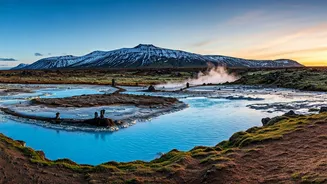
Iceland's moniker, the 'Land of Fire and Ice,' is profoundly rooted in its volatile geological activity. The island sits atop tectonic plate boundaries,
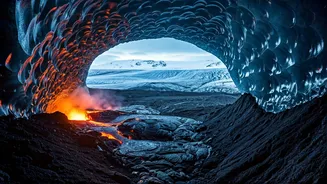
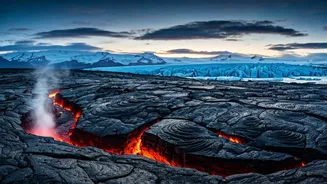
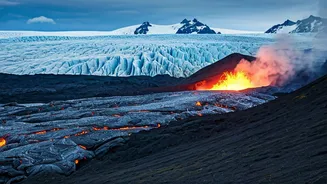
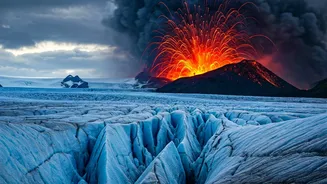
a prime location for volcanic eruptions that constantly reshape its terrain. These fiery spectacles are a defining characteristic, with active volcanoes like those in the Reykjanes Peninsula frequently gracing headlines. The visual drama of molten lava streams, glowing intensely against the often stark, surrounding landscapes of snow or barren earth, is a potent symbol of Iceland's 'fire.' Historically, eruptions like the infamous Eyjafjallajökull have not only impacted local environments but also captured global attention, underscoring the raw power simmering beneath the surface. This constant volcanic activity is a testament to the dynamic forces at play, making Iceland a living geology lesson.
Glacial Giants Reign
Complementing its fiery heart, Iceland is also defined by its immense frozen expanses, earning it the 'ice' part of its famous nickname. Vast glaciers cover significant portions of the island, with Vatnajökull standing as Europe's largest ice cap. These colossal bodies of ice are not static; they are powerful sculptors of the land, meticulously carving out valleys and fjords over millennia. As these glaciers slowly retreat, they give rise to stunning glacial lagoons, filled with icebergs that calve off into the water. The sheer scale of these ice formations, often existing in dramatic proximity to volcanic heat, highlights the striking duality that defines Iceland's natural environment. The slow, powerful movement of ice shaping the landscape is as fundamental to Iceland's identity as its volcanic activity.
The Fire-Ice Convergence
The most captivating aspect of Iceland's geology is the direct interplay between fire and ice, a phenomenon that perfectly embodies its 'Land of Fire and Ice' designation. Many of Iceland's active volcanoes lie directly beneath expansive ice caps, creating a unique and often volatile relationship. When these subglacial volcanoes erupt, the result can be spectacularly explosive, as the intense heat meets the immense cold of the ice. This convergence is not just a geological curiosity; it creates some of the most unique and photogenic landscapes on Earth. The contrast between fiery lava flows and pristine snow, or the formation of icebergs from glaciers that sit atop volcanic regions, is a constant visual reminder of the powerful, opposing forces that have sculpted this extraordinary island nation. This dynamic interplay ensures Iceland remains a place of continuous geological evolution and awe-inspiring beauty.
Spectacular Natural Wonders
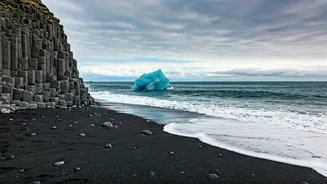
Beyond the elemental forces, Iceland offers a plethora of breathtaking natural wonders born from this fire and ice dynamic. At the edge of Vatnajökull, the Jökulsárlón glacial lagoon presents a mesmerizing spectacle where enormous icebergs break off from the glacier and drift serenely towards the Atlantic Ocean. Nearby, Diamond Beach provides a striking contrast with its black volcanic sand, upon which ice chunks, polished smooth by the waves, glitter like precious gems. Adding to the magic, Iceland's skies are frequently graced by the ethereal dance of the aurora borealis, particularly during the winter months. This celestial light show often illuminates the dramatic landscapes, casting an otherworldly glow over glaciers, volcanoes, and the iconic black pebble beaches, which are themselves framed by impressive basalt columns and battered by the powerful Atlantic surf. These sites offer a tangible experience of Iceland's raw, evolving beauty.