






Navigational Satellite's Purpose
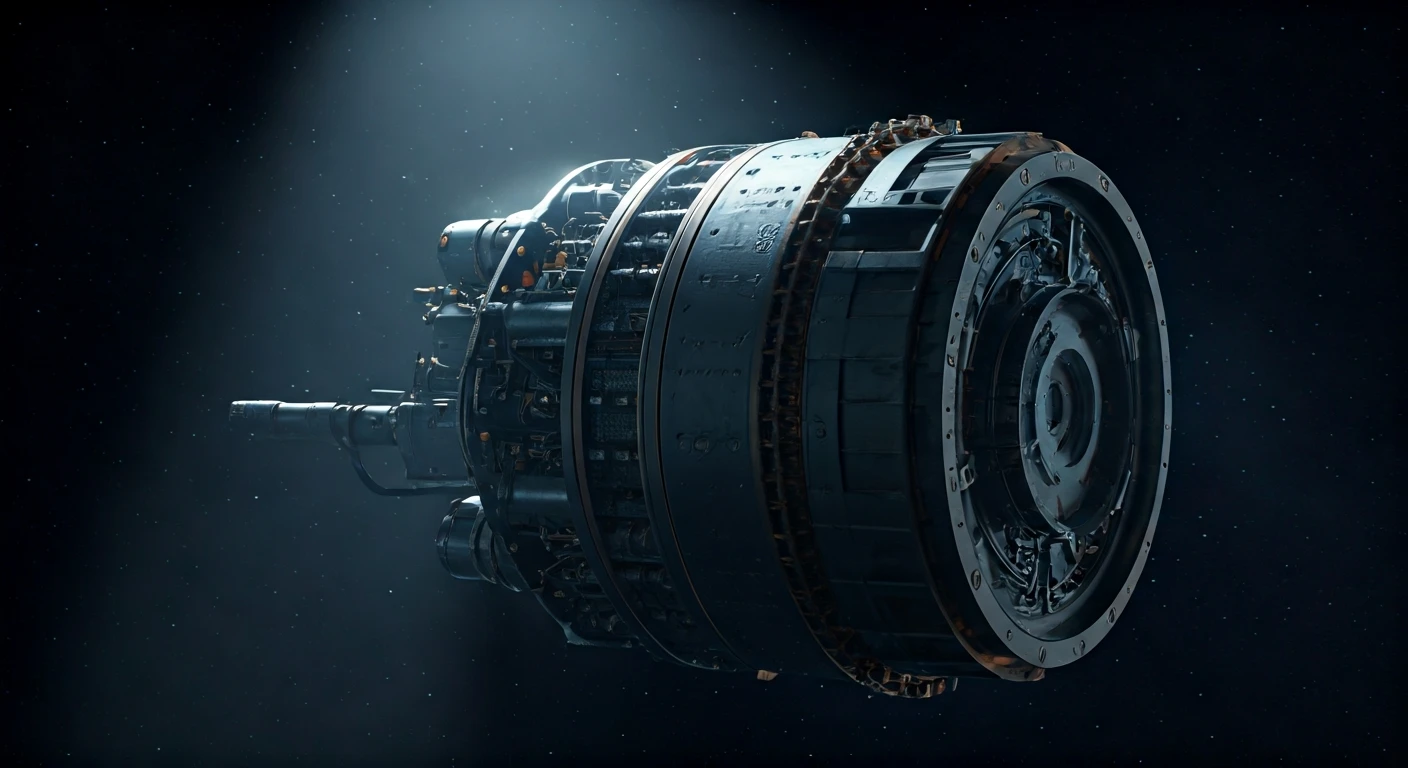
India's ambition in space navigation took a significant step with the development of the NVS-02 satellite, a robust 2,250-kilogram spacecraft designed
to bolster the nation's independent positioning capabilities. This advanced satellite was slated to deliver two critical services, enhancing both civilian accessibility and national security. The Standard Positioning Service, intended for everyday use, promised to offer location accuracy within 20 meters approximately 95% of the time, a crucial improvement for applications ranging from personal navigation devices and vehicular tracking to maritime and aerial guidance systems. Complementing this was the Restricted Service, a highly encrypted and secure navigation system exclusively for India's defense apparatus, vital for sensitive military operations, missile guidance, and ensuring a secure defense infrastructure against potential adversaries. Therefore, NVS-02 represented a pivotal advancement towards greater self-reliance and enhanced security for India across multiple domains.
The Liftoff and Orbit
The launch of the NVS-02 satellite on January 29, 2025, commenced with great anticipation, lifting off precisely at 6:23 AM from Sriharikota atop the GSLV-F15 rocket. The rocket's performance was impeccable, successfully placing the 2,250kg satellite into a Geostationary Transfer Orbit approximately 19 minutes after ignition. This orbit, characterized by its elliptical shape and altitude ranging from 170 km to 37,785 km, served as a temporary staging point. From this position, the satellite was expected to autonomously engage its own propulsion system to execute a series of orbit-raising maneuvers, ultimately settling into its designated final circular orbit. This critical final phase would have allowed NVS-02 to hover consistently over a fixed point on Earth, commencing its vital navigation signal transmissions. However, this crucial orbital transition never materialized as planned.
Engine Failure Mystery
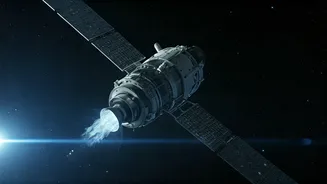
The pivotal moment of the mission arrived when the satellite's onboard engine was expected to ignite for the essential orbit-raising maneuver, a task it utterly failed to perform. Investigations revealed that the valves responsible for permitting the flow of oxidizer, a critical component required for the engine's combustion process, remained stubbornly shut. Without the necessary oxidizer, the engine could not combust its fuel, rendering it entirely silent and inoperable. Consequently, NVS-02 became stranded in its initial Geostationary Transfer Orbit, perpetually unable to achieve its intended operational position. While all other onboard systems, including power generation, communication arrays, and rudimentary control mechanisms, were confirmed to be functioning correctly, the satellite was rendered incapable of fulfilling its primary navigational purpose. This situation was akin to a fully fueled vehicle rendered immobile due to a single, non-functional switch, highlighting the profound impact of even minor technical failures.
Unraveling the Glitch
In the aftermath of the NVS-02 mission anomaly, ISRO promptly established a dedicated Failure Analysis Committee, chaired by the esteemed former ISRO Chairman A. S. Kiran Kumar, to meticulously investigate the root cause of the failure. After an extensive inquiry spanning several months, the committee compiled its findings and submitted a comprehensive report to the Indian government in October 2025. The official disclosure of these findings occurred on February 25, 2026, revealing a surprisingly minor yet critical culprit: a loose electrical contact. This issue pertained to the satellite's pyro valves, small pyrotechnic devices engineered to utilize a controlled explosive charge to open and enable fuel flow upon receiving an electrical ignition signal. The investigation determined that a faulty connection, similar to a loose wire behind a doorbell button, prevented the signal from reaching the valves. Critically, this same loose contact was present in both the primary and backup pyro valve systems, meaning neither could be activated. This dual failure meant the oxidizer could not be released, the engine remained inactive, and the mission was ultimately compromised.
Lessons Learned
The investigation concluded that the failure stemmed from issues within the satellite's fuel system connectors, specifically a single loose electrical connection in a critical location. This seemingly insignificant flaw led to the loss of the NVS-02 mission and years of dedicated effort. However, ISRO's response demonstrated resilience and a commitment to continuous improvement. Engineers immediately identified and rectified similar potential weak points in the connection systems before the subsequent satellite launch. This proactive approach proved effective, as demonstrated by the successful launch of the CMS-03 satellite on November 2, 2025, aboard the LVM-3 M5 rocket. The pyro systems on CMS-03 functioned flawlessly, enabling the satellite to achieve its intended orbit without incident. While the loss of NVS-02 was a significant setback, the experience provided invaluable lessons, underscoring that in the demanding field of space exploration, the capacity to learn from failures is as crucial as the achievement of mission success.