







Moon-Mercury Cosmic Dance
As February unfolds, a fascinating celestial pairing awaits observant skywatchers. On February 18th, the slender crescent of the new moon will appear in close
proximity to the planet Mercury. This occurs shortly after sunset, and to best appreciate this conjunction, one should direct their gaze towards the western horizon between approximately 6:15 PM and 7:30 PM. It's crucial to wait until the sun has completely set before attempting to view Mercury, as its brightness can be overwhelming. While binoculars can enhance the experience by revealing Mercury's disc, even a naked-eye observation, under clear conditions, will offer a glimpse of this close encounter between our natural satellite and the elusive innermost planet. This event marks a beautiful, albeit subtle, start to a series of celestial displays.
Mercury's Eastern Peak
Following the moon-mercury conjunction, February 19th presents another prime opportunity to spot Mercury. On this day, the planet achieves its greatest eastern elongation from the Sun. This astronomical milestone signifies the point where Mercury appears furthest from the Sun in our sky when viewed from Earth, making it the most favorable evening of the year to observe this speedy planet. From around 6:20 PM to 7:40 PM, look towards the western sky shortly after sunset. Mercury will be visible low on the horizon, shining brightly. This is an excellent chance for amateur astronomers and casual observers alike to catch a glimpse of a planet notoriously difficult to see due to its proximity to the Sun.
Crescent Moon & Saturn
Adding to the celestial charm of February 19th, the crescent moon will also be in the company of Saturn. On this evening, a two-day-old crescent moon will be positioned near the ringed planet, creating a visually striking scene. This delicate pairing will be observable in the west-southwest direction for approximately two hours after sunset, specifically between 6:30 PM and 8:30 PM. The sight of the slender lunar sliver beside the majestic Saturn offers a picturesque moment for stargazers. It's a relatively brief window, so planning to look up during this time will ensure you don't miss this beautiful celestial duet.
Moon Nears Pleiades
As the month progresses, February 23rd brings a graceful association between the waxing crescent moon and the famed Pleiades star cluster. The moon, growing fuller each night, will drift past this dazzling collection of stars, often referred to as the Seven Sisters. This conjunction provides a spectacular view, easily observable with the naked eye or enhanced with binoculars. Look towards the southwest sky after sunset, with the best viewing window between 7:00 PM and 1:30 AM. The duo will slowly traverse westward across the sky before setting around 2:00 AM. It’s a breathtaking sight that showcases the moon’s journey through different celestial landmarks.
Six-Planet Sky Parade
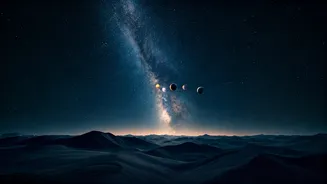
The latter half of February culminates in a truly remarkable event: a 'planet parade' featuring six planets visible in the evening sky. This rare lineup includes bright Venus, elusive Mercury, and majestic Saturn clustered in the west. Meanwhile, the gas giant Jupiter will be observable rising in the east. For those equipped with binoculars or a telescope, Uranus and Neptune will also be part of this grand cosmic assembly, positioned near the Pleiades star cluster. The optimal time to witness this grand celestial gathering is shortly after dusk, roughly between 6:30 PM and 8:00 PM. This event offers an unparalleled opportunity to see multiple planets simultaneously in the sky.
Milky Way's Return
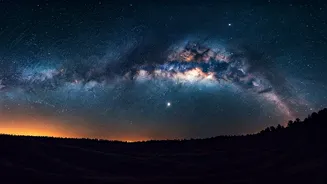
While many events are visible after sunset, February also marks the subtle reappearance of the Milky Way's bright core in the pre-dawn sky, particularly from locations in the southern hemisphere. For observers in India, this galactic center will rise just above the southeastern horizon before sunrise, typically between 4:30 AM and 5:30 AM. Its visibility will be limited, appearing very low on the horizon, and is best observed from the dark, southern regions of the country. While challenging to see clearly, its presence signifies the changing seasons and the gradual return of this awe-inspiring view as we move into March.