






Unique Coat Patterns
Delve into the visually striking Jacob sheep, instantly recognizable by their charming black and white spotted fleeces. These sheep are believed to have
roots stretching back to the ancient Middle East before making their way to the United Kingdom. Another breed with a distinct appearance is the Balwen sheep, characterized by its dark fleece accented by a prominent white stripe across its face and matching white socks on its legs. These striking visual differences set them apart in the pastoral landscape and hint at their specialized genetic heritage. Their appearances are not merely for show; these patterns are often tied to their adaptability and history within specific regions.
Prized Pelts & Hardy Nature
The Karakul sheep earns acclaim not only for its remarkable hardiness but also for its exceptionally unique pelts. Holding a place among the most ancient of domesticated sheep breeds, the Karakul has a long-standing history of contributing valuable resources. This resilience allows them to thrive in challenging environments, making them a symbol of enduring livestock. Their pelts are sought after for their texture and quality, representing a significant cultural and economic asset in the regions where they are raised. The longevity of the Karakul breed speaks volumes about its genetic superiority and adaptability over millennia.
Ancient Horned Breeds
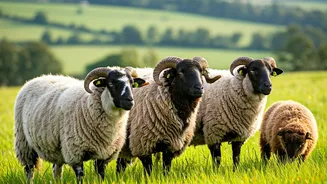
The Racka sheep stands out with its extraordinary, long, spiral-shaped horns, which can astonishingly exceed two feet in length. This ancient Hungarian breed, historically tended by shepherds in its native land, is now considered a rarity. Equally notable for its horns is the Manx Loaghtan sheep, which typically boasts four horns and a coat of dark brown wool. While historically valued more for its meat than its wool, the Manx Loaghtan adds another layer to the diversity of horned sheep. These breeds showcase evolutionary marvels in their cranial adornments, a testament to their distinct ancestral lines.
Smallest & Primitive Herds
The Ouessant sheep holds the distinction of being one of the world's smallest sheep breeds, a breed that once faced the brink of extinction. Its diminutive size is a remarkable trait in a species often associated with larger stature. Adding to the spectrum of primitive breeds, the Soay sheep is recognized as one of the most ancient domesticated sheep. A fascinating aspect of the Soay is its natural wool shedding, negating the need for traditional shearing. This natural process is a significant indicator of its close connection to wilder ovine ancestors, highlighting a unique evolutionary path.
Valuable for Weaving
The Navajo‑Churro Sheep breed is particularly esteemed for its long, high-quality wool, a material intrinsically linked to traditional Navajo weaving practices. The fiber produced by these sheep is essential for creating intricate textiles that are culturally significant and highly prized. This breed's value extends beyond its fleece, representing a vital connection to indigenous heritage and craftsmanship. The sustained importance of the Navajo-Churro in this artistic tradition underscores the breed's enduring contribution to cultural expression and economic sustenance for the Navajo people.