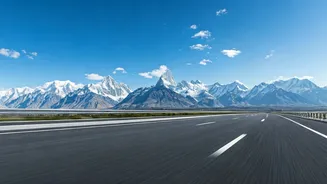







Expressway's Time Revolution
The newly inaugurated Delhi-Dehradun Expressway marks a monumental shift in inter-city travel, drastically reducing the time commuters spend on the road.
Previously, a journey from Delhi to Dehradun could consume as much as six hours of valuable time. However, with the advent of this advanced infrastructure, that same route can now be covered in a remarkably short span of approximately two hours and 55 minutes. This substantial reduction, confirmed by test drives, prioritizes passenger convenience and efficiency, turning what was once a long drive into a quick and manageable sprint. The focus is clearly on enhancing the travel experience through speed and accessibility, making Dehradun a much more reachable destination from the capital.
Savings on Bus Fares
Beyond the impressive time savings, the Delhi-Dehradun Expressway has also ushered in a welcome era of reduced costs for bus travelers. The Uttarakhand Transport Corporation (UTC) has responded to the new route's efficiency by implementing significant fare reductions across various service tiers. This adjustment is a direct result of shorter distances and lower fuel consumption. For those opting for premium Volvo services, the fare has dropped from Rs 945 to Rs 709, offering a saving of Rs 236. AC class tickets are now priced at Rs 557, down from the previous Rs 704, a saving of Rs 147. Even the ordinary bus services have become more economical, with fares reduced from Rs 420 to Rs 355, a saving of Rs 65. These fare adjustments make travel more accessible and budget-friendly for a wider range of commuters.
Engineering Marvel Features
The Delhi-Dehradun Expressway stands as an impressive feat of engineering, designed for optimal performance and safety, allowing speeds of up to 100 km/h. Spanning a considerable length of 6 to 12 lanes depending on the stretch, it originates from Akshardham in Delhi and winds its way through Loni, Baghpat, Baraut, Shamli, and Saharanpur before reaching Dehradun. A notable addition is a 50.7 km spur that provides rapid transit to Haridwar, enabling access from Delhi within just two hours. Furthermore, the project incorporates an exceptional 12 km overhead bridge, recognized as Asia's longest wildlife corridor, which passes through the ecologically significant Rajaji National Park, ensuring the safe passage of wildlife alongside vehicular traffic.