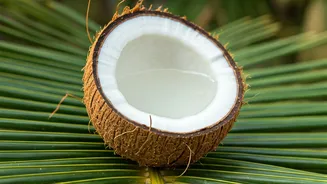

Budget 2026's Focus
The 2026 Union Budget included a significant announcement: a dedicated coconut promotion scheme. This initiative, spearheaded by Finance Minister Nirmala
Sitharaman, underscores the government's intention to fortify India's coconut sector. The principal goal is to enhance both the output and overall productivity of coconuts. The strategy emphasizes a practical approach, specifically replacing older, less productive coconut trees with new, high-yield saplings. This effort targets the major coconut-producing states, signifying a targeted approach to elevate the sector's performance and ensure long-term viability. The government’s investment in this area reflects its recognition of the economic and cultural importance of coconuts within India.
Coconut's Nutritional Power
Coconuts are rich in essential nutrients. They are an excellent source of dietary fibre, which helps maintain a healthy digestive system and assists with weight management by promoting satiety. Medium-chain triglycerides (MCTs) present in coconuts supply the body with quick energy and boost stamina. Furthermore, the potassium content helps regulate blood pressure. They contain antioxidants that slow down the ageing process. The coconut also possesses natural antimicrobial qualities, supporting the immune system and promoting oral health. These multiple health advantages have contributed to coconuts being a significant element in a balanced diet.
Economic Impact of Coconuts
India's coconut industry is a vital economic engine. The average national coconut productivity ranges between 9,687 and 9,871 nuts per hectare, positioning India among the global leaders in productivity. The southern states are the main producers and form the foundation of the coconut economy. This sector sustains nearly 12 million people and supports related industries, including coir, coconut oil production, and food processing. The focus on the promotion also extends to market education, underscoring the health benefits, and expanding urban retail distribution channels. Leveraging social media to showcase the versatility of coconuts in food and beauty can increase demand. Additional strategies involve government programs such as the 'One District One Product' initiative to boost local processing and value addition, ensuring coconut products align with global health and plant-based consumption trends.
Top Producing Regions
Karnataka currently leads the country in coconut production. In 2024–25, the state produced approximately 6,151 million nuts, followed closely by Tamil Nadu with 6,091 million nuts. Together, these two states account for over half of the total national output. Kerala, Andhra Pradesh, and Telangana also contribute substantially to the supply. However, Karnataka has recently surpassed Kerala due to consistent policy support and technology-driven farming practices. In northern India, coconuts are used more selectively, often featuring in sweets like 'nariyal ki barfi' and 'kopra pak,' especially during festive occasions. Coconut milk enriches gravies, such as 'navratan korma,' and some paneer dishes. Tender coconut water remains popular in the summer, with coconut oil being essential in hair care rituals.
Coconut in Indian Cuisine
In South India, coconut is an everyday essential rather than an occasional ingredient. Kerala utilizes it extensively in dishes such as 'avial,' 'meen kuzhambu,' and 'erissery.' Tamil Nadu incorporates coconut in 'thengai thuvaiyal,' various vegetable 'kootu,' and coconut rice, particularly during festivals and temple meals. Across coastal regions, coconut chutney is a staple with idli, dosa, and vada, seasoned with mustard, curry leaves, and urad dal. Coastal specialties like 'chemeen curry' use coconut gravy to balance the spices and seafood flavors. Coconuts play a significant role, from providing texture to adding a unique flavour profile in diverse recipes.
Key Coconut Products
Coconut water is widely consumed as a refreshing hydrating beverage. Coconut oil is used extensively for cooking, skincare, and hair care. Copra is the dried kernel that forms the base for oil extraction. The value-added products include coconut milk, cream, neera, jaggery, and vinegar. The demand for coconuts has seen a significant rise due to the popularity of vegan, keto, and plant-based diets. The government has also announced a focused programme for cashew and cocoa. Through this initiative, the government aims at making India self-reliant in raw cashew and coconut production and processing, improving export competitiveness and building Indian cashew and cocoa into globally recognised premium brands by 2030.
India's Coconut Production
India is consistently ranked among the top global coconut producers. In the fiscal year 2023–24, the nation produced approximately 15.3 million metric tons of coconuts across 2.33 million hectares of land. With the implementation of improved irrigation and more advanced farming techniques, there is an expectation that the production will increase to approximately 17.6 million metric tons by the year 2026. This data highlights the significant role that the coconut sector plays in the Indian economy and agricultural landscape, contributing to both domestic consumption and international trade. The focus on improving yields and efficiency demonstrates a forward-thinking approach to sustainable agricultural development.